Return to Sheridan MATH15121D course guide. Tutoring coverage for this course must be confirmed before booking and payment.
The difficult part of a double integral is often deciding which points its bounds include. These six original questions build from a triangle to curved regions, necessary splits, a useful change of order and a polar-coordinate choice. Each one includes a hint, an explained solution and an incorrect setup to diagnose.
Use this practice after learning iterated integrals in your course. First draw or describe a typical slice; then write the bounds; only then calculate. When a result is wrong, identify the first incorrect boundary before repeating the integration.
Course fit and limits
These original Nablio questions focus on region setup and integration choices for the multiple-integral and polar-coordinate topics in McGill MATH 222. They cover only part of the course and are not an official McGill assessment or a mock exam. For an exam, choose the questions that match your section’s current outline and your instructor’s instructions.
Source checked October 5, 2026: McGill Mathematics and Statistics course descriptions, MATH 222.
Before you start: read the slice
- All coordinates and integration variables in this set are real and dimensionless. The horizontal coordinate is ; the vertical coordinate is . In each question, names the stated region. The notation represents a small element of area. An integral of over gives its area, denoted by .
- In the order , hold fixed and move from the bottom boundary to the top boundary. The outer bounds describe the full horizontal extent.
- In the order , hold fixed and move from the left boundary to the right boundary. The outer bounds describe the full vertical extent.
- Reversing the order keeps the region and integrand unchanged. Solve the boundary equations for the other coordinate and describe fresh slices. The inner bounds may depend on the outer variable; they must not depend on the variable currently being integrated.
- A split is needed when a single boundary formula stops describing an endpoint of the slice. Find the height or horizontal position where the controlling boundary changes. Integrating the pieces separately also avoids hiding that change inside a minimum, maximum or piecewise function.
- The integrands here are continuous on the closed, bounded regions used. Integration in either valid slicing order therefore gives the same double integral. This statement is being used under those conditions; it is not a rule for arbitrary improper integrals.
Try questions 1–2 for bounds, 3–4 for splitting, 5 for choosing an order and 6 for choosing coordinates. No time limit or exam weighting is proposed.
1. A triangle whose left boundary moves
The region is bounded by the horizontal line , the sloping line and the vertical line . Write its area as an iterated integral in both orders, and evaluate it. Explain why the lower -bound after reversing the order is not .
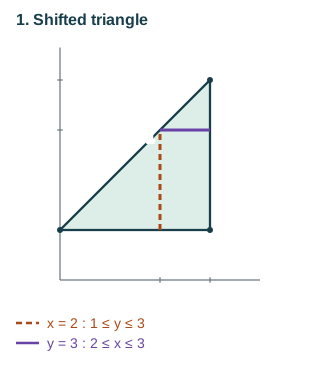
Text equivalent. The triangle lies above , below and left of . Its vertices are , and . The orange dashed segment is a vertical slice at . The purple solid segment is a horizontal slice at .
Hint
Find the vertices by intersecting pairs of boundary lines. At a fixed height , solve for and decide which side of that line belongs to the triangle.
Explained solution
1. Describe the geometry. The two nonvertical lines meet at . At , they meet the vertical boundary at heights and . Thus the horizontal extent is , while the vertical extent is .
2. Use vertical slices. For each fixed in that horizontal extent, starts at and ends at . Therefore
The inner integral measures the slice's height, . Hence
3. Use horizontal slices. Solve the sloping boundary as . For a fixed between and , the triangle begins at that line and ends at . This gives
The width is , so
4. Check a slice and the area. At , the correct horizontal slice runs from to . The triangle's base and perpendicular height are both , giving .
Diagnose and repair
Proposed setup: .
Diagnosis: It covers a rectangle. For example, is included even though it lies above . This setup gives area , double the triangle's area.
Repair: Replace the lower inner bound by . After reversing order, a boundary that was the top of a vertical slice becomes the left end of a horizontal slice.
2. Between a line and a parabola
Let be the bounded region between and . Find their intersections, write the area in both orders and calculate it. State which root of is relevant when describing horizontal slices.
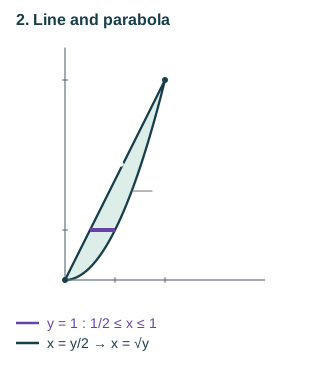
Text equivalent. Both curves meet at and . Between them the line is above the parabola. For a horizontal slice at height , the line gives the left endpoint , and the positive parabola branch gives the right endpoint . The illustrated slice has , so it runs from to .
Hint
Use to find the intersection coordinates. For reversed bounds, rewrite both boundary equations in terms of ; then use a test height to order the endpoints.
Explained solution
1. Find the bounded region. Factoring gives and . Their heights are and . On , the difference is nonnegative, so the line is the upper boundary.
2. Set up vertical slices. The lower and upper heights are and :
Integrate the height:
3. Reverse the order. The entire bounded region lies in , so the relevant inverse of the parabola is . The line becomes . For , the line is on the left; for example, at , . The endpoints meet again at .
Therefore
4. Check the endpoints. At heights and , the horizontal slice has zero width. At height , its width is . These checks help detect an inverted bound.
Diagnose and repair
Proposed reversed bounds: , .
Diagnosis: These bounds include both branches of the parabola and ignore the line. The point would be included, although the bounded region between the two stated curves has no negative -coordinates.
Repair: Keep the positive branch as the right boundary and use as the left boundary. The square-root sign comes from the region's location, not from a rule that every parabola contributes both roots.
3. One horizontal integral becomes two vertical integrals
Let denote the integral
Sketch or describe its region . Reverse the order using separate integrals where the upper boundary changes, identify the split point and evaluate the result. Explain why neither nor gives a valid upper -bound across the full horizontal extent.
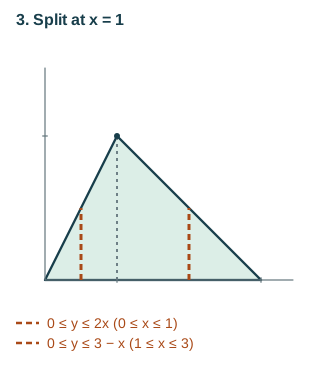
Text equivalent. The base is , from to . The other sides meet at . The left roof is , the right roof is , and the dashed vertical line marks the change at . Vertical sample slices are shown on both sides of that line.
Hint
Rewrite and as equations for . The region must lie below both resulting lines. Where do those two possible upper boundaries meet?
Explained solution
1. Read the original bounds. The height ranges from to . At height , a slice starts at and ends at . At , these are and . At , they both equal . The region is the triangle shown.
2. Find the change in the roof. The side equations are and . They meet where , giving , . From to , a vertical slice reaches first. From to , it reaches first. Both slices start at .
3. Write the two pieces. Let and denote the integrals over the left and right pieces. Then
The shared line has zero area; including it as the endpoint of both pieces does not add extra area to the double integral.
4. Evaluate each piece. An antiderivative of with respect to is . Therefore
For the right piece, let . This is just a one-variable substitution after the inner integral; as runs from to , decreases from to , and . Thus
5. Check in the original order. The horizontal width is . Hence the original integral reduces to
Diagnose and repair
Proposed setup: .
Diagnosis: It uses the right roof everywhere and includes points above the left roof. For example, passes these proposed bounds but violates . The incorrect value is .
Repair: Split at . Use for the upper height on the left and on the right. If you use a minimum or a piecewise upper bound instead, you have encoded the same split rather than removed it.
4. A curved region with a clipped left side
The region satisfies
Write its area with vertical slices. Then reverse to horizontal slices, explicitly splitting where the left endpoint changes, and evaluate the area in both descriptions.
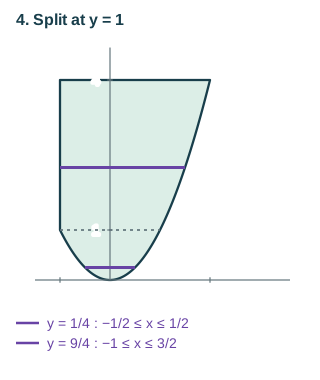
Text equivalent. The region lies above the parabola , below , and to the right of . The rightmost point is . The left vertical boundary runs from to . The dashed horizontal line at marks the change of the left boundary. Sample horizontal slices are shown below and above that height.
Hint
The inequality gives . You must also keep . At which height does pass to the left of ?
Explained solution
1. Read the vertical description. The lower boundary is the parabola and the upper boundary is the horizontal line. The area is
For the last calculation, the antiderivative has values at and at .
2. Find the full height range. The lowest point is ; the top lies on . Thus . The height is not restricted to just because the left vertical edge starts at height .
3. Compare the two left restrictions. For , the value is at least , so the parabola controls the left endpoint. For , the vertical line is farther right and controls it. The right endpoint is in both pieces; because , it already satisfies .
4. Write and evaluate the pieces. Let and denote the areas below and above height , respectively.
5. Check representative slices. At , the endpoints are and . At , they are and . Both descriptions agree with the parabola and the clipping line.
Diagnose and repair
Proposed reversed bounds: , .
Diagnosis: They forget the clipping line. For example, satisfies these proposed bounds and lies above the parabola, but violates . The proposed area is , larger than .
Repair: Keep the parabola's negative branch only up to , then replace the left endpoint by . You must preserve every original restriction when changing order.
5. Change the order to reveal a substitution
Let be the base of the natural exponential function. Evaluate
by reversing the order. Describe the region before manipulating the integral, and explain what makes the new order useful.
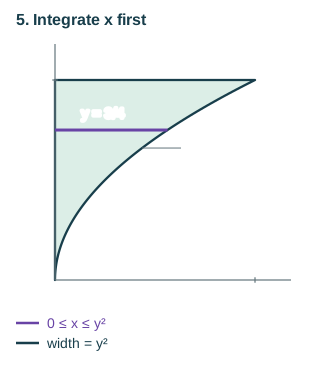
Text equivalent. The region has and lies between and . Equivalently, at every height , it runs from the vertical axis to the parabola . The illustrated horizontal slice has , so its width is .
Hint
Because and are nonnegative here, is equivalent to . If you integrate with respect to first, the exponential is constant along each slice.
Explained solution
1. Describe horizontal slices. The region starts at height , ends at height and has left endpoint . Its right endpoint at height is . The original restriction is automatic because .
2. Write the reversed integral. No split is needed: the same left and right boundaries work throughout the full height range.
3. Integrate in the easy variable first. Holding fixed, the exponential has no -dependence. Its inner integral is its value multiplied by the slice's width:
Thus
4. Substitute. Let , so . The new bounds remain and . Therefore
There is no need to find an elementary antiderivative of the original inner integrand with respect to . The new inner integral supplies precisely the factor needed for the substitution.
5. Check scale. The region's area is . On it, , so
The answer is approximately , within those bounds.
Diagnose and repair
Proposed reversed upper bound: .
Diagnosis: This repeats a square root rather than solving the original boundary for . At , the correct right endpoint is , whereas the proposed endpoint is about . The extra points do not satisfy .
Repair: Rewrite as , using the nonnegative coordinates to justify squaring. Verify by substitution at one height before evaluating anything.
6. Choose between Cartesian and polar coordinates
The region is the part of the annulus
in the first quadrant, including its boundary: , . Define . Set up
in Cartesian coordinates with vertical slices and in polar coordinates. Choose the simpler description and evaluate . Explain both the radial bounds and the area factor in the polar integral.
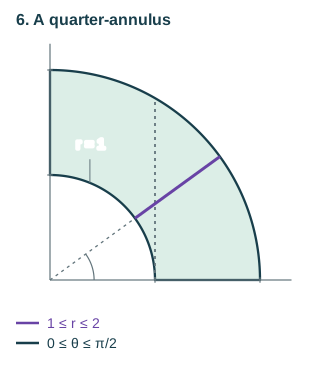
Text equivalent. Two concentric circles, centred at the origin, have radii and . Only their first-quadrant annular sector is included. The points with radius less than , including the origin, are excluded; the inner circular boundary at radius is included. A ray from the positive -axis through an angle in the first quadrant enters the region at radius and leaves at radius . The drawing also marks , where the lower Cartesian boundary changes.
Hint
For vertical slices with , the inner circle creates a lower boundary. For , the slice starts on the horizontal axis. In polar coordinates, ; check that the bounds refer to , not .
Explained solution
1. Describe Cartesian slices. Define the upper-circle height
and the inner-circle height
For , the slice runs from to . For , it runs from to . Let and be the contributions from these two horizontal ranges:
These are valid bounds, but they introduce two pieces and square roots.
2. Describe polar slices. The radial coordinate is the distance to the origin; the angle is measured counterclockwise from the positive -axis in radians. The constant has its usual circle value. Here
At every permitted angle, the entire slice runs between the same two radii, with no split.
3. Transform both the integrand and the area element. The integrand becomes . A narrow polar cell has radial thickness and tangential width approximately ; the exact change-of-variables formula uses
The extra accounts for the increasing area swept out by the same angle farther from the origin. Thus
4. Evaluate. The radial integral is
It is independent of , so
5. Check size. The area is one quarter of the difference of the disk areas:
The average value of is , between its minimum and maximum on the region. This is a plausibility check, not a replacement for the setup.
Diagnose and repair
Proposed polar setup: .
Diagnosis: The radii and angles are correct, but the polar area factor is missing. This gives , which computes a different weighted integral.
Repair: Transform along with the function. Multiply by to obtain . Also note that the inequality gives , because .
What to practise next
- If a test point fails your bounds, return to questions 1–2 and say “bottom to top” or “left to right” before writing symbols.
- If a boundary changes halfway through the region, redo questions 3–4 and mark the switch point on the sketch.
- If the inner integral is awkward, inspect the region in the other order as in question 5. Reversing order helps only if the new bounds and integrand are genuinely easier.
- If the region is built from circles centred at the origin, compare a polar description as in question 6. Check the angular sector, the radial interval and the area factor separately.
For the wider course context, use the existing Nablio McGill MATH 222 course guide. Its basic triangle example is a useful prerequisite to this practice. For a single-variable substitution refresher, use Nablio's integration-method resource. Before an assessment, match your practice to your own outline, assignments and permitted materials.
Useful for
Work on the step you’re missing.
Tell us the subject and your preferred time. Nablio confirms the details by text or email.
Request a lesson