Return to Algonquin MAT8101 course guide. Tutoring coverage for this course must be confirmed before booking and payment.
Stuck on a step? Text us Email us Request a lesson
For course topics and one-to-one help, see Concordia MATH 203 tutoring.
A radius, a water level and a distance can all change with time, but their rates need not be equal. Related-rates problems begin with an equation that connects the quantities. Differentiating that equation connects their instantaneous rates.
This lesson builds from implicit differentiation to two moving-geometry models, then gives four increasingly independent questions. You will practise choosing variables, separating fixed dimensions from momentary values, and explaining the sign and units of a result. Review the product and chain rules first if needed.
The examples and figures are original Nablio practice. They address topics listed for Concordia MATH 203; use your own section’s current outline for assessed material. This is an independent study guide, not an official course handout.
The changing variable inside the formula
If depends on , then is a composite function: square the value of . The chain rule gives
The factor records how the inside changes. The product also contains two factors that depend on :
Implicit differentiation means differentiating a relation without first isolating . We work on a portion of the curve where is a differentiable function of . We do not assume the entire curve passes the vertical-line test.
Worked example 1 Find a slope without isolating the function
Consider the curve
Here and are dimensionless coordinates. Find the tangent slope at .
Check the point and differentiate
The point lies on the curve because . Treat as a function of and differentiate every term:
The constant has derivative zero. The term needs the product rule, while needs the chain rule.
Collect the unknown derivative
This division is valid where . At , the denominator is , so
The tangent line is . Near this point, a small positive change in produces about half as much change in , with the opposite sign. If the denominator had been zero, this quotient would not supply a finite slope; you would need to examine the curve at that point.
Change the independent variable to time
For related rates, the independent variable is usually time . Both and may now change. Compare carefully:
In particular, is not generally . Differentiating the curve relation from example 1 with respect to time would give
At , this says . The curve’s slope tells us how two coordinate rates are related; it does not tell us how quickly the point travels until one time rate is supplied.
Set up a rate problem before using the numbers
- Define the variables. State what each quantity measures, its unit and its positive direction. Write the requested rate explicitly.
- Separate fixed facts from a snapshot. A rigid length is constant throughout the motion. A changing height that happens to equal at one instant is still a variable.
- Write a relation valid near the instant. Use geometry or another stated model. If there are too many unknown rates, look for another relation.
- Differentiate, then evaluate. Fixed constants may be substituted early. Substitute momentary values of changing quantities only after differentiating.
- Interpret the result. Check the sign, the units, and whether the rate is local or constant over an interval.
Writing at a particular time does not mean for nearby times. Replacing a changing radius by before differentiation would erase the change you are trying to measure.
Worked example 2 A rigid ladder with two moving ends
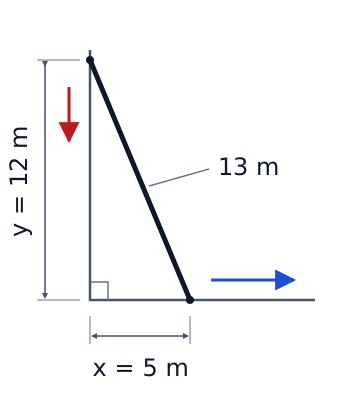
In an idealized geometry model, a straight ladder of fixed length keeps contact with a vertical wall and horizontal ground. Its base moves away from the wall at . How fast is the top moving vertically when the base is from the wall?
Let be time in seconds, the horizontal base-to-wall distance in metres, and the top’s height in metres. Increasing means away from the wall; increasing means upward. We know and want .
Use the relation that stays true during the motion
For this example, use numerical lengths in metres and time in seconds. The right triangle gives
Differentiate with respect to , keeping both changing lengths:
The fixed ladder length contributes zero. Solve before evaluating:
Evaluate at the requested instant
When , the positive height is . Therefore
The top moves downward at . Its signed vertical rate is negative. The ratio is dimensionless, so the answer retains the units of .
Why the ends have different speeds. The rigid ladder fixes the distance between its endpoints, not their separate horizontal and vertical speeds. Even if the base speed stays constant, changes, so the top’s speed generally changes too. The formula assumes and contact with both surfaces; it does not describe the instant the ladder lies flat or real-world contact failure.
Worked example 3 A filling cone with a drain
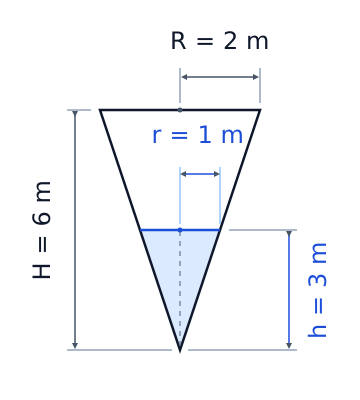
A fixed right circular cone stands with its vertex downward. Its height is , and its top radius is . Water enters at and leaves through a drain at . The surface stays horizontal. How quickly does the water depth rise when it is ?
Let be time in minutes. Let be water depth from the vertex, the radius of the water surface, and the water volume. Lengths are in metres and volume in cubic metres. The tank’s dimensions are fixed; , and change.
Use the net volume rate
Inflow adds volume and outflow removes it:
The depth rate has units , so it cannot simply equal this volume rate.
Eliminate the changing radius with similar triangles
The water occupies a smaller, similar cone. For ,
Substitute this relation into the cone-volume formula:
This substitution is valid before differentiation because holds throughout the filling process. It is different from replacing by its momentary value .
Differentiate and solve for the depth rate
At , the horizontal water-surface area is , giving
The water rises by about at that instant. Cubic metres per minute divided by square metres gives metres per minute, as required.
Check the geometry. At greater depths the cone is wider, so the same net inflow produces a smaller depth rate. For example, at , the rate would be , less than at . This model applies while , before overflow and under the stated flow assumptions.
A common trap. At the requested instant , but the radius is not constant. Writing and then differentiating would describe a cone whose radius stays fixed, which is not the filling process. If you keep both and , you must use the product rule and also .
Try four problems with less guidance each time
Keep the answers closed at first. For every problem, write a relation, differentiate it, then attach a sign and units to your result.
1 Guided A growing circular patch
A circular patch has radius in centimetres and area in square centimetres. Time is in seconds. At one instant and . Starting from , find . Explain why substituting before differentiating loses the required information.
Hint
The radius is a function of time. Apply the chain rule to , then use the instant’s radius.
Explained solution
Differentiate the relation for changing radius:
At the given instant,
This is approximately . The positive sign agrees with a growing patch. The equality describes only this instant, not the nearby areas whose change defines the derivative.
2 Diagnose A rectangle growing in one direction
A rectangle’s length and width are measured in centimetres, with in seconds. At an instant, , , and , using the corresponding centimetre and second units. A student claims the area rate is . Identify the rule error and find the correct rate.
Hint
Both factors in change. Also inspect the units of the student’s product.
Explained solution
The product rule adds two contributions:
Thus
The area increases: the gain from the increasing length exceeds the loss from the decreasing width. Multiplying the two rates is not the product rule; its units would be , not an area rate.
3 Independent A moving cart and a fixed sensor
A cart travels along a straight horizontal track. A fixed sensor is from the track along a perpendicular. Let be the cart’s signed coordinate measured from the closest point on the track, positive to the right; let be its straight-line distance to the sensor. Time is in seconds. The cart moves right at .
Find when (a) and (b) . Explain the sign change even though the cart moves right in both cases.
Hint
Draw a right triangle. The signed value of may be negative, but its square still gives the square of the horizontal leg length.
Explained solution
The relation is . Differentiate:
For either coordinate, . At ,
The distance is increasing. At ,
The cart approaches the closest point, so its distance to the sensor decreases. These are distance rates relative to the sensor, not the cart’s speed along the track.
4 Transfer Find an unknown inflow
A different inverted right circular cone has fixed height and top radius . Water drains at . At a water depth of , the level is rising at . What inflow rate , in , is required at this instant? Define any additional variables you use.
Hint
Use the new tank’s radius-to-height ratio, not the previous example’s ratio. First obtain the net volume rate from the depth rate; then account for the drain.
Explained solution
Let be depth, the water-surface radius, and water volume, with in minutes and lengths in metres. Similar triangles give , so
At the stated instant,
This is the net gain. Since ,
The inflow must exceed the drain because the level is rising. This calculation specifies the required inflow at the stated depth; holding the same depth rate at other depths would require a different inflow.
Check the first step that went wrong
- If a rate factor is missing, rewrite the changing quantity as a function of time and apply the chain rule.
- If an unknown rate remains, look for a second relation, such as similar triangles, before inserting numbers.
- If the sign seems surprising, state the positive direction and describe what is increasing or decreasing.
- If the units do not fit the question, distinguish length, area and volume from their time rates.
For more work on the prerequisite rules, try Derivative Rules: A Three-Question Check. Then choose a related-rates problem from your own course materials and explain why your starting equation remains valid while the quantities move.
Course context and further reading
Course: Concordia MATH 203.
- Concordia current course catalogue, MATH 203
- Concordia MATH 203 Fall 2026 outline
- OpenStax Calculus Volume 1, section 3.8, for further reading on implicit differentiation
- OpenStax Calculus Volume 1, section 4.1, for further reading on related rates
The explanations, numerical scenarios, questions, solutions and diagrams here were created for this lesson. No university assessment questions or textbook figures are reproduced.
Useful for
Work on the step you’re missing.
Tell us the subject and your preferred time. Nablio confirms the details by text or email.
Request a lesson