John Abbott 201-SN4-RE connects linear systems, matrices and determinants with vector geometry and its applications. The lesson below develops point-to-plane distance within that vector-geometry context.
Registration requirements
201-SN2-RE. Confirm current registration requirements with John Abbott.
201-SN4-RE topics to review
Linear systemsMatricesDeterminantsVector geometryVector applications
Common difficulties
Finding a perpendicular foot rather than just a distance
Keeping the signed numerator until taking the length
Checking both the plane equation and the normal direction
Distance to a plane: find the closest point
Find the closest point on a plane, calculate the distance, and verify both answers. You need dot products and the length of a vector. Coordinates use the same length unit on three perpendicular axes.
The shortest segment is perpendicular to the plane
Let Π be the plane ax+by+cz=k, where a,b,c,k are real constants and n=(a,b,c)=0. The normal vector n is perpendicular to the plane. For a point P=(px,py,pz), its perpendicular foot H is the point on the plane reached by starting at the given point and travelling in the normal direction. If P is already on the plane, H=P and the distance is zero.
Build the formula from two conditions
The foot must lie on the plane and on the line through P perpendicular to the plane. Write H=P−tn, where t is a real scalar. Substitute this into the plane equation: n⋅Hn⋅P−t∥n∥2=k,=k.
Define the signed numerator s=n⋅P−k. Since n=0, its squared length is positive, so tHd=∥n∥2s,=P−∥n∥2sn,=∥tn∥=∣t∣∥n∥=∥n∥∣s∣. Here d is the distance, in the coordinate length unit. Use the squared norm for the foot and the norm for the distance.
Worked example
Find the closest point to P=(4,1,0) on Π:2x−y+2z=−2, and find the distance.
1. Identify the normal and calculate the signed numerator
The coefficients give n=(2,−1,2). Therefore ∥n∥2=4+1+4=9 and ∥n∥=3. The right-hand side is k=−2, so s=n⋅P−k=8−1+0+2=9.
2. Move to the foot
The scalar is t=9/9=1. Subtract the corresponding normal vector: H=(4,1,0)−(2,−1,2)=(2,2,−2).
3. Verify the point and the direction
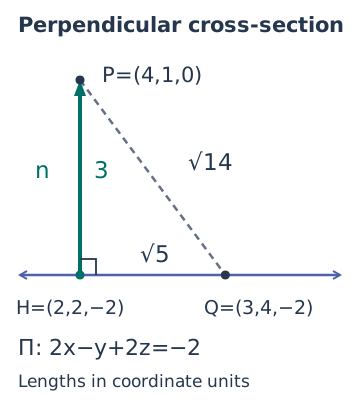
The foot lies on the plane because 2(2)−2+2(−2)=−2. Also, P−H=(2,−1,2)=n, so the segment joining the two points is perpendicular to the plane. Both conditions hold. Its length is d=22+(−1)2+22=3. The closest point is (2,2,−2); the distance is 3 coordinate units.
A perpendicular cross-section, with the same length scale in both directions. The horizontal line is where this slice meets the plane; it is not a coordinate axis or the whole plane. Here Q=(3,4,−2) lies on the plane, Q−H=(1,2,0), and ∥H−Q∥=5. Thus ∥P−Q∥=9+5=14>3.
Why this point really is closest
For any point Q on the plane, H−Q has zero dot product with P−H. Pythagoras gives ∥P−Q∥2=∥P−H∥2+∥H−Q∥2. The second term is nonnegative and is zero only when Q=H. So H is the unique closest point.
Try two independent checks
1. A point on the other side
For R=(0,3,−4) and Π:2x−y+2z=−2, find the perpendicular foot and distance. Verify that your foot lies on the plane and that the segment joining it to R is parallel to (2,−1,2).
Show the explained solution
Use n=(2,−1,2). The signed numerator is s=0−3−8−(−2)=−9, so t=−9/9=−1. Therefore HRd=R−(−1)n=(2,2,−2),=∣−9∣/3=3.
The plane check is 2(2)−2+2(−2)=−2. The vector from the foot to the given point is R−HR=(−2,1,−2)=−n. It is perpendicular to the plane, even though it points opposite to the chosen normal. The distance is 3 coordinate units; the signed distance is −3.
2. The same plane, a different equation
Let S=(4,2,0) and Γ:x+2y−2z=2. Find its perpendicular foot and distance. Then use the equivalent equation −2x−4y+4z=−4 to explain which of the signed numerator, signed distance, foot and ordinary distance change.
Show the explained solution
First use m=(1,2,−2). Then ∥m∥2=9, s=4+4−0−2=6, and HSd=S−32m=(310,32,34),=6/3=2. The plane check is 10/3+4/3−8/3=2, and S−HS=32m.
The new normal is m′=−2m, with squared norm 36 and norm 6. The new signed numerator is s′=−8−8+0−(−4)=−12. The vector to subtract to find the foot is 36−12(−2m)=32m. The foot stays the same. The signed numerator changes from 6 to −12, and the signed distance changes from 2 to −2. The ordinary distance stays ∣−12∣/6=2 coordinate units.
Further reading on vector geometry and point-to-plane distance:
Your tutor can review your row operations against the original equations and use a sketch to explain the vector calculation. For a point-to-plane distance, you can check the normal direction and perpendicular foot together, then solve a similar problem on your own.
Exam preparation for 201-SN4-RE
Choose the systems, matrix, determinant and vector-geometry topics assigned in your section. Practise a mixed set without a method label: decide how to start, show the calculation and check the result in the original equations or diagram. Redo a question you missed without consulting the solution.
We work through permitted practice and comparable problems, without completing graded assignments or exams on your behalf.
Related courses
Useful links for preparation or further study—not transfer equivalencies or a required registration sequence.