Work on this geometry lesson with a tutor
Start with the measurement you need
Choose a route: sections 1–4 build the angle and forward-scaling basics. If you already know those, use sections 5–6 to compare units and recover missing lengths from area or volume. Finish with the questions that match your current topic.
Is the question asking for an angle, a length, an area or a volume? Naming that quantity helps you choose a method and a unit. This lesson uses basic arithmetic, fractions and simple equations. All angles are in degrees, and all triangles are ordinary triangles in a flat plane.
Try each question before opening its answer. You can review basic algebra first, or use right-triangle methods when the question supplies a right angle.
1. Use angle facts before estimating from a sketch
Two adjacent angles that together make a straight angle sum to . If one is , let be the other angle:
The three interior angles of a triangle also sum to . For a triangle with angles and , the third is
This triangle has no right angle. Use the angle sum here; the Pythagorean theorem applies only to right triangles.
Try it: a triangle has angles and . Find its third angle and check the total.
Answer and reasoning
, because , and .
Common error: subtracting from without a reason. Read which angles form the stated triangle or straight angle; use the given information rather than the apparent size in a drawing.
2. Match corresponding sides in similar triangles
Similar triangles have the same shape: corresponding angles are equal, and corresponding side lengths have one common ratio. Two equal pairs of corresponding angles are enough to establish triangle similarity, because the third pair must also be equal.
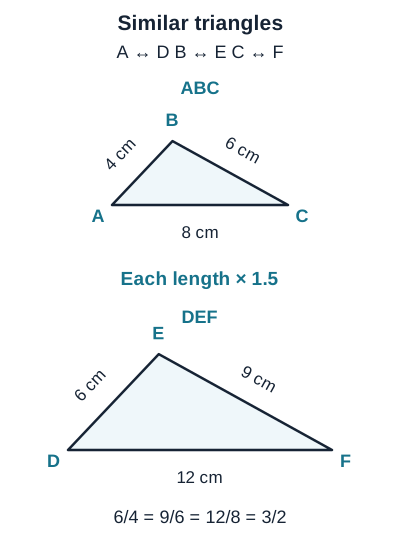
Worked example: triangles and are given to be similar, with matching , matching and matching . Thus matches , matches , and matches . Their side lengths are
- cm, cm and cm
- cm; find and
Let be the scale factor from triangle to triangle . Divide a new length by its matching original length:
Multiply each original side by this same factor:
Check: . The factor has no unit because the matching lengths use the same unit. Adding 2 cm to every side would not keep these ratios equal.
Try it: a triangle has side lengths 5 cm, 7 cm and 9 cm. A similar triangle’s side corresponding to the 5 cm side is 15 cm. Find the other two lengths.
Answer and reasoning
the factor is , so the other lengths are 21 cm and 27 cm. Correspondence comes from the stated similarity or angle matching, not from the way a sketch is turned.
3. Distinguish area from volume
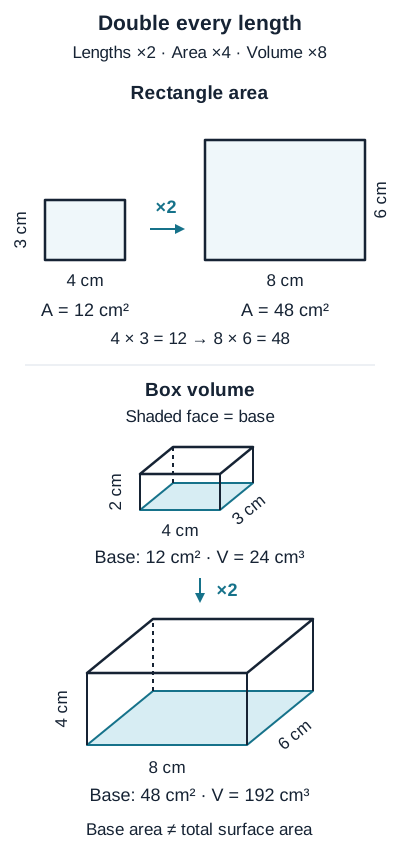
A rectangle 4 cm long and 3 cm wide has area
Area measures a flat region in square units. A rectangular box with this base and height 2 cm has volume
Here is the base area and is the volume. Volume measures three-dimensional space in cubic units. The base area is one face, not the box’s total surface area.
Try it: a rectangular box is 5 cm long, 2 cm wide and 3 cm high. Find the area of its 5 cm by 2 cm base and its volume.
Answer and reasoning
base area cm²; volume cm³.
Common error: mixing length units before multiplying. For a rectangle 2 m long and 50 cm wide, first write 50 cm as 0.5 m; the area is m². Multiplying 2 by 50 would mix metres and centimetres.
4. Scale every dimension, then count the factors
Double every length in the earlier examples. The rectangle becomes 8 cm by 6 cm, so its area is cm², four times 12 cm². The box becomes 8 cm by 6 cm by 4 cm, so its volume is cm³, eight times 24 cm³.
Each multiplication supplies another factor of 2:
More generally, when all corresponding lengths are multiplied by the same positive scale factor , areas are multiplied by , and volumes by . This rule describes uniform scaling. If only the height of a box doubles while its base stays fixed, its volume merely doubles.
Try it: a shape of area 45 cm² is enlarged by a length scale factor of 3. A solid of volume 20 cm³ is also enlarged uniformly by a length scale factor of 3. Find their new area and volume.
Answer and reasoning
area cm²; volume cm³. The length factor is 3, the area factor is 9, and the volume factor is 27.
5. Make the units agree before comparing measurements
A scale factor compares matching measurements in the same unit. An area ratio cannot be formed by dividing a number in square metres by a number in square centimetres without converting first. Changing a unit changes the numerical measurement; it does not enlarge the object.
Why square and cubic units need different conversion factors
One metre is 100 centimetres. A square measuring 1 m on each side therefore measures 100 cm on each side:
A cube with 1 m edges has three factors of 100, so . For capacity, , because a decimetre is 10 cm. Thus 0.6 m² is 6000 cm², while 0.6 L is 600 cm³. Count the dimensions before choosing a factor.
For example, two similar panels have areas of 0.12 m² and 2700 cm². Convert the first area to 1200 cm². From the first panel to the second, the area ratio is , not . The next section shows how that area ratio gives a length factor.
A scale drawing uses a length ratio
A plan marked 1:50 means that 1 cm on the plan represents 50 cm in the real object. From the plan to the real object, the length factor is 50. A 6 cm segment represents 300 cm, or 3 m. A region of 2 cm² represents cm², or 0.5 m². The area factor is because both dimensions change. This assumes the plan uses the same scale in every direction.
6. Work backward from an area or a volume
Sometimes the question gives an area ratio or volume ratio and asks for a length. First establish that the figures or solids are similar. Then decide which measurement is given and which one is wanted.
Let be the length scale factor from the original object to its similar image. Let be the original and image areas, expressed in the same square unit; let be their volumes in the same cubic unit. All these measurements are positive. For solids, compare corresponding faces, or compare their total surface areas with each other.
To undo squaring, take the positive square root. To undo cubing, take the cube root:
The square root of 9/4 is 3/2 because . Although the equation has a negative solution too, a ratio of positive lengths cannot be negative. Likewise, the cube root of 27/8 is 3/2 because . Check a proposed root by raising it to the indicated power. Use these positive factors for enlargements and reductions; this lesson does not use signed transformation ratios.
Worked example: an enlarged poster
An original rectangular poster is 24 cm by 18 cm. A similar poster has area 972 cm². Find its dimensions and perimeter.
- Name the direction: from the original poster to the enlarged one.
- Compare areas: the original area is cm², so .
- Recover a length factor: . The new dimensions are cm and cm.
- Check the requested quantities: cm². The perimeter is cm. The original perimeter is 84 cm; its ratio is , the length factor.
Perimeter adds lengths, so every term has one factor of . A rectangle’s area is the product of two lengths, so it has two factors of . Multiplying each side by the area ratio 9/4 would make the poster too large.
Worked example: a similar box, with surface area and volume
A closed rectangular box is 4 cm long, 3 cm wide and 2 cm high. A similar box has volume 81 cm³. Find its dimensions and total surface area. Treat the boxes as geometric solids, ignoring wall thickness.
The original volume is cm³. Thus , and . The new dimensions are 6 cm, 4.5 cm and 3 cm. Their product is cm³, as required.
Total surface area adds the areas of all six faces, two of each size. The original surface area is cm². Every face area scales by , so the new total is cm². Directly, cm². Surface area uses the area factor even though the box is three-dimensional.
Before using a ratio: similarity must be given or justified. Equal areas do not establish similarity. If only one dimension changes, calculate from the actual dimensions instead of assuming one common length factor.
Try again without the examples
- Two adjacent angles together form a straight angle. One is . Find the other.
- Similar triangles have matching sides of 12 cm and 8 cm. From the first triangle to the second, what is the scale factor? What happens to a different side measuring 15 cm in the first triangle?
- Every length of a solid is halved. A face initially has area 36 cm², and the solid has volume 80 cm³. Find the new area of that face and the new volume.
Answer and reasoning for question 1
.
Answer and reasoning for question 2
; the matching new side is cm. A reduction uses a factor between 0 and 1.
Answer and reasoning for question 3
The area becomes cm²; the volume becomes cm³. Halving lengths does not halve areas or volumes.
Continue from units to a new scale problem
These seven questions build on sections 5–6. For a similarity problem, write the direction of the ratio, name whether the given ratio concerns length, area or volume, and check the requested measurement. Use positive lengths throughout.
4. Convert the quantity actually given. Express 2500 cm² in m² and 18 000 cm³ in litres.
Answer and reasoning for question 4
m² and L. A square metre contains 10 000 square centimetres; a litre contains 1000 cubic centimetres. Dividing an area by 100 would use the length conversion factor incorrectly.
5. Recover a length from an area. An original rectangular card is 10 cm wide and has area 200 cm². A similar card has area 450 cm². Find the second card’s width and height.
Hint for question 5
From first to second, the area ratio is 450/200. Take its positive square root before multiplying a length.
Answer and reasoning for question 5
, so . The new width is 15 cm. The original height is cm, so the new height is 30 cm. Check: cm², and .
6. Reduce a solid from its volume. Two similar solids have volumes 625 cm³ and 40 cm³. The first has an edge of 15 cm and a particular face of area 150 cm². Find the matching edge and face area of the second.
Hint for question 6
The volume ratio from first to second is 8/125. Which positive number has that cube?
Answer and reasoning for question 6
, so . The edge is cm. The face area is cm². Check: cm³. The new edge, area and volume are all smaller, but their ratios are different.
7. Read an area from a plan. A rectangular floor is 4 cm by 3 cm on a uniformly scaled 1:50 plan. Find the actual dimensions in metres and the actual area in m².
Answer and reasoning for question 7
The actual dimensions are 200 cm by 150 cm, or 2 m by 1.5 m. The area is m². Alternatively, the plan area is 12 cm² and cm², which is 3 m². Multiplying the plan area by 50 once does not account for the change in both dimensions.
8. Recognize a change that is not uniform. A closed rectangular box changes from 4 cm by 3 cm by 2 cm to 4 cm by 3 cm by 4 cm. Find its new volume and total surface area. Can you use for the whole box?
Answer and reasoning for question 8
The new volume is cm³. The new surface area is cm². Only the height doubles; the length ratios are 1, 1 and 2. There is no common factor , so multiplying the original volume by 8 or its surface area by 4 would be unjustified.
9. Test the similarity assumption. Rectangles measure 2 cm by 12 cm and 3 cm by 8 cm. They have the same area. Does an area ratio of 1 prove a length scale factor of 1 between them?
Answer and reasoning for question 9
No. Both areas are 24 cm², but the short-side ratio is and the long-side ratio is . The rectangles are not similar. Their perimeters are 28 cm and 22 cm, which also rules out a length factor of 1. The equation describes figures already known to be similar; equal areas alone do not supply that condition.
10. Transfer: combine units and inverse scaling. A geometric model has volume 2 L and height 10 cm. A similar model has volume 6750 cm³. Find its height. If the first model has total surface area 1000 cm², find the second’s total surface area.
Hint for question 10
Convert 2 L to cubic centimetres, then recover a length factor from the volume ratio. Surface area uses the square of that factor.
Answer and reasoning for question 10
The first volume is 2000 cm³. Thus , so . The new height is cm, and the new surface area is cm². Check the volume: cm³. The height ratio 15/10, area ratio 2250/1000 and volume ratio 6750/2000 match , respectively.
Choose your next step: if the ratios were wrong, label the original and image and revisit corresponding sides. If the units were wrong, return to square and cubic units. If you used an area ratio to multiply a length, return to working backward and explain which root is needed before calculating.
Before moving on, explain why you used degrees, centimetres, square centimetres or cubic centimetres in one answer. Then explain which lengths correspond in a similarity question.
Need help choosing the first step? In algebra and precalculus tutoring, a tutor can check your angle markings and matching sides, work through one measurement problem with you, then help you try a new question on your own.
Curriculum references and scope
This is selected-topic practice, not a complete grade or course review. The Québec progression of learning, printed pages 31–32 (French) includes measurement units, missing measures and the area/volume relationships of similar figures and solids. Requirements vary by year and pathway. In Ontario MTH1W, 2021, with teacher supports, E1.3 concerns unit conversions, E1.4 changes to dimensions, and B3.5 contextual proportional reasoning. Choose the examples your current class is studying.
Useful for
Work on the step you’re missing.
Tell us the subject and your preferred time. Nablio confirms the details by text or email.
Request a lesson