1. Add small distances, not displacements
The length of a trip is not usually the straight-line distance between its endpoints. To measure a curved path, join nearby points with short segments and add their lengths. As the partition is refined, these sums approach the length of the traversal.
Write a continuously differentiable curve as , for , with . For a small positive increment , the change in position is approximately the vector . Its length is approximately . This gives
For a plane curve, omit the third coordinate. The formula also works for a continuous curve made of finitely many continuously differentiable pieces: calculate each piece and add. Isolated points with zero derivative do not invalidate this length formula.
If is time, the derivative is velocity and its norm is speed. If is merely a parameter, the same norm measures distance per unit of parameter. With coordinates in metres and time in seconds, integrating speed in m/s gives metres. Use the same length unit and scale on all coordinate axes.
The order of operations matters
Differentiate every coordinate, square the derivatives, add, then take the square root. Integrate this nonnegative quantity. In contrast, is a displacement vector; taking its norm afterward usually gives only the endpoint distance.
2. A graph is a parametric curve too
For , use . The derivative of the first coordinate is 1, so the formula becomes
This is not the signed-area formula , and it is not the total vertical change . Both horizontal and vertical movement contribute to length.
Worked example 1: a graph with a manageable integral
Find the length of on .
- Differentiate: , continuous on this interval.
- Build the length integrand: .
- Integrate and use both endpoints:
The endpoint distance is , about 4.58, while the curve length is about 4.67. A curved route being longer is a useful check. All values are in coordinate-length units. If you obtain , you have measured only the vertical change.
If a curve is more naturally written , exchange the roles of the variables: integrate with respect to , using its increasing bounds. Do not mix a derivative with respect to one variable and bounds for another.
3. A curve in space
Worked example 2: half a turn of a helix
Let , for , with angles in radians. Find the length and compare it with the endpoint distance.
The circular motion in the first two coordinates and the vertical motion occur together. Their speeds combine by the Pythagorean theorem, not by addition.
The endpoints are and . Their distance is , about 13.93, less than the length , about 15.71. The planar projection is a semicircle of length , but that projection omits the vertical motion. Using the circumference would also count a full turn rather than the specified half turn.
Constant speed makes the integral simple, but it is a conclusion to check from the derivatives, not an assumption for every curve.
4. Reparameterization and retracing
A change in parameter can alter speed without altering the route. If , the chain rule gives . For a continuously differentiable, strictly monotone change that covers the original parameter interval once, the length is unchanged. A decreasing change reverses orientation, not the sign of length. The absolute value is essential.
But a parameter interval can traverse a portion of the same curve more than once. The speed integral then counts every pass. It need not equal the length of the geometric image with repeated portions counted only once.
Worked example 3: one segment, two directions
Let , for . The motion starts at coordinate 1, goes left to 0, then goes right to 4.
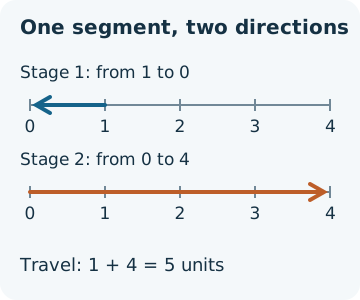
The endpoint distance is 3, the geometric image is the segment from 0 to 4 of length 4, and the traversal length is 5. These are three different questions. Integrating across the whole interval gives 3 because the leftward and rightward displacements cancel in part. The zero derivative at is harmless; it marks where the direction changes.
Before integrating, identify the endpoints and ask whether the parameterization reverses or repeats. Simplify as , then split at relevant sign changes.
5. Six graduated questions
Try each setup before opening its hint. Unless stated otherwise, coordinates use the same arbitrary length unit and all angles are in radians.
1. Start: a straight line
Find the length of for . Check using the endpoints.
Hint 1
The norm of the constant derivative is the speed; multiply by the parameter interval's width.
Explained solution 1
The derivative is , so its norm is 10. Therefore . The endpoints are and ; their separation is . Equality holds because the route is a straight segment traversed once without reversing.
2. Simplify before integrating
Find the length of on .
Hint 2
After differentiating, look for a perfect square in .
Explained solution 2
The chain rule gives . Hence . Its square root is , since this expression is positive. Thus
Do not replace the square root of a sum by a sum of square roots. The perfect-square identity is what permits the simplification here.
3. Check how many turns
For , find the length on . Then find it on . Compare the second result with the circle's circumference.
Hint 3
The angle is , not . Track its total change and keep the factor 3 when differentiating.
Explained solution 3
The derivative is , so the speed is 6. The first interval sweeps angle : , a semicircle. The second sweeps angle , or two turns: . The geometric circle has circumference ; the traversal counts it twice. Both intervals have nonnegative length.
4. Change the speed, then reverse the route
Compare the lengths of , and , each with its parameter from 0 to 1. Are their derivative vectors equal?
Hint 4
Compute all three derivative vectors. Equal lengths need not mean equal derivatives.
Explained solution 4
The derivatives are , and . Their norms are 5, and 5 on these intervals, giving lengths 5, and 5. The middle curve speeds up along the same segment; the last traverses it in the opposite direction. The derivatives are not generally equal. The zero initial derivative of does not change its length or cause a reversal.
5. Transfer: use distance as the parameter
For the helix in example 2, define as the distance travelled from . Find , invert it and write the curve in terms of . Check that the new derivative has norm 1 and state the new interval.
Hint 5
Speed is 5, so integrate it from 0 to , not over the entire trip.
Explained solution 5
We have , so . The new parameterization is
Its derivative has components , and . Its norm is . Each unit of now corresponds to one length unit travelled. Keeping the old upper bound would stop before the original endpoint.
6. Challenge: diagnose an answer without an antiderivative
A student says the length of on is 1, because . Explain the error, set up the correct integral, and bound its value using the endpoint distance and a speed bound. An exact antiderivative is not required.
Hint 6
The integral of is vertical change. The curve's speed when parameterized by is .
Explained solution 6
The student has ignored horizontal motion. The correct length is . The endpoints are and , so the length is at least , already ruling out 1. On the interval the integrand is at most , so
A numerical evaluation gives approximately 1.479, consistent with these bounds. The setup and checks can be correct even before choosing a numerical or symbolic integration method. Bounds alone do not establish that decimal approximation.
6. Check the answer and choose a next step
- Differentiate coordinates before taking the norm.
- Use the actual parameter interval and check how often the route is covered.
- Keep absolute values when a square root removes a square.
- Length is nonnegative and at least the straight-line endpoint distance.
- Distinguish traversal length, image length, displacement and area.
- When changing parameter, change the derivative and endpoints together.
For integration technique, review choosing an integration method. To compare signed displacement and total distance in one dimension, use motion graphs and kinematics.
McGill's departmental MATH 222 description includes parametric curves and arc length. This lesson is supplemental topic practice, not a complete course guide or a statement of your section's exam scope. Use your current outline and return to the MATH 222 guide for course context. All examples and questions here are original Nablio teaching material, not official exam questions. Tutoring is currently offered in English.
Useful for
McGill’s MATH 222 description includes parametric curves and arc length. This is supplemental topic practice, not complete course coverage or confirmation of any section’s exam scope. Follow your current outline.
Work on the step you’re missing.
Tell us the subject and your preferred time. Nablio confirms the details by text or email.
Request a lesson