Try nine questions without hints, then use the separate solutions to identify what to practise next. Suggested time: 90 minutes, including about 8 minutes to check your work. Use the 100-mark guide to check your answers.
This practice paper covers selected topics from weeks 1–6 of Concordia MATH 205 in Fall 2026. The outline lists the common midterm for November 1, 2026, 14:00–15:30 Montréal time. Check your instructor’s latest Moodle announcements for changes.
Included: finite sums and definite integrals; antiderivatives and the fundamental theorem; substitution; integration by parts; trigonometric integrals and substitution; partial fractions; areas; cross-section volumes. Improper integrals and sequences/series are later in the outline. Cylindrical shells are not used here.
Show your reasoning and keep exact values. All questions can be solved without a calculator. Apart from the physical units in Question 1, variables are dimensionless; geometric answers use square or cubic coordinate units. Angles are in radians. C denotes an arbitrary real constant, ln the natural logarithm, and e its base. In a few questions an intermediate sum or integral is named only for that question.
MATH 205 course guide · Guided integration practice
Question paper
1. A sum and a displacement (10 marks)
An object moves on a line with velocity for , where is the numerical time in seconds and is measured in metres per second.
(a) Divide the time interval into equal subintervals, with a positive integer. Use right endpoints to write a displacement estimate in sigma notation. Simplify it using . [4 marks]
(b) Find and , with units. [3 marks]
(c) Explain whether these right-endpoint estimates are above or below the exact displacement. Is the limiting displacement also the distance travelled? Justify without calculating the distance. [3 marks]
2. Recover a function and differentiate an accumulation (10 marks)
(a) Find if for all real , and . [4 marks]
(b) Define for . Find , and explain why the lower endpoint contributes a term. [6 marks]
3. A definite integral with an exponential (8 marks)
Evaluate . Show your substitution, its differential and the transformed endpoints. Give an exact answer and check its sign or size.
4. An integral with two factors (10 marks)
Evaluate . Explain your method choice, show the endpoint evaluation and verify your primitive by differentiation.
5. Even trigonometric powers (10 marks)
Find for real . Show the identity or identities you use, and verify your answer by differentiation.
6. An algebraic radical (12 marks)
Evaluate using a trigonometric substitution. State the angle interval, justify the sign when simplifying the square root, and show the transformed endpoints.
You may use .
7. A rational integrand (14 marks)
Find on any interval that does not contain . Show a suitable partial-fraction form and solve for its coefficients. State where your primitive is valid.
8. Two enclosed regions (12 marks)
The curves and enclose two bounded regions. Find their combined area. Show all intersections and identify the upper curve on each interval.
A student writes and concludes that the area is zero. Explain the mistake.
9. A solid about a shifted axis (14 marks)
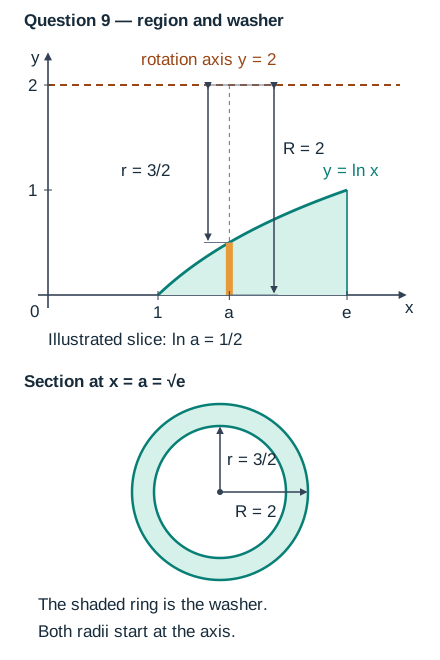
The region , is rotated about the line . Find the volume by using sections perpendicular to the rotation axis.
Include a labelled sketch or a precise description of a typical section, its outer and inner radii, and the integration bounds. Evaluate your integral exactly. Explain why does not describe this solid.
Open the worked solutions after your attempt
Worked solutions and self-check guide
Use the guide to award points for correct steps, and accept equivalent valid solutions. If one arithmetic error carries through later lines, count it once. Choose the two types of mistake that cost you the most points. Review the linked lessons, close the solutions and try the matching follow-up questions. Keep setup mistakes separate from algebra or endpoint errors.
1. A sum and a displacement (10 marks)
(a) The width is seconds; the th right endpoint is . A velocity times this width is a displacement in metres.
Expanding gives metres.
(b) Thus and . Directly, .
(c) The velocity decreases on this interval, so every right-endpoint rectangle is below the graph in the signed-sum comparison. The estimates are below the exact displacement. Since when , the object reverses direction. Distance is , which is greater than the net displacement here.
Illustrative mark guide
- (a) width and endpoints 1; correct sum 1; use of the square-sum formula and simplification 2
- (b) S₂ 1; limit 1; metres 1
- (c) decreasing-function comparison 1; reversal interval 1; distance uses absolute velocity 1
Check: The error is negative for every positive integer .
D1: If you added velocities without a time width, write the units of one summand before doing algebra. If you called the signed result a distance, locate the zero of the velocity.
2. Recover a function and differentiate an accumulation (10 marks)
(a) Integrating gives . The condition fixes . Thus .
(b) The integrand is continuous. Write . Apply the fundamental theorem and chain rule to both terms:
The lower endpoint moves too. Its accumulated contribution is subtracted, which produces the negative term.
Illustrative mark guide
- (a) polynomial antiderivative 3; initial condition 1
- (b) upper endpoint including factor 2: 2; negative lower-endpoint term 2; simplification 1; explanation 1
Check: Direct integration gives ; its derivative agrees.
D2: If one endpoint term is missing, split the integral at the fixed point 0. Apply the chain rule separately to each moving endpoint.
3. A definite integral with an exponential (8 marks)
Let , so . At , ; at , . Thus
The transformed variable is positive throughout, so the square root and primitive are valid on the whole interval.
Illustrative mark guide
- substitution and differential 2
- both transformed endpoints 2
- primitive 2
- exact endpoint subtraction 1; sign or size check 1
Check: The integrand is positive. Also , since the transformed interval has width 1.
D3: If your integral in u still has x-endpoints, change the endpoints or return to x before evaluating. Do not mix the two variables.
4. An integral with two factors (10 marks)
Integration by parts is useful because differentiating removes the polynomial factor and cosine has a simple primitive. Choose , ; then , .
An antiderivative is . At the lower endpoint it equals 1, so its contribution cannot be dropped.
Illustrative mark guide
- method choice and u, dv 2
- correct integration-by-parts equation 3
- primitive and both endpoint contributions 3
- exact result 1; derivative verification 1
Check: . The answer is positive, consistent with the integrand on the given interval.
D4: If you obtained π/2, evaluate the whole primitive at 0. If your remaining integral became harder, reconsider which factor you differentiate.
5. Even trigonometric powers (10 marks)
The double-angle and power-reduction identities give . Therefore
Differentiating gives , the original integrand by the same identity.
Illustrative mark guide
- valid identities, including both factors 4
- integration with correct frequency factor 3; constant 1
- derivative verification 2
Check: The derivative is nonnegative, as must be.
D5: If the cosine coefficient is wrong, reduce the powers in two separate lines. If the antiderivative coefficient is wrong, differentiate the sine term and retain its factor 4.
6. An algebraic radical (12 marks)
Choose , with . Then . Since on this interval, .
Here . A primitive is ; the logarithm argument is positive on the chosen interval.
At , , , and . At 0 the primitive is 0. Thus
Illustrative mark guide
- substitution, differential, angle bounds and square-root sign 3
- correct transformed integral and identity 4
- primitive 3
- exact endpoint values and subtraction 2
Check: In the original variable a primitive is . Its derivative is . The numerical value is about 0.0340, which is positive.
D6: If the radical simplification has an unexplained sign, choose an angle interval first. If the factors of 2 do not cancel, transform numerator, denominator and differential separately.
7. A rational integrand (14 marks)
The fraction is proper: the numerator has lower degree than the denominator. The quadratic has no real linear factors, so its numerator must be allowed to have degree 1:
Multiplication by the denominator gives . Comparing coefficients gives , , . Hence , , .
Now integrate . The result is
The expression is valid on each interval contained in or . The constant may differ between these disconnected intervals. The second logarithm needs no absolute value because .
Illustrative mark guide
- correct proper-fraction form with linear numerator 3
- coefficient equations and values 4
- three primitive terms 4; arbitrary constant 1
- domain and logarithm conditions 2
Check: Differentiating gives . Recombining yields numerator .
D7: If your coefficient equations are inconsistent, check whether you omitted the x term over the irreducible quadratic. If you obtained only logarithms, separate x/(x²+1) from 1/(x²+1).
8. Two enclosed regions (12 marks)
Intersections satisfy , or . Thus . On , ; on , .
The total geometric area is
The first integral is . The second is . Hence square coordinate units.
The student’s integral is a signed difference. Its negative and positive contributions cancel because is odd. For geometric area, use , or split where the order of the curves changes.
Illustrative mark guide
- all three intersections 3
- correct upper curves and explanation of signed cancellation 3
- two correct nonnegative integrals and evaluations 4
- combined area and square units 2
Check: Both lobes have positive area and are related by a half-turn about the origin, so their areas must agree.
D8: If an enclosed area is zero or negative, test the order of the curves separately between each pair of intersections. A signed integral can cancel; geometric area cannot.
9. A solid about a shifted axis (14 marks)
The rotation axis is horizontal, so use vertical slices of thickness . On , : the entire region lies below the axis. The lower edge is farther from it.
The outer radius is , and the inner radius is . A typical section is a washer, with a hole of radius . Consequently
Integration by parts gives . For the square, take , , so :
Hence cubic coordinate units.
The proposed expression squares the strip height . A washer’s area is , not . The proposed disks instead describe rotation of this region about .
Illustrative mark guide
- orientation, bounds and both radii 4
- washer model and correct integral 4
- evaluation of both logarithmic integrals and exact result 4
- cubic units and diagnosis of the proposed disk integral 2
Check: Writing , with , gives . Since , the volume must lie between and . The result does.
D9: If the setup is wrong, label the axis and measure both distances from it before integrating. If only the final value is wrong, check the lower endpoint in the logarithmic primitives.
Diagnose and retry
- For on , with the same units as Question 1, write the right-endpoint sum with equal intervals and find its limit. Does the limit represent distance or net displacement?
- For , find for real .
- Evaluate .
- Evaluate .
- Find .
- Evaluate using a trigonometric substitution.
- Find . Simplify the rational function first and explain the primitive formula used for the remaining fraction.
- Find the area between and for . Compare it with .
- Rotate the region , about . Find its volume with washers.
Retry solutions
D1
, . Hence . The limit is metres of net displacement. Velocity is negative for , so distance is larger.
D2
Continuity of cosine permits the fundamental theorem: . The subtraction comes from the lower endpoint; its chain-rule factor is .
D3
Use , , and endpoints 3 and 5. The integral is .
D4
Choose , , so , . Integration by parts gives . The definite integral is .
D5
Use . The primitive is . Differentiation multiplies the sine term by 6.
D6
Let , with . The integral becomes . Since the terminal sine is , the result is .
D7
Polynomial division gives . Since , a primitive is , valid for all real . A logarithm of the denominator would instead differentiate to a numerator proportional to .
D8
Split at . The area is square units. The signed integral is , which is not the area.
D9
The outer radius is 3 and the inner radius is . Thus cubic units. The strip height is not either radius.
Scope and sources
Course outline and further practice resources:
- Fall 2026 MATH 205 outline
- Concordia course calendar
- Undated faculty-hosted sample midterm
- Student Success Centre self-assessment
For step-by-step hints before a timed attempt, use the guided integration pack. Its shared Concordia/McGill topic practice remains a separate resource.
Useful for
Work on the step you’re missing.
Tell us the subject and your preferred time. Nablio confirms the details by text or email.
Request a lesson