Return to McGill MATH 133 course guide
Stuck on a step? Text us Email us Request a lesson
A matrix usually changes both the length and direction of a vector. An eigenvector is a nonzero input that stays on its own line through the origin. Its eigenvalue tells you how the matrix scales it, including whether the arrow reverses or collapses to zero.
By the end, you should be able to recognize an eigenvector geometrically, find eigenvalues and eigenspaces for a small matrix, and check every proposed answer in the original equation. You will work through two examples, compare repeated eigenvalues, then try five questions with optional hints and explained answers.
You should know matrix–vector multiplication, a two-by-two determinant and how to solve a homogeneous linear system. Revisit row operations and solution sets if needed. We use real matrices, real eigenvalues and real column vectors in this lesson; the last question explains why that choice matters.
1. What stays the same?
For a square matrix , a vector is an eigenvector with eigenvalue when
Here is matrix–vector multiplication and multiplies every component of the vector by the same real number. For example, is a column vector; its image under is another column vector.
- If , the output points the same way as the input.
- If , the output points the opposite way, along the same line.
- If , the output is the zero vector, which has no direction. The input can still be an eigenvector.
The length is multiplied by . It grows when , shrinks when , and is unchanged when . Thus “preserves direction” needs care: the line is preserved, but the arrow can reverse, and a zero output has no arrow direction.
For the diagonal matrix below, the horizontal and vertical axes are eigendirections:
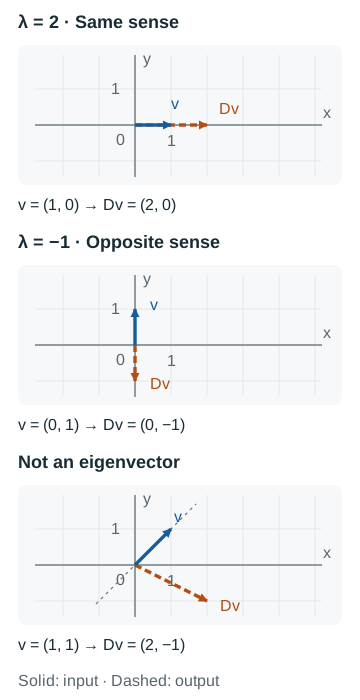
Indeed, . No single multiplier changes both input components to those outputs, so this vector is not an eigenvector.
If is an eigenvector, every nonzero multiple is one too, with the same eigenvalue, because . An eigenvector therefore need not be a unit vector, and there is usually no single preferred length.
2. Find the number, then the vectors
Rearrange the eigenvector equation using the identity matrix , which leaves a vector unchanged:
For an -by- matrix, this homogeneous system has a nonzero solution exactly when is singular, meaning it is not invertible. The determinant detects that condition:
This is the characteristic equation. It finds eigenvalues, not eigenvectors. Subtract only from the diagonal entries. In two dimensions,
gives
- Find the eigenvalues. Solve the characteristic equation.
- Find the vectors for each value. Substitute that value into , then solve the system. Keep the free parameters.
- Separate the space from its eigenvectors. The solution set is the eigenspace. The kernel means all vectors sent to zero by that matrix. The eigenspace includes zero; its nonzero vectors are the eigenvectors.
- Check in the original matrix. Compute and independently. All components must agree, and must be nonzero.
3. Worked example: two eigendirections
Find all eigenvalues and eigenvectors of
Find the two eigenvalues
Setting this to zero gives and .
Solve the system for each eigenvalue
For ,
Both equations say , so
For ,
Now both equations say , so
Each eigenspace is a line through the origin. To list its eigenvectors, require . The parameter can be positive or negative.
Check one nonzero vector on each line
Linearity extends each check to every scalar multiple on that line. These are all eigenvectors, because the characteristic equation has no other roots and each associated system has been solved completely.
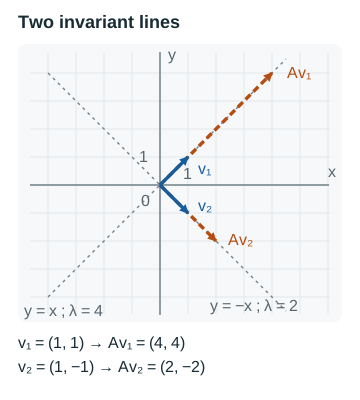
The vector is not on either line. Its image is not a scalar multiple of it. Two eigendirections do not make every vector an eigenvector.
4. Worked example: a zero eigenvalue
Projection onto the horizontal axis is represented by
The characteristic equation is , so the eigenvalues are and .
- For , solve . It gives : every nonzero horizontal vector stays unchanged.
- For , solve . It gives : every nonzero vertical vector collapses to the origin.
For example,
The input is nonzero, so it qualifies. The zero output has no direction; we do not call it an eigenvector. More generally, zero is an eigenvalue of a square matrix exactly when the matrix is singular. Its eigenspace for eigenvalue zero is its kernel.
Projection does not make every input an eigenvector: , which is not a multiple of the input.
5. What a repeated eigenvalue does not tell you
In the plane, two nonzero vectors are linearly independent when neither is a scalar multiple of the other. A basis of a space is a set of independent vectors whose scalar multiples can be added to produce every vector in that space, uniquely. One nonzero vector forms a basis of a line; two independent vectors form a basis of the plane. Their dimensions are one and two, respectively.
Compare
Both have characteristic equation . The root occurs twice, so its algebraic multiplicity is two. That does not tell you how many independent eigenvectors exist.
- For , the system gives . Its eigenspace is one line, with basis .
- For , the matrix is zero. Every real vector solves the system, so its eigenspace is the whole plane. Every nonzero vector is an eigenvector.
The dimension of an eigenspace is the eigenvalue’s geometric multiplicity: one for , two for . There are infinitely many eigenvectors in each case; the difference is the maximum number of linearly independent eigenvectors you can choose from that eigenspace. You must solve the system to find it.
Diagonalization means choosing a basis in which the same linear map has a diagonal matrix. A two-by-two real matrix can be diagonalized over the real numbers exactly when it has two linearly independent real eigenvectors. Thus cannot be diagonalized, while is already diagonal. A repeated eigenvalue alone settles neither outcome.
6. Five questions to try
Keep the answers closed at first. Start with direct checks, then find a complete eigenspace, diagnose a misleading shortcut and try a rotation. The hints are separate from the answers.
Question 1: one multiplier for the whole vector
For , decide which inputs below are eigenvectors. For each one that qualifies, give its eigenvalue.
Show a hint for question 1
Compute every output. A negative component in the input does not by itself make the eigenvalue negative. Exclude the zero input before comparing vectors.
Show the answer and reasoning for question 1
, so has eigenvalue . Also , so has eigenvalue ; the output points the same way as this downward input.
For , the output is . The first component would require multiplier , the second , so there is no eigenvalue for that input. The vector is excluded by definition.
Question 2: find and check both eigenspaces
Find all eigenvalues and eigenvectors of . Explain why the second coordinate axis is not an eigendirection, even though the matrix is triangular.
Show a hint for question 2
The determinant is the product of the diagonal entries of . For each root, solve both equations and retain a free parameter.
Show the answer and reasoning for question 2
, so the eigenvalues are and . For , the system gives . For , it gives , hence .
All eigenvectors are for eigenvalue , or for eigenvalue , with . Direct checks give and .
But , which leaves the vertical axis. For a triangular matrix, the diagonal entries are its eigenvalues; the coordinate vectors need not all be eigenvectors.
Question 3: can a whole plane collapse?
For the two-by-two zero matrix , find all eigenvalues and eigenvectors. Is its zero-eigenspace just the zero vector?
Show a hint for question 3
For a nonzero input, solve . Then distinguish the full solution space from the allowed eigenvectors.
Show the answer and reasoning for question 3
Every input maps to zero. Since , the equation forces , the only eigenvalue. Its eigenspace is all of , and its eigenvectors are all nonzero real two-component vectors. The eigenspace includes zero, but the eigenvector list does not. Here the root has algebraic and geometric multiplicity two.
Question 4: two vectors or two independent directions?
A student finds the repeated eigenvalue for from section 5 and proposes and as “two independent eigenvectors.” Check the vectors and correct the conclusion about diagonalization.
Show a hint for question 4
Both vectors can pass the eigenvector equation while failing a different requirement. Can one be made by scaling the other?
Show the answer and reasoning for question 4
Both are eigenvectors with eigenvalue , but the second is twice the first. They are linearly dependent. Since forces , every eigenvector lies on this same line. No second independent eigenvector exists, so cannot be diagonalized. Choosing another length cannot create another independent direction.
Question 5: a rotation with no real eigendirection
The matrix rotates the plane by a quarter-turn counterclockwise. Does it have a real eigenvalue? Explain with both its characteristic equation and its geometry.
Show a hint for question 5
Find . A nonzero arrow rotated by a quarter-turn cannot stay on its original line.
Show the answer and reasoning for question 5
, which is positive for every real . There are no real roots, so there are no real eigenvalues or real eigenvectors. Geometrically, every nonzero arrow turns onto a perpendicular line; none collapses to zero. Over the complex numbers the roots are and , where , but complex eigenvectors are outside the real-plane picture used here.
Diagonalization workshop: build the basis, check the factorization, use the powers
Continue after the five core questions. Diagonalization turns the eigendirections you found into a coordinate system for the same transformation. This original workshop adds two worked examples and six progressive exercises. Review the bases and coordinates workshop if matrix order or coordinate columns are unfamiliar. Allow additional study time beyond the core lesson.
McGill’s departmental description of MATH 133 lists eigenvalues and diagonalization. These are selected practice tasks, not a complete exam syllabus or a prediction of assessed questions. Follow your section’s current instructions. All matrices and bases here are real.
Why the factorization works
For an -by- matrix , choose linearly independent eigenvectors . Put their standard coordinates in the columns of , and put their matching eigenvalues in the same order on the diagonal of :
The th column of is . The th column of is . The eigenvector equations therefore give
Independence makes invertible. Multiplying this equation on the appropriate side gives both useful forms:
Read the second formula from right to left: finds eigenbasis coordinates, scales each coordinate separately, and reconstructs the output in standard coordinates. The matrix represents the same linear transformation in the eigenbasis. Changing coordinates does not itself apply the transformation.
Conversely, if is invertible and is diagonal, multiplying by shows that the columns of S are independent eigenvectors. Thus diagonalization over the reals is possible exactly when there is a full real eigenbasis. Having distinct real eigenvalues is sufficient, but not necessary. A repeated eigenvalue requires checking its eigenspace.
Return to the existing comparison of B and C: every eigenvector of B lies on one line, so every attempted two-column eigenvector matrix is singular. There is no inverse to use. Choosing a different nonzero multiple cannot repair the missing direction. For C, two independent directions are available despite the repeated eigenvalue.
Worked example 1: complete the geometric example
Section 3 found the eigenpairs of . Now turn them into a checked factorization:
The eigenvalues are for and for . Therefore
First check the basis: . The two-by-two inverse formula gives
Next check the column equations and then the diagonal result:
This verifies the order of the factors as well as the arithmetic. Here the columns of S are orthogonal but not unit vectors, so its inverse is half of S, not its transpose.
What happens to ? The superscript means transpose, so this notation describes a column. Compute the three stages:
Direct multiplication by A also gives . The input was : the first coefficient was multiplied by 4 and the second by 2. The coefficients changed because the transformation was applied; neither basis vector had to be a standard coordinate axis.
Worked example 2: a power without repeated matrix multiplication
Consider the nonsymmetric matrix
Its characteristic equation is . For , the eigenvector equations force ; choose . For , they give ; choose . These vectors are independent. Use a new S and D for this example:
The determinant of S is 1, and , . Thus and . This basis is not orthogonal; diagonalization does not require orthogonality.
In a power, adjacent inverse factors cancel:
Repeating this argument gives for every nonnegative integer , including , where both sides are the identity. Only the diagonal entries need powers:
Multiplication yields
This is an ordinary matrix power, not a power applied to each entry of M. For example, the upper-right entry at is , not .
For the recurrence , starting at , the initial eigenbasis coordinates are . Therefore
At , this gives . A direct check gives , , then the same . The second eigenbasis coefficient changes sign at each step, while the first coefficient doubles.
Boundary: negative integer powers additionally require the matrix to be invertible, so all its eigenvalues must be nonzero. A zero eigenvalue does not prevent diagonalization or positive powers. Exercise 5 separates these ideas.
Six progressive exercises
Use A from worked example 1 and M from worked example 2 where named. Each question has a separate hint and full explanation. Questions 1–2 build and check a factorization, 3–4 use it, and 5–6 test the conditions.
1. Change the column order, then change a length
For A, put before in a matrix R. What diagonal matrix E makes ? If instead you use the columns , do the eigenvalues change?
Hint for diagonalization question 1
Match each diagonal entry to its own column. A nonzero scalar multiple remains an eigenvector with the same eigenvalue.
Full solution to diagonalization question 1
The first column has eigenvalue 2 and the second has eigenvalue 4. Directly, . Keeping the old diagonal order would fail both column checks.
For the columns , the diagonal entries stay 4,2, because . Scaling a column changes the coordinate conversion and its inverse, not its eigenvalue. The new determinant is , so the columns still form a basis. Scaling by zero would destroy it.
2. Construct a new diagonalization
Diagonalize . Find the eigenspaces, give an invertible S and diagonal D, and check .
Hint for diagonalization question 2
The eigenvalues are the diagonal entries of this triangular matrix. The second standard coordinate vector is not an eigenvector; solve the system for eigenvalue 2.
Full solution to diagonalization question 2
The equation gives 4 and 2. For 4, the system gives . For 2, it gives . Thus and .
Here , and , which can be checked by multiplying S by itself. Also
Therefore and . Other nonzero choices on these eigenlines also work, provided the diagonal order matches.
3. Find a matrix power and one output
Find using worked example 1, then compute . Why is cubing each entry of A incorrect?
Hint for diagonalization question 3
Cube the two eigenvalues in D, then multiply by S and its inverse. The first column of a matrix is its output for the first standard basis vector.
Full solution to diagonalization question 3
The requested output is . As a direct check, ; multiplying once more by A gives the same result. Entrywise cubing would give , which ignores the sums of products required by matrix multiplication.
4. Solve a recurrence from a different initial vector
For and , derive a formula for , then check and .
Hint for diagonalization question 4
First find the coefficients of the new initial vector in the eigenbasis of M. Do not reuse the coefficients from the worked example.
Full solution to diagonalization question 4
The new coefficients are , so . Hence
For , this gives , the required initial vector. For , it gives , also obtained from . Each eigenbasis coefficient follows its own multiplier; the visible standard components combine them.
5. Diagonalizable but not invertible
For , construct a diagonalization. Find for positive integers n. What are and ?
Hint for diagonalization question 5
Try eigenvalues 1 and 0. A zero eigenvalue describes a collapsed eigendirection; it does not mean the eigenvector matrix must be singular.
Full solution to diagonalization question 5
For 1, the eigenspace is generated by . For 0, the equation gives generator . They are independent, so
For every positive integer n, , hence . Direct multiplication also gives . By definition , not N; treat the zeroth power separately instead of using an undefined scalar expression involving zero.
The inverse does not exist because . The independent eigenvectors make S invertible; they do not make N invertible. These are different requirements.
6. A repeated eigenvalue in three dimensions
Determine whether is diagonalizable over the reals. Build S and D if it is. Explain why the repeated root does not settle the answer by itself.
Hint for diagonalization question 6
For each distinct eigenvalue, solve the homogeneous system. You need three independent eigenvectors in total, not three different eigenvalues.
Full solution to diagonalization question 6
The characteristic equation is . For 2, the equations force , leaving x and y free. Thus , a plane. For 3, the equations give , , so .
Choose
Since , the three columns form a basis. Column checks give , proving the diagonalization. Eigenvalue 2 has algebraic and geometric multiplicity two; eigenvalue 3 contributes the third independent direction. Compare with B in section 5, where the repeated root supplied only one independent direction.
A final check before you move on
- Find all eigenvalues and solve each eigenspace, keeping the field of scalars clear.
- Count independent eigenvectors. Do not count different lengths as different directions.
- Put the vectors in columns and match the diagonal order.
- Check that S is invertible, then verify the column identity before using an inverse.
- For powers, state the allowed integers and check a small power or the initial condition independently.
For another explanation of the factorization and powers, see MIT OpenCourseWare: diagonalization and powers of A. This is mathematical background, not a statement of McGill assessment scope. Return to MATH 133 or MATH 204 to choose your next course topic.
7. Check your reasoning and choose a next step
- Can you say what the sign and magnitude of an eigenvalue do to a nonzero input?
- Did you subtract the eigenvalue only on the diagonal and solve the resulting homogeneous system?
- Did you give the full eigenspace, then exclude zero when listing eigenvectors?
- Did you verify each representative using the original matrix, rather than only the determinant?
- For a repeated root, did you count independent vectors by solving the system?
If the multiplication or free parameters caused difficulty, return to matrix and vector fundamentals. If the computations worked, explain the contrast between and without looking at section 5, then complete the diagonalization workshop and use your course materials for further practice.
For wider course context, see the guides for Concordia MATH 204 and McGill MATH 133.
Course context and further reading
This original lesson supports the eigenvalue and eigenvector topics in MATH 204 at Concordia and MATH 133 at McGill. Use your own course outline for the scope assigned to you. The links below establish topic relevance and provide further explanation.
Useful for
Work on the step you’re missing.
Tell us the subject and your preferred time. Nablio confirms the details by text or email.
Request a lesson