Start with a signed area vector, then move to curved surfaces, added closing pieces and a theorem whose hypotheses fail. Each question asks for a setup that you can explain before you calculate. Try it first, use the hint only if needed, and compare your work with the solution afterward.
All coordinates and field values are dimensionless. In every flux integral, denotes the chosen unit normal, and is the upward coordinate unit vector. If you need the method first, read the surface-flux lesson.
Question 1 A tilted patch and its area factor
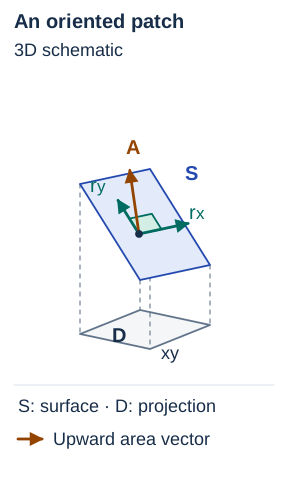
Let be the patch over , . For , find the upward flux. Check it using a unit normal and the actual patch area. What changes for downward orientation?
Show hint
Parameterize by . The z component of should be positive. The parameter rectangle has area 2, but the tilted patch has a different area.
Show explained solution
The tangent vectors are and . Their cross product is , which points upward. The signed integrand is
Thus
The unit normal is , and the surface area is . Since the field and normal are constant, the second calculation gives . Keeping the unit normal but using only the projected area 2 would omit the area stretch. Downward orientation gives .
Before moving on: identify the exact factor lost by the incorrect unit-normal calculation. Repair it with the area-vector explanation.
Question 2 A curved graph with zero net flux
Let be over , oriented upward. For , compute the flux directly. Explain whether your result means the field is tangent everywhere or vanishes on the surface.
Show hint
Use for the upward vector area element. Change the projection-disk integral to polar coordinates after taking the dot product.
Show explained solution
Substitution into the field and the dot product give
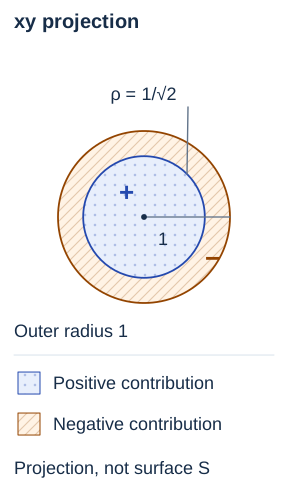
With , , the planar Jacobian is . Therefore
The upward normal contribution is positive for and negative for . The inner disk contributes ; the surrounding annulus contributes . They cancel. The field is never zero because its third component is 1, and it is tangent only along the circle where the normal contribution vanishes.
This surface has an edge at ; it does not enclose a solid by itself. The direct calculation is already valid, so no closing surface is needed for this method. If the Jacobian or area element was unclear, revisit the graph formula before retrying.
Question 3 The cylindrical side is missing two disks
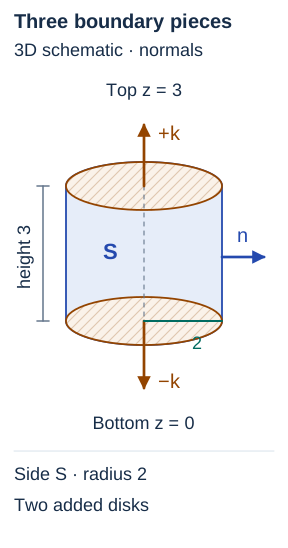
Let be only the lateral surface , , with normal directed away from the z axis. For , calculate the flux directly. Then check it by closing the cylinder with both disks. State all three surface contributions.
Show hint
Use . Check the direction of . The top and bottom disks have different field values and opposite outward normals.
Show explained solution
With and ,
so . It points outward and has magnitude 2. The field evaluated on the side is , hence the dot product is 4. The vertical component contributes nothing through this side.
For a theorem check, the solid cylinder has volume . The polynomial field has divergence 3, so its whole closed-boundary flux is .
- Top disk: , , , area , flux .
- Bottom disk: , , , area , flux .
- Curved side: .
The sum is . Forgetting either disk means that the theorem has been applied to a different boundary. Review signed closing-surface subtraction if those signs did not match your sketch.
Question 4 A spherical cap above the equator
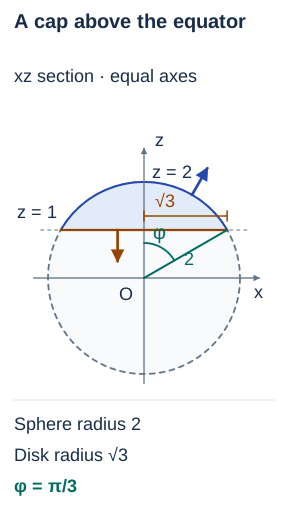
Let be the curved part of with , oriented away from the origin. For , find its flux by adding the disk at . Verify the result directly. The disk is not part of .
Show hint
At height , the solid's cross-section has area . The closing disk has radius , not 2. For the direct calculation, use spherical colatitude .
Show explained solution
The cap and disk enclose the solid inside the sphere with . Its volume is
The field is polynomial and has divergence 3, so the flux through the whole boundary is . On the added disk, the solid is above the plane, hence the outward normal is . At , the field's third component is 2. The disk area is , giving
For a direct check, parameterize the sphere by
The cap condition is , which explains the upper colatitude bound. The outward unit normal is , so
The surface-area element is . Therefore
Both methods agree for the curved cap alone. If your direct answer disagrees, check both the sphere radius in the area element and the colatitude limit. Revisit the hemisphere's direct calculation.
Question 5 Diagnose an incomplete paraboloid solution
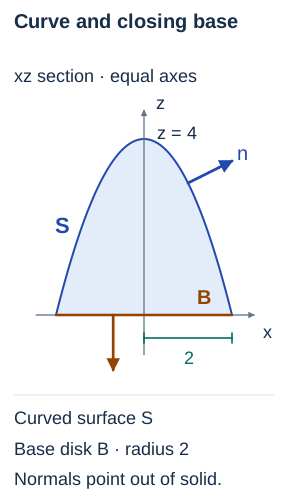
Let be , , oriented upward. For , a student finds , computes the volume under the paraboloid as , and reports flux through .
Which part of the argument is incomplete? Correct the result using a closing disk, and verify it directly from the graph. Give the downward flux as well.
Show hint
The student's volume calculation concerns the boundary of the solid under the paraboloid and above . List every surface on that boundary before deciding what represents.
Show explained solution
The volume is correctly calculated:
The field is smooth everywhere, so is the total outward flux through the paraboloid and its base disk together. The missing step is removing the base contribution. The disk has radius 2, normal , and , giving . The upward orientation on the paraboloid is outward from this solid. Thus
For the direct calculation, , , so the upward area-vector density is . On the graph, , and the dot product becomes
Therefore
Downward orientation reverses the surface flux to . The enclosed volume stays the same. The divergence theorem's outward-orientation convention must be applied before that sign reversal. Review the theorem conditions and the closing-surface identity if you treated a correct volume as a complete solution.
Question 6 A singularity inside a smooth sphere
Let
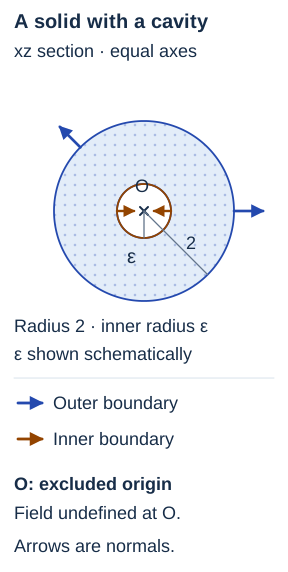
for , and let be the radius-2 sphere centered at the origin with outward orientation. A student calculates away from the origin and concludes that the flux through is zero. Explain the failure, compute the flux directly, and check what the divergence theorem does say on a shell , where .
Show hint
On a radius- sphere, write . For the shell, the normal on its inner boundary points toward the origin, away from the material of the shell.
Show explained solution
The field is undefined at the origin. It is smooth on the sphere, but not on an open set containing the filled ball. Therefore the usual divergence theorem cannot be applied to that ball. Removing one point from the integral without accounting for the new boundary is not a justification.
For completeness, write . The three diagonal derivatives sum to
where the field is defined. This calculation is correct; its use over the filled ball was the problem.
On a radius- sphere,
Multiplying by area gives outward flux , so the required radius-2 answer is .
The shell excludes the origin and has a smooth field on a neighbourhood of its closure. Its boundary has two components. The outer sphere contributes ; the inner sphere uses the opposite radial normal and contributes . The total agrees with the volume integral of zero divergence over the shell. The theorem succeeds on the region that satisfies its hypotheses.
If the sign of the inner boundary surprised you, reread outward orientation and cavities. For the domain failure, revisit the differentiability condition.
Use the results to choose a second attempt
- If question 1 failed, recompute its tangent vectors and cross product before doing any integral. Explain the difference between projected area and surface area.
- If question 2 failed, draw the positive and negative contribution regions. Check the polar Jacobian separately from the surface area vector.
- If question 3 failed, list the side and both disks with their own normal, field value and flux.
- If question 4 failed, derive the colatitude bound from , then compare each method's included surfaces.
- If question 5 failed, state in a sentence what the volume integral calculates before using its value.
- If question 6 failed, mark where the field is undefined and identify every component of the shell boundary.
Then retry the original question without the worked answer. A useful explanation names the surface, parameter region, normal and field-domain check before presenting a number.
Course scope and tutoring
The MAST 219 course guide and ENGR 233 course guide connect this practice to the relevant course. Use it when your current chapter covers surface integrals and flux. These original questions sample that topic; they make no claim about a specific assessment, schedule or complete course coverage.
The existing ENGR 233 vector and line-integral practice keeps its own stated scope. For bounds and polar-coordinate repair, use the existing double-integral questions; check their stated course context separately.
Bring your sketch and attempted setup to a tutor. Ask for a check of the included surfaces, normal direction or theorem condition that you could not justify, then explain the corrected step yourself.
Curriculum scope was checked on 11 October 2026 against Concordia's mathematics calendar and engineering calendar. The surface-flux lesson lists further references.
Useful for
Work on the step you’re missing.
Tell us the subject and your preferred time. Nablio confirms the details by text or email.
Request a lesson