Marianopolis 203-SN2-RE tutoring
Electricity and Magnetism: one-to-one online tutoring and exam preparation.
Course overview
Marianopolis 203-SN2-RE brings together static electricity, circuits and electromagnetism. Use the short circuit example below to connect a voltage reading to current, then choose a linked lesson for the topic you are studying.
203-SN2-RE topics to review
Common difficulties
- Separating voltage across a component from current through it
- Recognizing which components share the same two nodes
- Distinguishing a negative meter reading from a reversed current
Choose the step you need to practise
- Which quantity does the question ask for?
Distinguish electric field, force, potential and energy by their meaning and units.
- How do I choose the signs in a circuit?
Read voltage rises and drops, then continue to worked Kirchhoff problems.
Use one voltage reading to find two branch currents
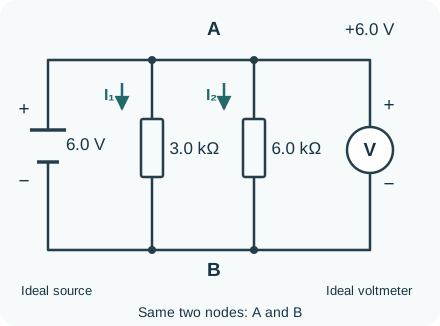
This paper-and-pencil circuit model connects a measurement with Ohm’s law and charge conservation. Assume steady direct current, ideal wires and an ideal 6.0 V source. The ideal voltmeter draws no current; real meters have a finite input resistance.
Connect a 3.0 kΩ resistor and a 6.0 kΩ resistor in parallel between nodes A and B. The source’s positive terminal is at A. A voltmeter with its positive lead at A and negative lead at B reads +6.0 V. Find the conventional current in each resistor and the current supplied by the source.
1. Read the same two nodes
The meter reads , so A is 6.0 V above B. Both resistors connect directly between these same nodes. Each has a 6.0 V drop from A to B; the voltage is not divided between parallel branches. Choose and from A to B.
2. Calculate each branch separately
Use , where means . Convert kiloohms to ohms before calculating: 1 kΩ = 1000 Ω. The positive results follow our arrows, from A to B.
3. Balance the current and check the voltage
At A, the source current splits between the two resistors. The ideal voltmeter adds no current, so = 3.0 mA. The smaller resistance carries the larger current. Check each branch: (2.0 mA)(3.0 kΩ) = 6.0 V and (1.0 mA)(6.0 kΩ) = 6.0 V. Each resistor therefore returns the same voltage reading. Units agree: V/Ω = A and mA × kΩ = V.
Try two checks
1. Reverse only the meter leads
Keep the source and both resistors connected exactly as before. Put the meter’s positive lead at B and its negative lead at A. What does it read? Do the currents through the resistors reverse?
Show a hint
The meter now reports . Changing which potential you subtract does not swap the source terminals.
Check your reasoning
It reads −6.0 V. The physical resistor currents stay 2.0 mA and 1.0 mA from A to B, and the source still supplies 3.0 mA. Only the meter’s measurement order changed; the negative display does not mean either current reversed.
2. Add a resistor before the split
Return the meter’s positive lead to A and negative lead to B. Keep the ideal source at 6.0 V, but insert a 2.0 kΩ resistor between its positive terminal and node A. The original 3.0 kΩ and 6.0 kΩ resistors still connect from A to B, and B still connects to the negative source terminal. Find the new meter reading and all three resistor currents.
Show a hint
First replace the two parallel resistors by their equivalent resistance. The added resistor carries the total current. Recover the voltage from A to B before calculating either branch current.
Check your reasoning
The parallel pair has = (3.0 kΩ × 6.0 kΩ)/(3.0 kΩ + 6.0 kΩ) = 2.0 kΩ. In series with the added 2.0 kΩ, the source sees 4.0 kΩ, so the added resistor carries 6.0 V/4.0 kΩ = 1.5 mA.
Its voltage drop is 3.0 V, leaving = +3.0 V on the meter.
The branch currents are 3.0 V/3.0 kΩ = 1.0 mA and 3.0 V/6.0 kΩ = 0.50 mA, both from A to B. Check: 1.0 + 0.50 = 1.5 mA at the junction, and 3.0 + 3.0 = 6.0 V around either complete source loop. The source voltage stayed fixed, but the voltage across the parallel pair changed.
How tutoring can help
Bring your labelled circuit, your meter-reading convention and the first equation that stalled. A tutor can help you identify the nodes, choose current arrows and check whether a sign comes from a measurement order or a physical direction.
Exam preparation for 203-SN2-RE
Choose a comparable problem from your section’s outline. State the idealizations, label the quantities and units, then check both a current balance and a voltage balance. For laboratory questions, explain how the instrument is connected and which quantity it measures.
We work through permitted practice and comparable problems, without completing graded assignments or exams on your behalf.
Need help with 203-SN2-RE?
Send your topic and preferred times. We’ll confirm whether we can help and, if so, agree on a time by text or email before payment.
Request 203-SN2-RE tutoringNablio is an independent service and is not affiliated with this institution.