Free-Body Diagrams and Friction: From Forces to Equations
Choose a system, distinguish static from kinetic friction, and turn a force diagram into equations. Compare horizontal and angled pulls with original diagrams and worked practice.
Introduction to General Mechanics (Non-program): send your chapter so we can check whether we can help before you book.
PHY0350 builds introductory mechanics through motion, forces and conservation laws, then extends these ideas to rotation. UQAM identifies it as a non-program course whose credits do not count toward a program; the study focus is developing physical models as well as carrying out calculations.
Topics include Kinematics and Newton’s laws, Free-body diagrams, Work, energy and momentum, Rotation and angular momentum.
Practise resolving a vector into perpendicular components, converting units and reading slopes on motion graphs. Rearrange equations symbolically before inserting numbers. A labelled diagram often reveals whether the difficulty is geometry, algebra or the physical model.
Consult the official course description for prerequisites, restrictions and section details.
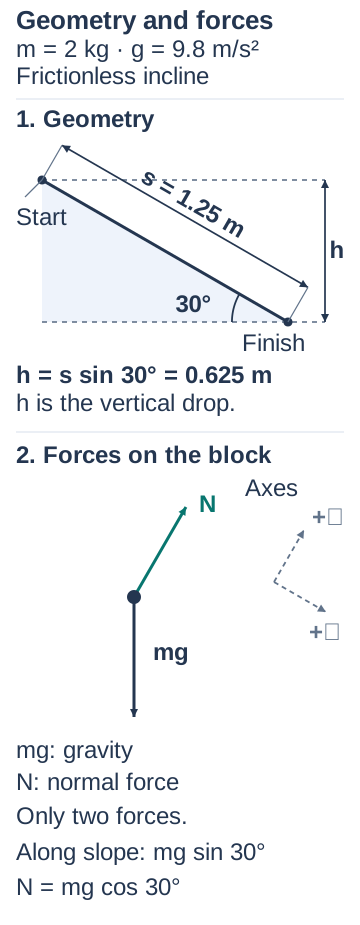
Check the official course catalogueA block of mass starts from rest and slides a distance down a straight, frictionless incline at an angle to the horizontal. Take gravitational acceleration to be . Find the final speed using Newton’s second law and constant-acceleration kinematics, then check it using energy. Would doubling the mass change the speed?
1. Resolve forces along the incline, choosing downhill as positive. Gravity’s component in that direction is . The contact force exerted by the incline, called the normal force, is perpendicular to the incline. It therefore has no component along the motion, and there is no friction. With denoting the downhill acceleration, Newton’s law gives , hence . 2. Use the constant acceleration. Let be the initial speed and the final speed. Then . Speed is nonnegative, so . 3. Check with energy. Let be the vertical drop; geometry gives . The lost gravitational potential energy is . It equals the gained kinetic energy , giving the same speed. The normal force does no work because it is perpendicular to the displacement. 4. Explain the mass dependence. In the force equation the mass cancels, and in the energy equation it cancels again, leaving . Doubling the mass therefore leaves the speed unchanged under these assumptions. Using the distance along the incline as the vertical drop would overestimate the available energy.
You can start with the problem statement, a concept you want explained or any work you have already tried. Your tutor can help identify the forces and assumptions before choosing between Newton’s laws, energy and momentum. Comparing two valid approaches to the same motion can then make clear why a conservation argument works or fails.
Organize the material in your section outline around motion, forces, energy, momentum and rotation. In mixed practice, state the system and assumptions before choosing a method. Check units and signs, and include a conceptual variation such as zero friction or twice the mass instead of repeating only the original numbers.
Use your section’s outline to choose the chapters to review. We work through permitted practice and comparable problems, without completing graded assignments or exams on your behalf.
Choose a system, distinguish static from kinetic friction, and turn a force diagram into equations. Compare horizontal and angled pulls with original diagrams and worked practice.
Send your topic and preferred times. We’ll confirm whether we can help and, if so, agree on a time by text or email before payment.
Request PHY0350 tutoringNablio is an independent service and is not affiliated with this institution.