University of Toronto — St. George MAT135H1: Calculus I tutoring
Practise derivatives, tangent-line estimates and Euler’s method for MAT135H1. Follow a worked example or start with a concept you want explained. Send your topic so we can confirm whether we can help before you book.
MAT135H1 at U of T St. George connects rates of change with formulas, graphs, numerical estimates and written explanations. Work through the example below to see how a derivative becomes both a tangent-line estimate and an Euler step.
MAT135H1 topics to review
Limits, continuity and asymptotesDerivatives and rates of changeLinear approximationDifferential equations and their solutionsSlope fields and Euler’s method
Common difficulties
Explaining what a derivative means at one input, including its units, rather than stopping after differentiation
Distinguishing a tangent-line estimate from an Euler calculation that updates the slope at each step
Preparing for this course
Review function notation, fractions, powers and graph scales. Practise finding an average rate of change and stating its units before reviewing derivative rules. For algebra or limit gaps, use the linked foundational guides. These are study suggestions; the official prerequisite is high-school calculus.
Registration requirements
High school level calculus. Consult the official entry for exclusions. This is the St. George course MAT135H1.
Let x>0 be a real input and let f(x)=x. Use the tangent line at x=4 to estimate f(4.04). Explain why your estimate should be slightly too large.
Show the reasoning
The derivative f′(x) is the slope at input x. Here f(4)=2 and f′(x)=1/(2x), so f′(4)=1/4. Let L(x) denote the tangent-line approximation. Then L(x)=2+(x−4)/4, giving L(4.04)=2.01. For positive inputs the slopes decrease as x increases, so the curve bends below its tangent: the estimate is high. Direct evaluation gives 4.04≈2.009975, confirming the direction of the error.
One growth model, three meanings of a derivative
A rate gives the slope of a graph and lets us estimate a change over a short time. This original example connects those ideas, then shows why repeated Euler steps differ from extending one tangent line.
1. Define the model and check its rate
Let t≥0 be time in hours, and let P(t) be the amount of a substance in milligrams. Use the idealized model P(t)=100e0.2t, where e is the base of the natural exponential and the growth constant 0.2 has units of inverse hours. The prime in P′(t) means derivative with respect to time. Differentiating gives P′(t)=20e0.2t=0.2P(t). Thus the formula satisfies the differential equation “rate equals 0.2 times the current amount” and the initial condition P(0)=100. We verify this solution by differentiation; no differential-equation solving technique is needed.
2. Read the same derivative in formula, graph and words
At time zero, P′(0)=20 milligrams per hour. On a graph with time horizontally and amount vertically, the tangent at (0,100) has slope 20. In words: initially, a small time increase produces about 20 times that increase in added milligrams. It does not mean the amount increases by exactly 20 over the next whole hour. Let Δt>0 denote a time interval in hours. The average rate is ΔtP(Δt)−P(0). For intervals of 0.1 and 0.01 hour it is approximately 20.2013 and 20.0200 milligrams per hour. These are secant slopes: the slopes of lines through the starting point and a later point on the graph. They approach the instantaneous rate 20 as the interval shrinks.
3. Make one local linear approximation
Let L(t) be the tangent-line approximation to the amount near time zero. Starting from 100 milligrams and using the initial slope gives L(t)=100+20t. At t=0.1, this estimates P(0.1)≈L(0.1)=102 milligrams. The exact model gives 100e0.02≈102.0201. The approximation is about 0.0201 milligram low. The true slope increases as the amount grows, while this line keeps its slope fixed at 20. A local approximation should always be checked against the size of the time interval.
4. Update the slope with Euler’s method
Now use only the rate rule P′=0.2P and the initial amount to estimate the amount after one hour. Let h=0.5 hour be the step size, n=0,1,2 the step number, tn=nh the step time, and pn the Euler estimate in milligrams at that time. Lowercase pn is an approximation, while P(tn) is the exact model value. Euler’s rule is pn+1=pn+h(0.2pn),p0=100. First use slope 0.2(100)=20: p1=100+0.5(20)=110. At the new approximate point, use slope 0.2(110)=22: p2=110+0.5(22)=121. Each increment is a time step multiplied by a rate, so its units are milligrams.
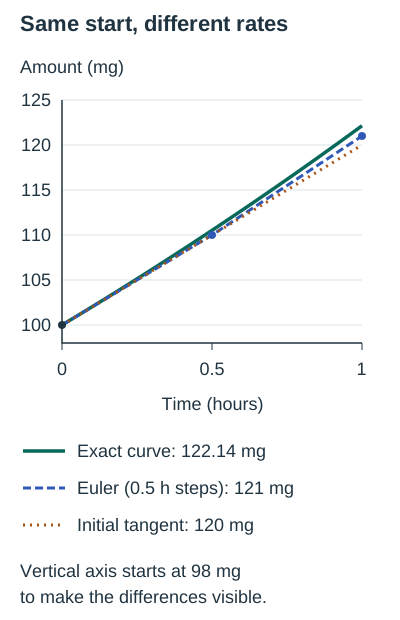
5. Compare the paths and explain the error
Extending the first tangent to one hour gives L(1)=120. Two Euler steps give 121, while the exact model gives P(1)=100e0.2≈122.1403. Euler improves this estimate because it updates the rate, but remains low here: within each forward step, the true positive growth rate continues increasing. A slope field draws a short segment with slope 0.2P at each plotted time and amount. All segments at the same amount have the same slope; larger positive amounts have steeper upward segments. Euler follows the field’s slope at each approximate starting point rather than following the curved solution exactly.
The tangent keeps the initial slope; Euler updates the slope at each step. The exact model grows faster than both approximations.
1. Interpret a rate
For the same model, find P′(1), including its units. Is it the average rate over the first hour?
Show the explained solution
P′(1)=20e0.2≈24.4281 milligrams per hour is the instantaneous rate at one hour. The average rate over the first hour is (P(1)−P(0))/(1−0)≈22.1403 milligrams per hour. These differ because the rate increases during that hour.
2. Use a smaller Euler step
Redo Euler’s method to one hour with h=0.25 hour. List all four updated amounts and compare your final estimate with the exact value.
Show the explained solution
Each step multiplies the current estimate by 1+0.25(0.2)=1.05. Starting at 100 milligrams gives 105, 110.25, 115.7625 and 121.550625 milligrams. The exact amount is about 122.1403 milligrams, so the error is about 0.5897 milligram. The half-hour estimate 121 has error about 1.1403 milligrams. The smaller step is more accurate here; neither estimate is exact.
3. Diagnose an Euler mistake
A classmate gives 100+0.5(20)+0.5(20)=120 milligrams as the Euler estimate after one hour using half-hour steps. Explain the incorrect assumption and correct it.
Show the explained solution
The slope was held at its initial value of 20. After the first step, the approximate amount is 110, so the rate rule gives a new slope 0.2(110)=22. The next increment is 0.5(22)=11, giving 110+11=121. The answer 120 lies on the initial tangent; it does not use Euler’s required slope update.
Try a fresh rate model from your practice set. Before calculating, label the initial point, units and step size; afterwards, explain which values are exact and which are estimates.
How tutoring can help
Your tutor can review your calculation alongside your graph or explanation to find where a limit, derivative or rate has been misinterpreted. For an Euler-method attempt, you can examine one update together, distinguish a slope error from an arithmetic error, then practise the next update with guidance.
Exam preparation for MAT135H1
Build a mixed set from your current outline: interpret a limit or graph, calculate and explain a derivative, justify a local approximation, and carry out an Euler calculation. After each answer, check signs, units and whether you used exact equality or an approximation. Use your section’s outline for assessment scope, dates and permitted tools.
We work through permitted practice and comparable problems, without completing graded assignments or exams on your behalf.
Related courses
Useful links for preparation or further study—not transfer equivalencies or a required registration sequence.
Learn why cancelling a factor preserves an excluded input and distinguish a function value from a limit, with a worked example and three self-checks for Concordia MATH 203 and McGill MATH 140.