Use an integral to recover accumulated change from a rate, then check what the answer means. MAT136H1 at U of T St. George connects these ideas with series and differential-equation models.
MAT136H1 topics to review
Integration, substitution and integration by partsImproper integralsTaylor polynomials and seriesPower-series ratio test and radius of convergenceFirst-order and systems of differential equations; separable modelsComputer algebra systems (CAS) for integration and differential equations
Common difficulties
Choosing a method from the integrand’s structure, then preserving signs and bounds
Distinguishing a finite approximation from an infinite series, and a symbolic answer from a justified convergence argument
Preparing for this course
Review the chain and product rules, exponential derivatives and algebraic rearrangement. Check a proposed antiderivative by differentiation. Use the sign of a rate graph to identify where the accumulated amount increases or decreases before attempting an integral. These are study suggestions, not registration requirements.
Registration requirements
One of: MAT130H1 / MAT135H1 / MAT135H5 / MATA30H3 / MATA31H3 / APS162H1 / ESC194H1 / MAT186H1 / MAT196H1. Consult the calendar for exclusions and registration rules.
Let t be elapsed time in minutes, and let Q(t) be the amount of liquid in litres. The net rate of change in the amount of liquid is a constant Q′(t)=−2 L/min for three minutes. If Q(0)=10 L, what is Q(3)?
Show the reasoning
The integral gives the change, not the final amount: ∫03(−2)dt=−6 L. Add the initial amount: Q(3)=10−6=4 L. The negative rate means the amount is decreasing; it does not make the remaining amount negative.
A changing rate: how much remains, and how much changed?
An integral of a net rate measures signed change. When the rate changes sign, the final amount can hide a larger decrease followed by a recovery.
1. Define the model and inspect the sign
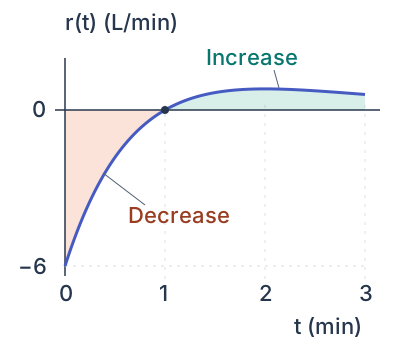
Let t be the numerical time in minutes after observation begins. Let Q(t) be the numerical amount of liquid in litres, initially Q(0)=10. Suppose its net rate, expressed in L/min, has numerical value r(t)=6(t−1)e−t,0≤t≤3. Thus Q′(t)=r(t). The exponential uses the numerical time in minutes. Since e−t>0, the rate is negative before t=1 and positive afterward. Find the final amount and add the sizes of all decreases and increases, counting each as positive.
Area below the time axis contributes a decrease; area above it contributes an increase. The signed areas partly cancel in the net change.
2. Choose a method that reduces the work
The linear factor t−1 becomes a constant when differentiated; the exponential stays easy to integrate. Integration by parts is therefore useful. Set u=t−1 and dv=e−tdt, so du=dt and v=−e−t. Then ∫6(t−1)e−tdt=−6(t−1)e−t+6∫e−tdt=−6te−t+C. Here C is an arbitrary constant. Calling this antiderivative F(t)=−6te−t, differentiation gives F′(t)=−6e−t+6te−t=r(t). A substitution u=t−1 would only shift the linear factor; it would leave a linear factor times an exponential.
3. Recover the final amount
The fundamental theorem of calculus gives Q(3)−Q(0)=∫03r(t)dt=F(3)−F(0)=−18e−3≈−0.896. This is a net loss of about 0.896 L. The final amount is therefore Q(3)=10−18e−3≈9.104 L. The initial amount must be added; the integral alone is not the amount remaining.
4. Add the magnitudes when the question asks for all change
The amount first falls by 6/e L and then rises by 6/e−18e−3 L. Let T denote the sum of these magnitudes, also called the total variation of the amount. Split at the sign change: T=∫03∣r(t)∣dt=−∫01r(t)dt+∫13r(t)dt=e12−18e−3≈3.518 L. Taking the absolute value of the final net change would give only 0.896 L and miss the recovery. The minimum amount is Q(1)=10−6/e≈7.793 L, so the model never empties the tank on this interval. A net-rate model alone does not reveal the separate inlet and outlet volumes.
Level 1 · Use the model
Using the same Q and r, calculate the net change over 1≤t≤3. Is the amount increasing throughout that interval?
Show the explained solution
Endpoint subtraction gives F(3)−F(1)=6/e−18e−3≈1.311 L. Since r(t)>0 for 1<t≤3, the amount increases after t=1. The zero rate at the starting point does not prevent it from increasing over the interval.
Level 2 · Change the rate, choose again
In a different model, let s(t)=4t/(1+t2) be the numerical net rate in L/min, where t is again the numerical time in minutes and 0≤t≤2. Find the net change. Does it equal the total variation?
Show the explained solution
Use substitution: set u=1+t2, so du=2tdt and the bounds become 1 and 5. Then ∫02s(t)dt=2∫15du/u=2ln5≈3.219 L. The rate is nonnegative throughout, so the total variation equals this net increase. There is no cancellation.
Level 3 · Extend to an improper integral
As a mathematical extension, suppose the original rate r(t)=6(t−1)e−t remains valid for all t≥0. Find the long-run amount and the total variation over [0,∞). Write the improper integral as a limit.
Show the explained solution
Let b be a finite upper time. Since be−b→0 as b→∞, ∫0∞r(t)dt=limb→∞[−6be−b]=0. The amount tends to its initial 10 L. The decrease before time 1 has magnitude 6/e; the later recovery has the same magnitude. Thus ∫0∞∣r(t)∣dt=12/e≈4.415 L. The two integrals, before and after the rate changes sign, both converge. A zero net integral does not mean nothing changed.
For any accumulation problem, decide first whether you need the final amount, the signed change, or the sum of change magnitudes. Then choose an integration method and check the result against the signs and units.
How tutoring can help
Your tutor can review your attempted integral or differential-equation solution to help you choose a method and locate a setup, bounds or initial-condition error. You can then work through a similar problem together, explaining each choice and checking what the result means. Where CAS is permitted, your tutor can help you interpret its output.
Exam preparation for MAT136H1
Build a mixed set from your current outline: a method-choice integral, an improper integral written as a limit, a Taylor approximation, a power-series interval with endpoint checks, and a differential-equation model. For each, write why your method applies. Check instructor rules for CAS and other tools; this guide supplies no exam dates or predictions.
We work through permitted practice and comparable problems, without completing graded assignments or exams on your behalf.
Related courses
Useful links for preparation or further study—not transfer equivalencies or a required registration sequence.
Compare substitution, integration by parts, partial fractions and trigonometric substitution, with sign-aware radical choices, worked examples and progressive checks.
Need help with MAT136H1?
Send your topic and preferred times. We’ll confirm whether we can help and, if so, agree on a time by text or email before payment.