Return to Sheridan MATH15382D course guide. Tutoring coverage for this course must be confirmed before booking and payment.
See course topics and exam details
How to use this practice pack
Use questions 1–8 to find out which step needs practice: keeping a domain, comparing one-sided limits, checking continuity, building a derivative from its definition, or choosing derivative rules. The questions move from guided algebra to an independent implicit tangent. Each has a hint, an explained solution and a specific error to diagnose.
For questions 1–8, allow about 60–65 minutes for a first attempt, then 20–30 minutes to compare methods and redo missed steps. Adjust these suggested times as needed, or work in two shorter sessions: questions 1–4, then questions 5–8.
Keep the hints and solutions closed on your first attempt. Beside each answer, write your method, one domain or sign check, and the first step you were unsure about. Use the matching lesson link only when you need the fuller explanation. A correct answer reached after a hint is useful feedback; it is not yet an unaided check.
There are fourteen questions in total: the original eight-question core, two optional optimization questions and four optional L’Hôpital method-choice questions. Work on questions 9–10 and the L’Hôpital extension in separate sessions at your own pace.
Notation: in questions 1–8, all inputs, outputs, constants and graph coordinates are real and dimensionless. denotes the real numbers. For this core, a prime means differentiation with respect to ; is an input increment, not a time variable. Trigonometric arguments are in radians, and is the usual circle constant. Each function’s domain is stated or requested. The symbol means “with these values removed.” Questions 9–10 define their own physical units and differentiation variable locally.
1. Keep the domain when a factor cancels
Guided start · 5 min suggested
Let . State its real domain, simplify without changing that domain, and find both and . What value would make a new extension continuous at ?
Hint
Look for two numbers with product and sum . Write the denominator restriction before cancelling.
Explained solution
Choose the method. Substitution into the fraction gives , which does not determine the limit. Factoring is appropriate because numerator and denominator share a factor.
The domain is . The original is undefined. At every nearby allowed input the function equals , so
A new extension that agrees with elsewhere must take the value at to be continuous there.
Check your result
At , both the original fraction and give . This checks the simplification at an allowed input; it does not restore .
Diagnose the error
If you wrote , you confused a limit with a function value. Repair the answer by writing the excluded input next to the simplified formula.
2. Compare the two sides before claiming a limit
Guided sign check · 6 min suggested
Let , with . Find the left-hand and right-hand limits at , then decide whether the two-sided limit exists. Could assigning any real value to make an extension continuous there?
Hint
For , the number is negative, so . Use the other sign for .
Explained solution
Choose the method. An absolute value changes formula at , so work on each side separately.
The one-sided limits are unequal, so the two-sided limit does not exist. Changing the value at one input cannot change either nearby branch. No assigned real value at makes the extension continuous.
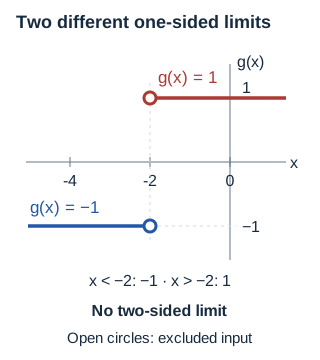
Text equivalent: g(x)=−1 when x<−2 and g(x)=1 when x>−2. Therefore the left limit is −1, the right limit is 1, and no two-sided limit exists.
Check your result
Use and : the outputs are and . The sign calculation establishes the whole branches, rather than just these two samples.
Diagnose the error
Cancelling with as if they were identical loses the negative branch. An absolute value is not the same expression on both sides.
3. Join the values, then compare the slopes
Explain the condition · 8 min suggested
Let be a real constant and define for every real by
Find the unique that makes continuous at . With that choice, is differentiable at ? Justify the second answer using the one-sided difference quotients.
Hint
Continuity requires the left limit, right limit and actual value to agree. After choosing , use with and .
Explained solution
Match values first. The left limit is . The right limit and are both . Thus continuity requires , giving .
Test the derivative separately. Now . For ,
For , the same difference quotient is . The one-sided derivative limits are and ; they do not agree. The continuous join has a corner, so is not differentiable at .
Check your result
With , both formulas meet at height . Equal heights check continuity; the unequal slopes explain why that check alone cannot prove differentiability.
Diagnose the error
If you concluded “continuous, therefore differentiable,” the implication is reversed. Differentiability implies continuity, but continuity alone does not force matching slopes.
4. Find a tangent slope from the definition
Choose the algebra yourself · 9 min suggested
Let , whose real domain is . Use the limit definition, without a derivative rule, to find . Then give the tangent line at .
Hint
Write . Multiply numerator and denominator by the conjugate . Keep until the limit is taken.
Explained solution
Start with the requested definition. Since ,
The increment is nonzero during simplification; values sufficiently close to zero also keep . Rationalizing gives
The last expression tends to . The tangent therefore has equation
Here is the vertical coordinate on the tangent line. Its slope describes the instantaneous change in the output per unit change in the input.
Check your result
The line passes through and has a positive slope, consistent with the square-root function increasing nearby.
Diagnose the error
Substituting before simplifying gives an indeterminate quotient, not the derivative. Another common error is changing into ; these are different expressions.
5. Name the first rule before differentiating
Plan without calculating · 6 min suggested
For each expression below, state the real domain, identify the outermost operation and name the first derivative rule. Identify any inner expression that will need the chain rule. Do not calculate the full derivatives yet.
Hint
Ask which operation finishes building the whole expression. A power, a product and a quotient require different first moves, even if more than one expression contains a composition.
Explained solution
- A: domain . The final operation raises to the fifth power. Start with the chain rule; the inner expression is , whose derivative is .
- B: domain . The final operation multiplies by . Start with the product rule. The sine has input , so no nontrivial inner factor is needed; the polynomial uses the sum and power rules.
- C: domain . In the displayed form, start with the quotient rule. Differentiating the numerator also requires the chain rule, with inner expression and derivative .
A valid alternative for C is to rewrite it as and use product plus chain rules. Your plan must fit the form you actually use and preserve .
Check your result
Name the two factors of B and the numerator and denominator of C aloud. If you cannot identify the whole pieces, pause before choosing a rule.
Diagnose the error
“There is a sine, so start with the sine derivative” misses the operation around that sine. Read the whole expression from the outside inward.
6. Repair a product rule error and check it
Diagnose and correct · 8 min suggested
Let , defined for every real . A student writes
Explain the first incorrect step, find the correct derivative, and compare both expressions at .
Hint
The student differentiated each factor correctly. The problem is how those factor derivatives were combined. Write first.
Explained solution
Select the rules in order. The whole function is a product. Set , . Then , while the chain rule gives . Multiplying by is not the product rule.
At , use and . The correct derivative is ; the student’s expression gives . The function and its derivative are defined for all real inputs.
Check your result
The first term retains the cosine; the second retains the polynomial. Each term changes one factor while keeping the other.
Diagnose the error
If your answer has only the product of the two derivatives, a whole contribution is missing. If it has rather than , the inner derivative was lost.
7. Differentiate a quotient without losing its restrictions
Independent calculation · 10 min suggested
Let . State its real domain. Choose and apply derivative rules to find , state where that derivative formula is valid, and find .
Hint
The square root requires , and the denominator requires . For the derivative, first write .
Explained solution
Record the domain before calculating. The function domain is . Use the quotient rule with and . The chain rule gives
On the open part of the domain,
The numerator is
Combine these two terms over . Their numerator is
Therefore
The function exists at , but this endpoint does not have an ordinary two-sided derivative, and the displayed derivative formula is undefined there. At ,
Check your result
For every allowed derivative input, and the denominator is positive, so the derivative is negative. The value is consistent with that sign check.
Diagnose the error
Watch three independent mistakes: reversing the quotient-rule subtraction, forgetting the inner factor , or giving the derivative the same endpoint as the original function. Write the two domains separately.
8. Find an implicit tangent and verify the point
Bring the methods together · 10 min suggested
The dimensionless coordinates and satisfy
Verify that lies on the curve. Treat locally as a differentiable function of , find , and state the condition needed to divide by its coefficient. Find the tangent line at . Finally, explain the error in differentiating as just .
Hint
Both factors in change with , because . Differentiate every term before substituting the point, then collect all terms containing .
Explained solution
Check the point. Substitution gives , so is on the curve.
Use product and chain rules. Write . Differentiating the relation with respect to gives
The product term contributes , and the square of contributes . Collecting the derivative terms,
At , the denominator is , so the slope is . The tangent line is
Differentiating as just incorrectly treats as constant and loses . The slope formula is local: it applies on portions of this curve that can be expressed as differentiable functions of , with the stated nonzero denominator.
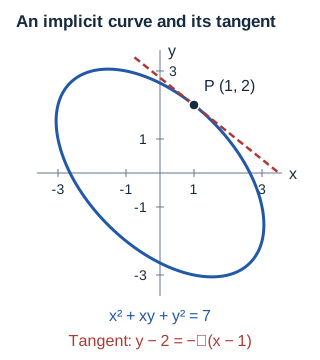
Text equivalent: the curve is x²+xy+y²=7. At P=(1,2), dy/dx=−4/5 and the tangent is y−2=−(4/5)(x−1). Coordinates are dimensionless.
Check your result
The line passes through . In the differentiated relation at that point, , so the computed slope also satisfies the derivative equation.
Diagnose the error
If you substitute before differentiating, the equation becomes the constant equality and loses all slope information. Differentiate first, substitute second.
Optional extension: apply derivatives to optimization
Questions 9–10 extend the original eight-question core. Choose them when optimization is part of your current topic list; they are not presented as part of the Concordia weeks 1–6 midterm scope described below.
- State the quantity to optimize and its allowed inputs.
- Find interior derivative candidates and include the interval’s endpoints.
- Compare values of the original quantity and interpret the result with units.
The functions in these two questions are continuous on closed, bounded intervals and differentiable in their interiors. Therefore a greatest and a least value exist, and the candidate list is complete after checking interior stationary points and both endpoints. For derivative-sign reasoning, revisit the existing first-derivative example.
9. Keep endpoints and every tied extremum
During a four-minute observation, a tank’s volume is modelled by litres, where is elapsed time measured in minutes and . The coefficients use these stated units. Find the smallest and largest volume attained and every time each is attained. Explain when the tank is filling or draining according to the model.
Before calculating, write the allowed time interval and decide which points a derivative-only search could miss.
Hint
Factor , then make a list containing its interior zeros and both endpoints. Compare volumes, not derivative values.
Explained solution
List the candidates. The rate is measured in litres per minute:
Its zeros in the interior are and . Add and , since the model includes both endpoints.
| Time (min) | Volume (L) |
|---|---|
| 0 | 20 |
| 1 | 24 |
| 3 | 20 |
| 4 | 24 |
Compare. The absolute minimum is 20 L, attained at 0 and 3 minutes. The absolute maximum is 24 L, attained at 1 and 4 minutes. Keep both times in each answer.
Interpret the signs. On , both derivative factors are negative, so the net volume rate is positive: the tank fills. On , the rate is negative: it drains. On , it fills again. A zero net rate at an instant does not mean the tank is empty.
Check your result
Substituting into the original model gives , , and . The sign intervals confirm the changes between candidates, and the volume stays between 20 and 24 L throughout the observation. Do not extend the model beyond its given interval.
Diagnose the error
Reporting only the stationary times misses the endpoint ties. Solving finds candidates; comparing on the complete candidate list establishes the absolute extrema.
10. Build a paper-area model before minimizing it
A rectangular printed region has area 96 cm². Its printed width must satisfy , with lengths measured in centimetres. Add a uniform 2 cm border on every side. Find the printed dimensions that minimize the total paper area, and give that minimum area.
Start by expressing the printed height and both outer dimensions in terms of . Explain why the border adds 4 cm to each dimension.
Hint
The printed height is cm. There is a border at both ends of each dimension. Compare the area at any allowed stationary width with the areas at 6 and 12 cm.
Explained solution
Build the model. The printed height is cm because width times height equals 96 cm². The outer width is cm and the outer height is cm. Let be total paper area in cm²:
Find the interior candidate.
The allowed width is cm, approximately 9.798 cm, which lies in the given interval. The negative square root is excluded by the positive width domain.
Compare the original areas.
The last value is approximately 190.384 cm², smaller than both endpoint values. The minimum therefore occurs at cm. The printed height is also cm. The full sheet is a square with side cm.
Check your result
The printed dimensions give cm². Adding two borders gives the stated outer dimensions. Squaring the outer side gives cm², matching the area model. Keep the exact value until rounding the final result.
Diagnose the error
Adding only 2 cm to each printed dimension accounts for only one of its two borders. Setting the derivative to zero without checking the width interval and endpoints also leaves the global minimum unproved.
Optional extension: Choosing when to use L’Hôpital’s rule
Practise deciding whether L’Hôpital’s rule applies before using it. These examples use exponential and logarithmic derivatives. Work on this section when those derivatives and L’Hôpital’s rule are among your current topics; you can study it separately from questions 1–8.
Start with the form, not the derivatives
L’Hôpital’s rule is a theorem about certain limits of quotients. It is not a rule for differentiating a quotient, and it does not apply to every quotient limit.
For a quotient , first ask:
- Can continuity, substitution, factoring, or a standard limit settle the problem?
- If not, does the quotient have the indeterminate form or ? Here “infinity over infinity” allows either function to tend to positive or negative infinity.
- Do the other hypotheses below hold?
A sufficient version of the rule
Consider a one-sided limit or , or a limit as or . Here is a finite real limit point. Let and be real-valued functions. On some interval approaching the limit point from the chosen side, excluding the limit point itself, require:
- and are differentiable;
- and throughout that interval;
- either both and tend to zero, or each tends to positive or negative infinity;
- the derivative-ratio limit exists, where may be a real number, , or .
Then for that approach. At an infinite endpoint, use a tail for , or for , where is a real cutoff. For a two-sided limit at a finite point, justify both sides; their limits must agree. The original functions need not be defined at the limit point.
These are sufficient hypotheses: if they fail, this version of the rule does not justify a conclusion. Another method may still establish the original limit. In particular, failure of the derivative ratio to have a limit does not by itself prove that the original quotient has no limit.
Worked example: Two applications, two checks
Evaluate
Substitution gives the form . On each punctured side of zero, the numerator and denominator are differentiable, , and the denominator derivative . The first derivative ratio is
Do not assume a second application is automatic. This new ratio again has form . Its numerator and denominator are differentiable on both sides of zero; its denominator there, and the derivative of that denominator is . The next derivative ratio has the limit
The second application therefore proves that from each side. That establishes the derivative-ratio limit needed for the first application, which then proves
Non-example: A quotient is not enough
For
direct substitution is valid because the denominator tends to . The answer is .
Blindly replacing the quotient by the ratio of derivatives would give . That answer is wrong: the original form is , not or , so L’Hôpital’s rule does not apply.
Try again: An infinite endpoint
Evaluate .
Hint
State the real domain of , identify the form, and check the denominator derivative before calculating a new limit.
Full solution
The real logarithm has domain . On the tail , both functions are differentiable, , and the denominator derivative is . Both and tend to , so the form is . The derivative ratio is
All the stated hypotheses hold, so the original limit is .
Method-choice check
For each problem, name the form and your first method before calculating. In Question 2, the angle is measured in radians.
.
Explained answer
; factoring gives for , hence . L’Hôpital’s rule is also available after its hypotheses are checked, but is unnecessary.
.
Explained answer
; use the standard limit . L’Hôpital’s rule is an alternative only once the derivative formula for sine has been established independently of this limit; otherwise the argument can be circular.
.
Explained answer
, not an indeterminate form; continuity gives . Do not apply L’Hôpital’s rule.
Use your first error to choose the next practice
- Questions 1–2: if you lost an excluded input or merged unequal limits, revisit cancellation, domains and limits, then redo the sign or domain step without looking.
- Questions 3–4: if you treated continuity as differentiability or substituted an increment too early, write the relevant limit definition before doing algebra. Redo the two-sided comparison or conjugate step, then explain why it is valid.
- Questions 5–7: if the first rule was wrong, revisit the polynomial chain-rule example to practise reading the outermost operation. The other questions in that lesson use exponential or logarithmic derivatives and are not assigned in this midterm-focused path.
- Question 8: if a factor of disappeared, review the changing variable inside the formula and the implicit-slope example. Stop before the time-dependent related-rates sections for this midterm-focused pass.
- Questions 9–10: if a candidate or endpoint was missed, list the allowed interval before differentiating and compare the original quantity at every candidate. Revisit derivative signs and extrema. If the model was wrong, label the dimensions or units first, then rebuild the objective.
On a fresh attempt, explain why your first move fits the expression, then check the domain and the result. Choose a new problem from your instructor’s assigned practice once you can reproduce the method unaided. Finishing the core or its optional extension is a diagnostic, not evidence that every exam topic is secure.
Use a tutoring session to repair the step you missed
Bring a problem you’re stuck on or a concept you’d like to understand better. If you have a course outline, it can help choose the topics to work on. A tutor can ask you to identify the outermost operation before calculating, compare your one-sided limits, check where a domain restriction disappeared, and watch you redo an implicit derivative with every factor visible. For the optional optimization questions, you can build the model together and check the candidate list against the physical domain. The next practice can target that specific error rather than repeat a solution you already remember. For course topics and individual help, see Concordia MATH 203 tutoring.
Course topics and exam information
Concordia Fall 2026: scope and assessment arrangements
The Concordia MATH 203 Fall 2026 outline lists reading week as October 10–16 and a common MATH 203 midterm on Sunday, November 1, 2026, starting at 17:30 and lasting 90 minutes, ending at 19:00. Its stated coverage is weeks 1–6, including the chain rule and implicit differentiation. Check Moodle and your instructor’s announcements for current arrangements.
Questions 1–8 focus on selected skills from weeks 1–6. Questions 9–10 are a separate optional optimization extension; choose them according to your current course outline, not as part of this midterm-focused core. It does not assess every prerequisite, graph transformation, limit at infinity or asymptote topic in those weeks. Related rates are listed in week 8 and are outside this midterm practice core. Derivatives of logarithmic and inverse functions are listed in week 7 and are also not assessed in questions 1–8. The optional L’Hôpital extension is separate from this early-midterm practice core.
MATH 209 has its own outline and assessment. For McGill MATH 140, choose questions that match your current course outline.
Course outline
See the Concordia MATH 203 Fall 2026 outline for the exam schedule and weekly topics. Confirm any updates in Moodle or with your instructor. These are original Nablio practice questions.
Ready to practise without hints? For Concordia MATH 203, try the nine-question midterm practice mock, with a question-only paper and separate explained solutions.
Useful for
Concordia MATH 203: limits, continuity and derivatives. Also useful for overlapping topics in McGill MATH 140.
Work on the step you’re missing.
Tell us the subject and your preferred time. Nablio confirms the details by text or email.
Request a lesson