9 multi-part questions • 100 illustrative marks • Suggested practice time: 90 minutes
This practice paper covers selected topics from weeks 1–6 of Concordia MATH 203 in Fall 2026.
- Work without the solutions or lesson links on your first attempt. Use separate paper and show your reasoning. Give exact answers unless the question says otherwise.
- For a timed attempt, allow about 90 minutes: 82 minutes to work and 8 minutes to check your answers. You can also try the questions without a time limit first.
- All variables and coordinates are real and dimensionless except the position/time quantities in question 7. Angles are in radians. A square root is the nonnegative real root; is the natural logarithm; is its exponential base.
- A prime denotes differentiation with respect to the function’s input. Ordinary derivatives in this paper are two-sided unless stated otherwise. denotes the real numbers; a square interval bracket includes its endpoint and a round bracket excludes it.
- The questions can be answered exactly without a calculator. For the actual assessment, follow the course’s current calculator and other exam rules.
The official outline lists a 90-minute common midterm on November 1, 2026, starting at 17:30, with weeks 1–6 coverage. Its calculated end time is 19:00. Check Moodle and your instructor’s latest announcements for current arrangements. Source: Fall 2026 outline, page 2.
Question paper
1. Transform and compose
10 marksLet , for , and define wherever the expression is real.
- (a) State the domain and range of . [4 marks]
- (b) The graph of contains , and . Give the corresponding three points on the transformed graph of , in the same order. [3 marks]
- (c) Write a formula for and state its real domain. [3 marks]
2. Invert and solve
10 marksLet for all real .
- (a) State the range of , and justify without differentiation why is one-to-one. [2 marks]
- (b) Find a formula for the inverse function . State its domain and range. [5 marks]
- (c) Solve over the real numbers. Include the restrictions on . [3 marks]
3. Read trigonometric structure
8 marksLet for all real . Angles are in radians.
- (a) State the amplitude, period and horizontal shift relative to . [3 marks]
- (b) Find every solution of in the closed interval . Give exact values. [5 marks]
4. Read a graph
12 marksThe graph below defines on . Every drawn branch is a straight line segment. A filled dot belongs to the graph; an open circle does not. Both coordinate axes are dimensionless and use the same scale.
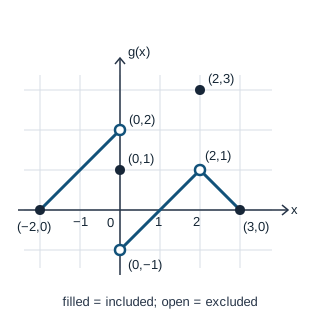
Text equivalent: one segment runs from the filled point to the open point ; a second runs from the open point to the open point ; a third runs from the open point to the filled point . There are also separate filled points at and . There are no other points or branches.
- (a) Find , and . Does exist? Justify. [4 marks]
- (b) Find and . Is continuous at 2? Justify. [4 marks]
- (c) A new function agrees with everywhere except possibly at . Can any choice of its value at 2 make it differentiable there? Justify. [4 marks]
5. Limits and asymptotes
14 marksEvaluate the following limits or identify the requested features. Show the algebra or limit reasoning that supports each result.
- (a) The expression is considered on its real domain. [3 marks]
- (b) [3 marks]
- (c) For , state the real domain and find every vertical and horizontal asymptote. Give both one-sided limits at every vertical asymptote. Classify any remaining excluded input, including the limiting height there. [8 marks]
6. Two claims about zeros
8 marksGive a complete justification for each conclusion. A decimal approximation alone is not a justification.
- (a) Prove that has at least one solution in , without calculating an approximate root. [4 marks]
- (b) Let , for . A student states: “Since , there must be a zero of in .” Is the claim true? Identify the condition missing from the argument and settle whether has such a zero. [4 marks]
7. Position and rate
12 marksA particle moves along a straight track. Its signed position , in metres, is modeled by
where is the numerical time in seconds and the formula returns the numerical position in metres. Increasing is the positive direction along the track. In this question, an increment is a change in time measured in seconds.
- (a) Find the average velocity from to seconds. Include units. [3 marks]
- (b) Use the limit definition of the derivative to find the instantaneous velocity at . Derivative rules alone do not meet this part’s requirement. Show your difference quotient and its simplification. [6 marks]
- (c) Give the tangent line to the position–time graph at . Let denote its numerical vertical coordinate in metres. Explain the meaning and sign of the tangent slope, including its units. [3 marks]
8. Differentiate three functions
14 marksFor each function below, find the derivative and show the rule steps. State both the real domain of the original function and the domain of its ordinary two-sided derivative. An equivalent unsimplified derivative is acceptable.
- (a) [5 marks]
- (b) [5 marks]
- (c) [4 marks]
9. An implicit curve
12 marksThe dimensionless coordinates satisfy
- (a) Verify that lies on the curve. Treat locally as a differentiable function of , derive , and explain whether its denominator can vanish at a point on this curve. [6 marks]
- (b) Find the tangent line at . [3 marks]
- (c) Find every point on the curve with a horizontal tangent. Justify that your list is exhaustive. [3 marks]
MATH 203 Mock: Marking Guide and Explained Solutions
Illustrative total: 100 marks. Use this suggested marking guide to check your work. Accept mathematically equivalent methods unless a question requires a specific method. Give points for correct reasoning, and count a carried arithmetic error only once when later reasoning is valid. Use the mistakes you find to choose what to practise next.
Compare the earliest incorrect or unjustified step in each answer before reading its next-step link. An answer reconstructed from the solution is not yet an unaided result.
1. Transform and compose
(a) The square-root input must satisfy . Thus the domain is . The square root can take every nonnegative value, so takes every value at most 1. The range is ; the maximum 1 occurs at .
(b) If lies on the base graph, set . Then and the new height is . The coordinate map is
The three images are , and . Substituting their first coordinates into verifies their heights.
(c) Substitute into the entire input slot:
The requirement is equivalent to . Both endpoints are included because the square root of zero exists.
Illustrative marking · 10 marks
- (a) Domain with inequality justification: 2 marks. Range with endpoint justification: 2 marks.
- (b) Each correctly mapped point: 1 mark (3 total).
- (c) Composition formula: 1 mark. Domain inequality and correct closed interval: 2 marks.
Repair the first error
If you changed an output instead of the input, review functions, composition and domains. Redo the coordinate map using an arbitrary base point before retrying the three points. For more transformations, use your assigned section 1.2 practice.
2. Invert and solve
(a) Since ranges over , ranges over . The upper bound 3 is never attained. If , then ; multiplying by reverses the inequality. Hence , which proves that is strictly increasing and one-to-one without a derivative.
(b) Solve for :
After exchanging the input/output names,
Its domain is , the range of . Its range is , the domain of . The logarithm argument is positive precisely when .
(c) Both logarithm arguments must be positive: and , so . On this domain the product rule for logarithms gives
The logarithm is one-to-one on positive inputs, so . Thus , which satisfies the restrictions. At that input both sides equal .
Illustrative marking · 10 marks
- (a) Correct open range: 1 mark. Valid one-to-one argument: 1 mark.
- (b) Inverse algebra: 3 marks. Inverse domain: 1 mark. Inverse range: 1 mark.
- (c) Both restrictions: 1 mark. Valid logarithm manipulation: 1 mark. Admissible solution and check: 1 mark.
Repair the first error
If the inverse became a reciprocal or a logarithm rule was invented, revisit exponentials and logarithms. Rebuild the inverse by solving for the original input, then check one composition. Keep inverse-function algebra separate from later inverse-function differentiation.
3. Read trigonometric structure
(a) Write the argument as . The amplitude is 2, the period is , and the horizontal shift is to the right.
(b) The equation is . Set . The required input interval becomes
All angles in this interval with cosine are , and . Solving gives
Both interval endpoints are solutions and must be retained. The general-angle form , with integer , followed by interval filtering is equally valid.
Illustrative marking · 8 marks
- (a) Amplitude, period and correctly directed shift: 1 mark each (3 total).
- (b) Cosine equation: 1 mark. Correct transformed interval or equivalent filtering: 1 mark. Each of the three solutions: 1 mark.
Repair the first error
If a quadrant or endpoint was lost, revisit radians and familiar angles. List the allowed angle interval before converting back to x. The linked lesson repairs angle basics; use your assigned section 1.3 exercises for further periodic-function work.
4. Read a graph
(a) The filled point on the vertical line is , so . The branch on the left approaches height 2, while the branch on the right approaches height :
Because the one-sided limits differ, the two-sided limit does not exist. The isolated value 1 changes neither limit.
(b) Both adjacent segments approach , so the two-sided limit is 1. The actual filled point is , hence . Since the limit and value differ, is not continuous at 2.
(c) Differentiability would require continuity, so the only possible replacement value is 1. With that value the new function is continuous at 2, but its left and right derivative limits are the slopes of its straight segments:
The slopes disagree, giving a corner. Thus no choice of the single value at 2 makes the function differentiable there: every other choice already fails continuity.
Illustrative marking · 12 marks
- (a) Function value, left limit and right limit: 1 mark each. Justified nonexistence of the two-sided limit: 1 mark.
- (b) Agreement of both sides and limit: 2 marks. Function value: 1 mark. Continuity comparison: 1 mark.
- (c) Continuity requires replacement value 1: 1 mark. Each exact slope: 1 mark. Conclusion covering every possible replacement: 1 mark.
Repair the first error
If filled and open points were confused, review nearby limits versus point values. If matching values seemed to guarantee a derivative, redo the short-pack continuity/derivative comparison before revisiting the two straight-segment slopes here.
5. Limits and asymptotes
(a) The expression requires and . For nonzero inputs close to 0, multiply by the conjugate:
The cancellation uses . The simplified expression tends to . The initial form is indeterminate; it is not the limit.
(b) Factor inside the root, keeping . For negative , , so
As , the numerator tends to and the denominator to 1. The limit is . The sign is consistent with a positive numerator and a negative denominator for large negative inputs.
(c) Factoring gives
The original domain is . On that domain,
Near 2 the numerator of the reduced fraction is positive. The denominator approaches zero from the negative side on the left and the positive side on the right:
Thus is the only vertical asymptote. At the other excluded input,
There is a removable discontinuity (a hole) at , not a vertical asymptote. Finally, at both positive and negative infinity, so is the horizontal asymptote in both directions. No other denominator zeros or infinite-end limits can add further vertical or horizontal asymptotes.
Illustrative marking · 14 marks
- (a) Valid conjugate algebra: 1 mark. Cancellation valid for nonzero x: 1 mark. Limit: 1 mark.
- (b) Absolute value and negative-x handling: 1 mark. Normalized quotient: 1 mark. Limit: 1 mark.
- (c) Domain with both exclusions and valid reduction: 2 marks. Vertical asymptote: 1 mark. Each signed one-sided limit: 1 mark. Hole and its height: 1 mark. Horizontal asymptote justified in both directions: 2 marks.
Repair the first error
If part (b) became positive, revisit radicals and absolute values and state the sign of x before simplifying. If a cancelled denominator became an asymptote, review the original domain and compare a finite hole limit with an infinite one-sided limit. Use assigned section 2.6 problems for more infinity/asymptote practice.
6. Two claims about zeros
(a) Define . As a polynomial, is continuous on the whole closed interval . Its endpoint values are
Zero lies strictly between those values. By the intermediate value theorem, there is at least one for which . This argument establishes existence; it does not by itself establish uniqueness.
(b) The endpoint values are indeed and . However, the intermediate value theorem requires continuity on the entire closed interval . The function is undefined at 1, so that condition fails.
A failed theorem condition alone would not prove that no zero exists. Here we can settle the question directly: is impossible for every permitted input, since its numerator is the nonzero constant 1. Therefore the claim is false and has no zero in , or anywhere else in its domain.
Illustrative marking · 8 marks
- (a) Continuity on the full closed interval: 1 mark. Endpoint values: 1 mark. Correct intermediate value theorem application: 1 mark. Open-interval existence conclusion: 1 mark.
- (b) Identifies missing whole-interval continuity and the obstruction at x = 1: 2 marks. Directly proves no zero exists: 1 mark. Clear false-claim conclusion: 1 mark.
Repair the first error
If endpoint signs seemed sufficient, write all intermediate value theorem hypotheses before using them. Review matching a limit to an assigned value for continuity at a point, then check continuity at every input of the required interval. The linked lesson is a continuity refresher; use section 2.5 of your course materials for the theorem itself.
7. Position and rate
(a) The endpoint positions are m and m. The average velocity is
This compares a change in position with a change in time; it is not an average of the two positions.
(b) Use nonzero time increments close to 0. Both positive and negative increments are allowed near , while keeping . Since , the numerical difference quotient is
Combining the numerator over its common denominator gives
Taking the limit gives
The cancellation precedes the limit; setting in the original quotient would produce the indeterminate form .
(c) The point on the graph is , with time in seconds and position in metres. The tangent line is
Its slope is the instantaneous velocity, metre per second. Its positive sign means the particle is moving in the chosen positive direction at that instant. The slope is a rate, not the position 3 m. It need not equal the average velocity over the earlier two seconds.
Illustrative marking · 12 marks
- (a) Endpoint positions: 1 mark. Difference-of-positions quotient: 1 mark. Result with units: 1 mark.
- (b) Correct defining limit and substitution: 2 marks. Common-denominator algebra: 2 marks. Legitimate cancellation for nonzero h: 1 mark. Limit with velocity units: 1 mark. A derivative-rule-only calculation earns no method marks for this part.
- (c) Line through the correct point with the correct slope: 2 marks. Positive-direction rate interpretation with units: 1 mark.
Repair the first error
If the numerator was an average of positions, revisit average rate versus average output. If the substitution or algebra failed, review algebraic inputs to a function and common denominators. Rebuild the quotient with units before taking its limit.
8. Differentiate three functions
(a) The two factors are and . The product rule gives . Apply the chain rule within each factor:
The base-e exponential keeps its form when differentiated, then gains the inner derivative . The sine gains the inner derivative 3. Substituting both contributions gives one derivative:
Equivalently,
The function and its derivative are defined for every real input, so both domains are .
(b) For the numerator and denominator , the quotient rule gives
Here and , so
An equivalent simplified numerator is . Because for every real , both domains are .
(c) The original function requires , giving the closed domain . At interior inputs the chain rule gives
This formula is defined for . The endpoints belong to the original function’s domain, but not to the domain of its ordinary two-sided derivative. Thus the derivative domain is .
Illustrative marking · 14 marks
- (a) Both product-rule contributions: 2 marks. Base-e and sine derivatives with both inner factors and correct signs: 2 marks. Both domains: 1 mark.
- (b) Quotient structure with correct subtraction and squared denominator: 2 marks. Numerator and denominator derivatives: 2 marks. Both domains with nonzero-denominator reason: 1 mark.
- (c) Chain-rule derivative: 2 marks. Original closed domain: 1 mark. Derivative open domain: 1 mark.
Repair the first error
If the outer rule or an inner factor was lost, revisit the polynomial chain-rule explanation. For product and quotient repair using this cutoff, use short-pack question 6 and question 7. Write separate lines for the function domain and derivative domain, then redo part (c).
9. An implicit curve
(a) At , , so the point belongs. Write and differentiate before substituting the point:
The product contributes both and . The chain rule supplies when differentiating . Collecting gives
For real coordinates, is zero only at . That point does not satisfy the curve equation. Thus the denominator is strictly positive at every point on this curve, so this division loses no curve points.
(b) At , the slope is
The tangent line is
It passes through ; its slope also satisfies the differentiated equation at that point.
(c) A horizontal tangent requires . The denominator is nonzero, so . Consider both possibilities. If , the original equation becomes , which is impossible. If , the original equation gives , hence .
Therefore the only point is . Its derivative denominator is , and its numerator is zero, confirming a horizontal tangent. Both cases of have been checked.
Illustrative marking · 12 marks
- (a) Point verification: 1 mark. Full differentiated equation: 3 marks. Collecting and solving for the derivative: 1 mark. Denominator argument: 1 mark.
- (b) Correct slope: 2 marks. Correct tangent line: 1 mark.
- (c) Zero-slope condition: 1 mark. Both cases checked against the original curve: 1 mark. Sole valid point with nonzero denominator: 1 mark.
Repair the first error
If a changing y was treated as a constant, revisit the changing variable inside a formula and the implicit-slope example. Stop before the later time-dependent related-rates material for this paper. On a retry, mark every y′ contribution before collecting, and test candidate points in the original curve.
Use the result to choose your next work
- For each lost mark, record the first reason: missing domain, wrong graph value, missing theorem condition, wrong first derivative rule, algebra/sign error, or unclear units.
- Repair one or two recurring errors using the specific links under the solutions. Where the linked lesson only refreshes a prerequisite, continue with the named section of your assigned course practice.
- Close the worked solution and redo the failed reasoning on a fresh page. Then choose a different assigned problem testing that skill; remembering this paper’s answer is not enough.
- Return to mixed, unaided practice after the method is reliable. If time ran out, distinguish slow algebra from an unknown concept rather than treating the total alone as your readiness level.
For more guided work, return to the eight-question limits-and-derivatives core or the MATH 203 study path.
Topics covered
The paper samples functions and transformations, elementary trigonometric/exponential/inverse/logarithmic functions, rates and tangents, limits including one-sided and infinite-end behaviour, continuity, derivative definitions, and differentiation through the product, quotient, chain and implicit rules. A single paper cannot assess every possible skill in these topics.
The official sequence places derivatives of inverse/logarithmic functions and inverse trigonometric functions in week 7, and related rates and linearization in week 8. Those later topics are not part of this paper. Base-e exponential differentiation is included with the product and chain rules. Confirm any additional rules in your instructor’s assigned work.
Course outline: Fall 2026 weekly topics, page 3, and later topics, page 4.
Useful for
Work on the step you’re missing.
Tell us the subject and your preferred time. Nablio confirms the details by text or email.
Request a lesson