Work on geometry foundations with a tutor
Choose perimeter or area
A border and a surface need different measurements. Perimeter is the total length around a region’s boundary. Area measures how much flat surface the region covers. A circle’s perimeter is called its circumference. Strictly, a circle is the boundary and a disk is the filled region inside it; “area of a circle” usually means the area of that disk.
For a circular sign, the edging needs a length in centimetres, while a covering needs an area in square centimetres. Before calculating, name the quantity, trace the boundary or shade the region, and label the dimensions. This lesson assumes basic multiplication, fractions and square roots. All dimensions are positive. The examples and questions are original practice, not a particular course’s exam or grade-level checklist.
Keep answers involving exact unless an approximation is requested. When a decimal approximation is shown below, it is rounded to two decimal places using the calculator’s value of , not an early approximation of 3.14. Diagrams are labelled sketches, not a substitute for the given measurements.
1. Radius, diameter and a full circle
The radius runs from the centre to the circle. The diameter goes from one side to the other through the centre, so and . The number is the constant ratio of a circle’s circumference to its diameter.
Circumference has one length factor; area has two. In , square the radius, not . Doubling the radius doubles circumference but multiplies area by four.
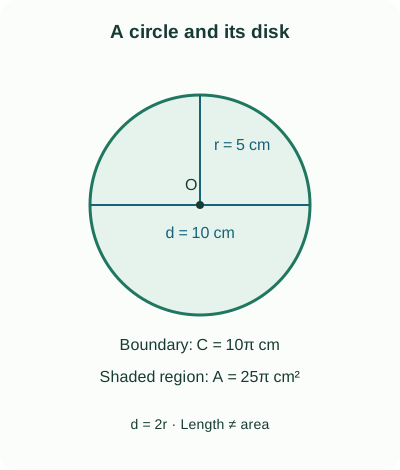
Worked example 1: a circular sign
A circular sign has diameter 10 cm. Find its circumference and area.
- The radius is cm.
- Its circumference is cm, approximately 31.42 cm.
- Its area is cm², approximately 78.54 cm².
Check: using the diameter in would give cm², four times the correct area. Label the given measurement before substituting.
2. A semicircle has a curved and a straight boundary
A semicircle is half a circle. Its curved arc has half the full circumference, . But the boundary of a filled semicircle also includes the diameter, . If a question asks only for the curved arc, do not add the diameter; if it asks for the whole perimeter, include it.
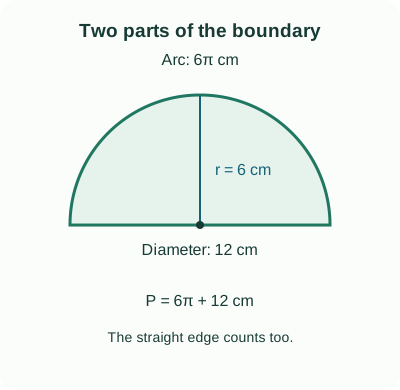
Worked example 2: the entire edge of a semicircular panel
A semicircular panel has diameter 12 cm, so its radius is 6 cm.
- Curved arc only: cm, approximately 18.85 cm.
- Entire perimeter: cm, approximately 30.85 cm.
- Area: cm², approximately 56.55 cm².
Check: half the full circumference gives the arc, not the entire perimeter. Trace the curve and then the straight edge back to your starting point.
3. Join a rectangle and a semicircle
A composite figure can be split into familiar shapes. To find area, add the areas of pieces whose interiors do not overlap. To find perimeter, trace only the outside boundary. A shared join inside the figure is not an outside edge.
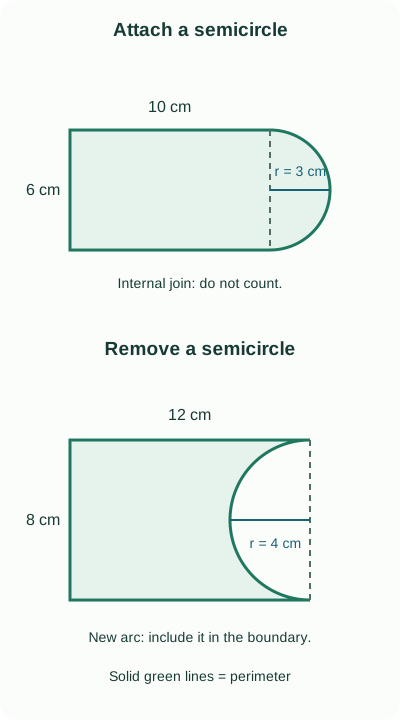
Worked example 3: a rounded end
A rectangle is 10 cm long and 6 cm wide. A semicircle is attached outside it along the entire 6 cm side, with that side as its diameter. The two interiors do not overlap.
- The semicircle’s radius is cm.
- Add areas: cm², approximately 74.14 cm².
- Trace the outside: two 10 cm sides, the other 6 cm side and the curved arc. Thus cm, approximately 35.42 cm.
Check: the dashed 6 cm join is inside the shape. Adding the complete rectangle and semicircle perimeters counts that join twice. If you use that method, subtract cm.
4. Remove a semicircular piece
Removing a region subtracts area. It does not mean that every boundary length is subtracted. A cut can create a new exposed edge.
Worked example 4: a semicircular notch
A rectangle is 12 cm long and 8 cm wide. A semicircular notch is cut inward from one entire 8 cm side. That side is the semicircle’s diameter; the notch lies inside the rectangle and does not reach the opposite side.
- The removed semicircle has radius cm.
- Subtract areas: cm², approximately 70.87 cm².
- The boundary now has two 12 cm sides, the other 8 cm side, and the inward curved arc: cm, approximately 44.57 cm.
Check: the original perimeter was 40 cm. We removed an 8 cm straight edge but added a cm curved edge: . Here the area decreases while the perimeter increases. A smaller area does not guarantee a smaller perimeter.
For a cutout spanning only part of a side, keep the straight portions that remain. These examples have a notch open to the outside, not a completely enclosed hole; a question with a hole must state whether it wants the outer perimeter or all boundary lengths.
5. Check units and recover a radius
Convert lengths before calculating
Use one length unit throughout a calculation. Since 1 m is 100 cm, 1 m² is cm². Dividing a square-centimetre area by 100 would use the wrong conversion factor. You can convert the radius to metres before calculating, or convert the finished area by 10 000; the two methods agree.
Work backward from the quantity you know
If the full circumference is given, divide by . If the disk’s area is given, divide by and take the positive square root:
A radius is positive. The negative algebraic root does not represent a length. Check by substituting the recovered radius into the original formula. These inverse formulas are for a complete circle and disk; do not use the full-circle circumference formula for the whole perimeter of a semicircle.
Before finishing: did you halve a given diameter, count only the requested boundary, square the radius for area, and include the correct unit? Keep and square roots until the last step to avoid unnecessary rounding error.
Eight progressive practice questions
Questions 1–2 practise the measurements, 3–5 test boundary tracing, and 6–8 combine units or inverse reasoning. Try a question before opening its hint or full solution. Give exact answers in terms of , except where a decimal is also requested.
1. Identify the measurement
A disk has radius 3.5 cm. Find its diameter, circumference and area.
Hint 1
The diameter is twice the radius. Circumference uses one radius factor; area uses its square.
Worked solution 1
cm. Thus cm and cm². Check that only the area uses squared units.
If your answer differs: If you used for the area, relabel 7 cm as the diameter and return to the 3.5 cm radius.
2. Start from a diameter
A circular mat has diameter 18 cm. Find the length around it and the area it covers.
Hint 2
Find the radius before using the area formula.
Worked solution 2
cm. The length around it is cm and the covered area is cm². You may use the diameter directly in , but not as the radius in .
If your answer differs: If your area is cm², halve the diameter before squaring.
3. Count a whole semicircle boundary
A semicircular tile has radius 5 cm. Find its curved arc length, entire perimeter and area.
Hint 3
The perimeter includes the 10 cm diameter as well as the arc.
Worked solution 3
The arc is cm. The entire perimeter is cm. The area is cm². Arc length and perimeter differ by the diameter, 10 cm.
If your answer differs: If your arc and perimeter are equal, trace the straight edge that closes the region.
4. Add a rounded end
A 9 cm by 4 cm rectangle has a semicircle attached outside along one entire 4 cm side. Find the combined area and outside perimeter.
Hint 4
The shared diameter is 4 cm, so the radius is 2 cm. Do not count the shared join.
Worked solution 4
cm². The outside boundary is , so cm. Check by adding the two separate perimeters and subtracting the shared 4 cm edge twice.
If your answer differs: If your straight-edge total is 30 cm, you have counted the internal diameter twice; remove 8 cm.
5. Remove a notch, not its curved edge
A 14 cm by 10 cm rectangle has a semicircular notch cut inward from one entire 10 cm side. The notch lies inside the rectangle. Find the remaining area and perimeter.
Hint 5
Subtract a semicircle’s area. For the perimeter, replace the 10 cm side by the new arc.
Worked solution 5
cm. The area is cm². The boundary is cm. Equivalently, start with perimeter 48 cm, remove 10 cm and add cm.
If your answer differs: If you subtracted the arc, trace the curved edge of the remaining material: it is now exposed and must be added.
6. Keep length and area units separate
A disk has radius 25 cm. Find its circumference in metres and its area in square metres. Check the area by first calculating in square centimetres.
Hint 6
Convert 25 cm to 0.25 m. For the area check, divide cm² by 10 000, not by 100.
Worked solution 6
m. The area is m². In centimetres, cm²; dividing by 10 000 gives m² again.
If your answer differs: If your area is m², you converted with a length factor. A square metre contains 10 000 square centimetres.
7. Recover a radius from circumference
A complete circle has circumference cm. Find its radius and the area of its disk.
Hint 7
Divide the circumference by , then use the resulting radius for area.
Worked solution 7
cm. Hence cm². Check: cm, the given circumference.
If your answer differs: If your radius is 18 cm, dividing by alone found the diameter. Divide that diameter by two.
8. Recover a radius from area
A disk has area cm². Find the exact radius, diameter and circumference, then round the circumference to two decimal places.
Hint 8
First find , then take its positive square root. Keep the root exact until the last step.
Worked solution 8
, so cm. Thus cm and cm, approximately 53.31 cm. Check: cm². The positive root is required because a radius is a length.
If your answer differs: If you got a radius of 72 cm, you stopped at . Take a square root and square your result to check it.
Choose your next step
- Review angles, similarity and how lengths and areas scale
- Practise rearranging a formula
- Return to the foundations lessons
If a boundary or formula still feels unclear, start with that question in a tutoring session. Share your topic and level so support and availability can be confirmed before booking. Tutoring is currently offered in English.
Useful for
Work on the step you’re missing.
Tell us the subject and your preferred time. Nablio confirms the details by text or email.
Request a lesson