Stuck on a step? Text us Email us Request a lesson
A complex number can be described by a point or by a distance and an angle. Switching between those descriptions helps you multiply, take powers and find every root without losing a sign.
By the end, you should be able to choose the correct quadrant, convert between Cartesian and polar forms, check a power in two ways, and list all the roots of a nonzero complex number. You need algebraic expansion, square roots and basic sine and cosine. All angles here are in radians.
The examples and questions are original practice. Concordia’s MATH 202 description lists Cartesian and polar forms among possible topics; check your section’s outline. ENGR 213 explicitly includes complex numbers, powers and roots. This lesson covers that shared topic, not either whole course.
1. Read the point before choosing the angle
Write , where and are real numbers and . This is Cartesian form. The real part is ; the imaginary part is the real number , not . Plot at : horizontal real axis, vertical imaginary axis.
The modulus is the distance from the origin. For , an argument is an angle from the positive real axis to the point, positive counterclockwise. Then
This is polar form. We sometimes write to save space. Euler’s notation means the same expression for real ; you do not need it for the calculations below.
Adding any whole number of turns gives the same point. All arguments are , where is any integer. In this lesson the principal argument is the one in . A course may use another interval; follow the stated convention.
For , the modulus is zero and there is no defined argument. Although for any angle, none is a direction of the origin.
2. Worked example: why the quadrant matters
Convert to polar form.
Find the length
, , so .
Locate the point
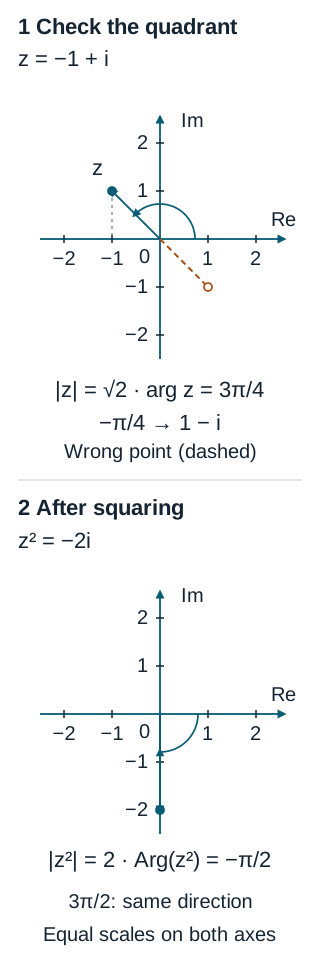
The point is in quadrant II. Its reference angle, the acute angle to the nearest real-axis direction, is . Measured counterclockwise from the positive real axis, the angle is .
Write and check
Reconstruct the coordinates: and . Both match.
A calculator may give . But that angle has positive cosine and negative sine: it points to quadrant IV and produces . It is not an argument of . In contrast, is an argument because it differs from by one full turn.
Quick check: What is the principal argument of ? Its point lies straight down the imaginary axis, so the answer is . The angle describes the same direction, but is outside our principal interval.
3. Multiply lengths and add angles
For nonzero numbers and , with positive moduli and real arguments , the sine and cosine addition formulas give
Multiplication scales the length and turns the direction. For a positive integer , repeating that multiplication gives De Moivre’s formula:
You multiply the angle by , and raise the modulus to the power . You may subtract whole turns from the resulting angle.
Check the same square in two forms
For , Cartesian expansion gives
Polar form gives
The new modulus is , and the new point is directly below the origin. Both methods agree. Squaring the two terms separately would miss the middle term .
For addition and subtraction, Cartesian form is usually simpler: combine real parts and imaginary parts separately. The add-the-angles rule is a multiplication rule.
4. Find every root
Suppose you want every complex number satisfying , where is a positive integer and . Write , with positive modulus and argument . Comparing lengths gives , so , the positive real nth root of . Comparing angles gives . Thus
The subscript labels the different roots. They lie on a circle of radius , with neighbouring angles separated by . These choices are distinct; increasing by adds a full turn and repeats a root. Dividing only one argument by usually finds just one root. If , the only distinct root is .
Worked example: solve
Use . Each root has modulus . The three angles are , and , from . Therefore
Each cube has modulus ; its angle is an odd multiple of , so each cube is . An independent Cartesian check for the first root gives , then . The other nonreal root is its conjugate, obtained by reversing the imaginary sign; its cube is also . Finally .
5. Try it, check it, try again
Write your attempt before opening an answer. If a result looks wrong, first check the quadrant, then the modulus, then the number of distinct roots.
1. Convert a new point
Find the modulus and principal argument of , and write its polar form.
Hint
Both coordinates are negative. Use the reference angle , then choose an angle in .
Explained answer
The modulus is . Quadrant III gives an argument ; subtracting gives the principal argument . Thus . Its cosine and sine reconstruct and .
2. Use a power, then check it
Compute using polar form. Check by squaring twice.
Hint
The modulus of is , and its argument is .
Explained answer
. Independently, , and .
3. Recover both square roots
Solve . Give both answers in Cartesian form.
Hint
Use modulus , argument , and .
Explained answer
The root modulus is ; the angles are and . The roots are and . Squaring either gives . A square-root equation asks for both roots; a principal-square-root convention selects just one.
4. Find four distinct roots
Solve . List the roots and explain why adding gives no new answer.
Hint
Use , , and . The roots have modulus , not .
Explained answer
The angles are . The roots are , , , and . Each fourth power has modulus and angle equivalent to , hence equals . At the angle is , one full turn past the first root.
5. Retry with a rotated target
Without copying the previous angles, solve . Predict the root spacing before calculating, then check one root in Cartesian form.
Hint
The target has argument . Divide by .
Explained answer
The spacing is . The root modulus is , with angles . Thus the roots are , , and . For the last root, . Tripling each listed angle also gives plus a whole number of turns.
6. Choose your next step
If angles are the sticking point, sketch the real and imaginary signs before calculating. If roots are the sticking point, write the full family before dividing. A good final check asks: correct modulus, correct direction, and enough distinct answers?
For course context, see MATH 202 support or ENGR 213 support. For a different algebra topic, try finite sums and induction; for algebra preparation, revisit algebra skills before calculus.
If you would like help, bring an attempt and your current course outline to a tutoring session. We can work through where the quadrant or root count became unclear, then use a fresh practice question to check your understanding. Request tutoring.
Useful for
Work on the step you’re missing.
Tell us the subject and your preferred time. Nablio confirms the details by text or email.
Request a lesson