Stuck on a step? Text us Email us Request a lesson
For course topics and one-to-one help, see Concordia MATH 205 tutoring.
An integral can have an infinite interval and still give a finite answer. It can also have finite bounds and fail to exist. The deciding question is whether the relevant limits of ordinary definite integrals exist as finite real numbers.
This lesson builds the definition before using shortcuts. You will learn to locate every improper point, set up separate one-sided limits, use power functions and comparisons, and explain a conclusion. Be comfortable with basic antiderivatives and one-sided limits; the integration-methods guide can help with the calculations.
All examples and practice are original Nablio teaching material. Improper integrals are listed in the current description of Concordia MATH 205. This independent guide does not establish any particular section’s assessment coverage; use your instructor’s current outline.
1. What makes an integral improper?
The definite integral of a continuous function on a closed, bounded interval is ordinary, or proper. Two situations require a limiting definition here:
- An infinite bound: the interval continues without end.
- An unbounded integrand: near an endpoint or an interior point, the function being integrated can take values as large in absolute value as you like. Such a point is called a singularity here.
A missing value by itself does not force divergence. For example, a removable hole can be filled without changing an integral. A bounded jump can also be integrable in the ordinary sense. First inspect the domain and the behaviour near each excluded point.
For a right-infinite interval, assume that is continuous on every finite interval . The definition is
The symbol is not a number to substitute into an antiderivative. Evaluate the definite integral for finite , then take a limit. For a left-infinite interval, use a separate finite lower bound:
The improper integral converges if its defining limit is a finite real number. It diverges otherwise. A limit of or is divergence, and a limit that fails to exist because of oscillation is also divergence. For instance, the truncated integral equals , which has no limit as .
2. An infinite interval, a finite limit
Worked example: how much area remains?
Determine whether converges. For , define the accumulated area :
Now take the limit:
Thus the improper integral converges to . The curve stays positive forever, but the additional area becomes small enough for the total to approach a finite value.
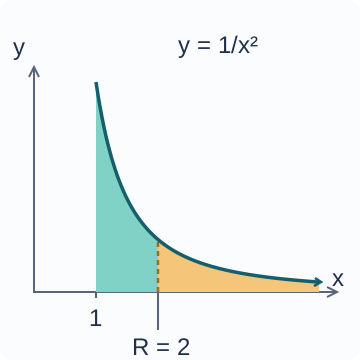
More generally, the tail after is
To make the omitted area at most , choose . This is an exact error bound for this particular example, not a general rule for all improper integrals.
Approaching zero is not enough
Compare with a slower-decaying function:
Although , the accumulated area grows without bound. Therefore diverges. A small function value far out on the axis does not by itself control the total area over an infinite interval.
3. An unbounded integrand near an endpoint
Suppose is continuous on and unbounded as . Approach the endpoint from inside the interval:
For a singularity at the right endpoint instead, use
These formulas apply to one problematic endpoint at a time. If both endpoints are problematic, split at an ordinary interior point and test the two pieces separately.
Worked example: a vertical asymptote with finite area
For , the interval is finite, but the integrand is unbounded near . For ,
As , this tends to . The integral converges. The unbounded height alone does not determine the result; we must examine the limiting accumulated area.
Replacing the integrand by changes the outcome:
Since as , the integral diverges to .
4. Split at every interior singularity
If lies inside and the function is unbounded near , do not apply one antiderivative across the whole interval. Assuming no other improper points, define two separate quantities:
Only when both limits are finite does . If either piece diverges, the original improper integral diverges. The cutoffs and are independent.
Worked example: cancellation does not repair divergence
Consider . Its interior singularity is at . On the left,
This tends to as . On the right,
which tends to as . The improper integral diverges. The expression is not an allowable cancellation.
If we deliberately use equal positive cutoffs on both sides, a different calculation gives
The limit of this symmetric expression is called the Cauchy principal value. Here it is , but the ordinary improper integral still diverges. Odd symmetry cannot replace the separate convergence checks.
An interior singularity can still be integrable
For a contrasting example, consider . Split at . For , the left truncated integral is
It tends to as . For , the right truncated integral is
It tends to as . Both limits are finite, so the integral converges to . The split is required even though the final answer is finite.
Two infinite bounds also need two checks
For , choose a finite splitting point where the function is regular. If there are no finite singularities, test and separately. Both must converge. A single symmetric limit from to is not the defining test. Split at any finite singularities as well.
5. Why the two power tests differ
Power functions provide useful benchmarks. Let be real. For ,
As , the term tends to zero precisely when . At , the logarithm diverges. Hence
In that convergent case, its value is . Near zero, the same antiderivative gives a different limit:
Now , so tends to zero when . Thus
Its value is then . At , this integral also diverges.
Keep the endpoint attached to the rule. At infinity, larger positive powers make the tail decay faster. Near zero, larger positive powers make the singularity stronger. Memorizing only “greater than one” loses the distinction.
In particular, diverges for every real : convergence would require both near zero and at infinity. A function with different behaviour at the two ends can still converge at both.
6. Compare when an antiderivative is unhelpful
For continuous nonnegative functions on a tail , suppose . Then:
- If converges, the smaller integral of converges.
- If diverges, the larger integral of diverges.
You can also compare the functions as you approach a finite singularity from one side, provided they are continuous on every closed interval on that side that stays away from the singularity. Closed, bounded intervals where the functions are continuous do not affect convergence. Use these comparisons only where both functions are nonnegative.
Worked comparison: prove convergence without finding a value
For , we have
The integral of from to infinity converges. Therefore converges. Comparison establishes convergence and an upper bound; it does not say that the two integrals have the same value.
Choose the useful direction
To prove divergence of , find a divergent lower bound. Since for ,
The lower-bound integral diverges like , so the original integral diverges. Merely bounding a function above by a divergent one would be inconclusive.
7. Four progressive questions
For each question, identify the improper point before calculating. State the limiting expression or comparison, then give a finite value when available or a clear convergence conclusion. Try the question before opening its hint or solution.
1. Evaluate an exponential tail
Determine convergence and the exact value, if it exists, of .
Hint
Replace the upper bound by . An antiderivative is .
Solution and reasoning
The only improper point is the infinite upper bound. For finite ,
Since , the integral converges to . The positive result agrees with a positive integrand.
2. Repair a calculation across a singularity
A student uses the antiderivative and concludes
Explain why the method fails and decide convergence.
Hint
Inspect the denominator inside the interval. A negative value is also a warning because the integrand is positive wherever it is defined.
Solution and reasoning
The singularity at separates the interval into two pieces. The fundamental theorem cannot be applied across that point. On the left,
As , this tends to . On the right,
This also tends to as . The improper integral diverges. Either divergent side alone would already settle the question.
3. Use a comparison, not an exact value
Decide whether converges. An exact value is not required.
Hint
Use to bound the whole numerator. Choose the power test at infinity.
Solution and reasoning
For ,
The upper-bound integral converges because . Its value is
The original integral therefore converges, with value between and . The oscillation of the numerator causes no problem here because the entire nonnegative integrand is controlled by an integrable upper bound.
4. Find a parameter range at both ends
For which real values of does the following integral converge?
Use comparisons; you do not need its exact value. For , interpret as the usual positive real power.
Hint
Split at . On , the factor lies between and . On , it lies between and .
Solution and reasoning
The integrand is positive and continuous for . Both zero and infinity need checking. For ,
The upper bound proves convergence near zero when . The lower bound proves divergence there when . For ,
At infinity, the upper bound proves convergence when , meaning . The lower bound proves divergence when . Both pieces converge exactly when
The boundary values and are excluded: each produces a divergent logarithmic comparison at one end.
Your next check
- Mark every infinite bound and every point where the integrand becomes unbounded.
- Split so that each piece has one improper end. Give each cutoff its own one-sided limit.
- Evaluate the truncated integral, or justify a nonnegative comparison with the useful inequality direction.
- Conclude convergence only when every piece has a finite limit. Add the values only then.
For a next step, compare this limiting-area reasoning with the series-convergence questions. A series sums discrete terms; an improper integral takes a limit of accumulated integrals. Their convergence tests are related, but a justification still needs the conditions of the test being used.
Official course context
Course description: current Concordia undergraduate calendar.
Useful for
Work on the step you’re missing.
Tell us the subject and your preferred time. Nablio confirms the details by text or email.
Request a lesson