Start with what a graph shows
A graph places pairs of numbers on a picture. In this lesson, the horizontal axis shows the input and the vertical axis shows the output. Read the labels and the size of each step on an axis before reading a point.
You will use whole numbers, negative numbers and simple equations. If substituting a value or solving is unfamiliar, use the basic-algebra start in our existing algebra guide first.
A function assigns one output to each allowed input. The notation means “the output when the input is 2”; it does not mean .
1 Read an ordered pair
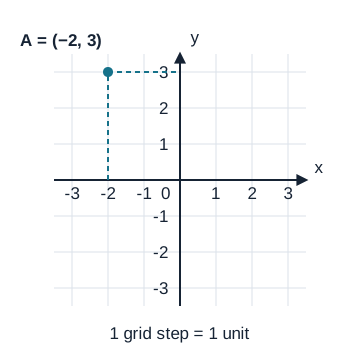
A point gives the horizontal coordinate first and the vertical coordinate second. The origin is , where the axes meet. Positive horizontal values lie to the right; positive vertical values lie above the origin.
Worked example: locate . Starting at the origin, move 2 units left, then 3 units up. A coordinate unit is one marked step in this diagram; no physical unit is assigned.
Try it
where is ?
Answer and reasoning
2 units right and 1 unit down from the origin. Reversing the coordinates would give , a different point.
2 Turn a rule into points
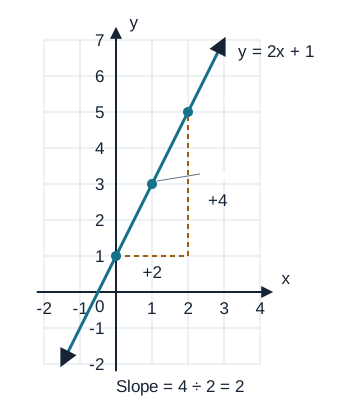
Worked example: the rule says to double the input and add 1. Substitute each input separately:
- : , so the point is .
- : , so the point is .
- : , so the point is .
Plot those points. This rule is defined for every real input and gives a straight line, so draw the straight line through them. A table with three points alone does not prove that an unknown rule is a straight line; here the given rule justifies it.
Try it
for , find the outputs when , and write the three points.
Answer and reasoning
the outputs are , giving , , . Each pair keeps the input first.
3 Measure the change with a slope
For a nonvertical straight line, the slope is the change in vertical coordinate divided by the change in horizontal coordinate. Use the same order in both subtractions.
Worked example: use and from the previous rule.
The line rises 2 vertical units for each increase of 1 horizontal unit. Using the points in reverse order gives the same slope: .
Try it
find the slope through and .
Answer and reasoning
. The output falls by 2 whenever the input increases by 1 along that line.
A horizontal line has slope 0. A vertical line has no defined slope because its horizontal change is 0; division by 0 is not allowed.
4 Read a straight-line rule
A nonvertical straight line can be written as . Here is the input coordinate, is the output coordinate, is the slope and is the output at . The point is the y-intercept.
For , the slope is 2 and the y-intercept is . To find where this line meets the x-axis, set : , so . The x-intercept is . An intercept is a point, not a slope.
Worked application: a tank begins with 6 litres of water and fills at a constant 3 litres per minute. Let be elapsed time measured in minutes, and let be the volume measured in litres. Before the tank is full,
The slope represents 3 litres per minute. The vertical coordinate of the intercept, 6, represents the initial 6 litres. At , , so the tank contains 18 litres, provided it has not filled earlier. We use and stop using this model when the tank is full; a context can restrict an otherwise valid algebraic rule.
Try it
a different tank starts with 5 litres and fills at 2 litres per minute. Write its rule and find its volume after 3 minutes, assuming it is not yet full.
Answer and reasoning
, with measured in minutes and in litres. At , the volume is 11 litres. The slope is 2 litres per minute, not 11 litres per minute.
Where two lines meet: substitute an equal expression
A line equation describes many points. A system asks for coordinates that satisfy two equations at the same time. Here and are real numbers representing the horizontal and vertical coordinates. A solution is an ordered pair , not just one value of .
Worked example
Find the point shared by these two lines:
The first equation tells us that and have the same value at every point on that line. We may therefore replace with the whole expression in the second equation. This is substitution:
The parentheses keep the replacement together. Now use the first original equation to recover :
The candidate solution is .
Check both original equations:
is true.
is true.
So lies on both lines. Their slopes are different: the second rule can be written . They meet at exactly one point. On a sketch, mark the intersection at and ; each line must pass through it.
Why does the method work?
Every shared solution obeys , so it must also obey . Conversely, if solves that substituted equation and we define , then both original equations hold. Keeping the first equation is what lets us recover the whole pair. Replacing inside the first equation itself would only give , which supplies no new restriction.
Another route for these same lines is comparison: write both as rules for , then set their outputs equal, . This leads to the same . Substitution is especially convenient when one equation already gives a variable on its own.
Three short checks
Check 1
Check a proposed point. For the original pair and , does solve the system? Check each equation.
Answer and reasoning for check 1
It satisfies the first because . It fails the second because , not 7. Being on one line is not enough.
Check 2
Guided retry. Solve and . Start by filling the gap: . Then find both coordinates and check them.
Answer and reasoning for check 2
Replace by : . Thus and . Recover . Both original equations hold: and . The solution is .
Check 3
Independent retry. Solve and . Keep exact fractions and check the pair in both equations.
Answer and reasoning for check 3
Substitution gives , so and . Then . Check: , and The solution is . Coordinate values need not be whole numbers.
Choose the next step
If combining terms was difficult, revisit basic algebra and equations. If locating a point was difficult, revisit the ordered-pair section above. These examples have one intersection; other systems may have no shared point or infinitely many. When your course reaches elimination or matrices, the existing row-operations lesson explains those cases and why its operations preserve solutions.
Optional extension: distance, midpoint and perpendicular bisectors
A slope describes a direction. A distance measures a length. A midpoint is a position. Learn to choose the quantity the question asks for, then combine these ideas to find a line or check a geometric claim.
Start when you can read coordinates, work with signed numbers and fractions, calculate a slope and solve a linear equation. For the distance formula, you will also use Pythagoras and square roots. Coordinates are real numbers in a Cartesian plane with perpendicular axes. Both axes use the same unit of length. Unless a problem gives physical units, report lengths in units.
1. Build distance from a right triangle
Let the endpoints be and . The subscripts label the two points; they are not exponents. Moving from to changes the coordinates by
These changes may be negative. The absolute value is the nonnegative distance of a real number from zero; for example, . Draw a horizontal move and a vertical move between the endpoints. Their lengths are and , and they meet at a right angle. When both changes are nonzero, the straight segment is the hypotenuse. If denotes its length, Pythagoras gives
A length is nonnegative, so take the nonnegative square root:
The formula also works for horizontal or vertical segments: one squared change is zero. If both changes are zero, the points coincide and the distance is zero. Reversing the endpoints reverses both changes, but squaring keeps the distance unchanged.
Worked example 1: straight-line distance is not the two-leg route
Find the distance from to . The horizontal change is , and the vertical change is . Therefore
The distance is 10 units. A route that first moves 6 units horizontally and then 8 vertically is 14 units long; it is not the straight segment. The slope of the segment's supporting line is , a different quantity again. Do not divide the changes when asked for a length.
2. Find the point halfway along the segment
To reach the midpoint , start at and take half of each coordinate change:
Thus
Average the two horizontal coordinates together, and the two vertical coordinates together. Taking half of the changes alone gives a displacement from ; it does not give the midpoint's coordinates until you add the starting coordinates.
Worked example 2: check both halves
For the same and ,
From to , the changes are . From to , they are also . Each half has length , half of 10. The midpoint is the point ; the half-length is the number 5.
3. Combine a midpoint with a perpendicular direction
For two distinct endpoints, the perpendicular bisector is the line that passes through the segment's midpoint and meets its supporting line at a right angle. Both conditions matter: a line through the midpoint alone need not be perpendicular.
For a nonhorizontal, nonvertical line of slope , a perpendicular line has slope . One way to see the sign and reciprocal is to turn a movement through a quarter-turn: the new movement is . Its slope is . This argument uses perpendicular axes and the same length unit on both axes.
- If the original segment is horizontal, its perpendicular bisector is vertical: .
- If the original segment is vertical, its perpendicular bisector is horizontal: .
- Do not calculate , and do not assign a numerical slope to a vertical line.
- If the endpoints coincide, they do not determine a unique perpendicular bisector. Every point is equally distant from those identical endpoints.
Worked example 3: build the equation, then check the conditions
Find the perpendicular bisector of the segment from to .
- Find the midpoint. .
- Find the direction. The slope of is , so the perpendicular slope is .
- Use the midpoint to find the intercept. Write . Since lies on this line, , so .
Check the point: at , the rule gives . Check the direction: . These two checks establish the perpendicular bisector.
Every point on this line is equally distant from and . For a point other than , the two right triangles from the point to and an endpoint have the same two leg lengths: the common distance to , and the equal half-segment lengths. Pythagoras therefore gives equal distances to the endpoints. At , the equality holds by the midpoint definition.
The converse also holds: every point equally distant from two distinct endpoints lies on their perpendicular bisector. For this pair, check the converse algebraically by expanding the squares and collecting terms. A point has equal distances exactly when their squares are equal, because distances are nonnegative:
Each step is reversible. The equal-distance condition gives exactly the line we found.
4. Use the line to answer a location question
Worked example 4: an equally distant point on a path
On a courtyard plan, coordinates are measured in metres on both axes. Markers are at and . A straight path follows . Where on that path could a fountain be equally distant from the two markers? Treat the path as the whole line in this model.
The fountain must lie on the perpendicular bisector found above and on the path. Substitute :
The candidate is . Verify using distances from the original coordinates:
Both distances agree, and lies on . The two lines have different slopes, so their intersection is unique. If a real path is only a segment, its endpoints create an extra restriction; check that restriction before choosing a location.
Eight questions, from a single step to a new situation
Try each question before opening its hint or answer. Unless stated otherwise, coordinates have no physical units. Sketches should help you organize information, not replace the calculation.
1. Start with a horizontal segment
For and , find the distance and midpoint without a calculator.
Hint
The vertical coordinate stays fixed. How far apart are the horizontal coordinates, and what is their average?
Explained answer
The distance is units. The midpoint is . A midpoint can have a fractional coordinate even when both endpoints have integer coordinates.
2. Separate length from position
For and , find the distance and midpoint. Check the distance from the midpoint to each endpoint.
Hint
The full changes are 4 and 3; each half-segment has changes 2 and .
Explained answer
The distance is units. The midpoint is . Each half has length units. Report the midpoint as a coordinate pair, not as the half-length.
3. Work backwards from a midpoint
One endpoint is , and the midpoint is . Find the other endpoint .
Hint
Write and .
Explained answer
The equations give and , so . Check: . Averaging and would find a point halfway along the wrong segment.
4. Build a perpendicular bisector independently
Find the perpendicular bisector of and . Check both required conditions.
Hint
Find the midpoint and the slope of before writing the new line's rule.
Explained answer
The midpoint is . The original slope is ; the perpendicular slope is . The line is . It contains , and , so it is the required perpendicular bisector.
5. Handle the exceptions
Find the perpendicular bisector of (a) , ; (b) , . Explain why a reciprocal-slope calculation is unnecessary.
Hint
A vertical segment needs a horizontal bisector; a horizontal segment needs a vertical one.
Explained answer
(a) The segment is vertical and its midpoint is , so its perpendicular bisector is . (b) The segment is horizontal and its midpoint is , so its perpendicular bisector is . A vertical line has undefined slope; taking the reciprocal of zero is not allowed.
6. Keep every possible position
Let and . The distance is 5 units. Find every possible . Which one remains if is to the right of ?
Hint
Square the nonnegative distance equation, then solve .
Explained answer
From , obtain . Thus or , giving or . Both give distance . The right-of- condition requires , so only remains. The nonnegative value is distinct from the two solutions of .
7. Verify a geometric claim
A triangle has vertices , , . Verify that , then show that the line from through the midpoint of is perpendicular to . Is the triangle equilateral?
Hint
Compare squared distances. Check whether and the line through its midpoint are horizontal or vertical.
Explained answer
and . The midpoint of is , so the line through it and is . It is vertical, while lies on the horizontal line ; the lines are perpendicular. The triangle is isosceles. It is not equilateral because , while the other sides have length 5.
8. Check whether a mathematical answer fits the path
On a plan measured in metres, markers are at and . A path consists only of points with and : the vertical coordinate is between 0 and 5, including both endpoints. Can a point on this path be equally distant from the markers? Justify your answer.
Hint
Find the perpendicular bisector and its intersection with , then check the permitted vertical coordinates.
Explained answer
The midpoint is ; the slope of is . Its perpendicular bisector has slope , so . At , it gives . This is the only intersection with the vertical line, but 6 is outside . No point on the stated path works. You can check the conclusion directly: at a point , equal squared distances require , which simplifies to , so again . The point does have equal distances metres to the markers; it fails the path restriction.
Choose your retry. For a sign or square-root error, redo questions 1–2 and check the original coordinate differences. For a missing midpoint or incorrect perpendicular direction, return to questions 3–5. For a lost solution or an invalid location, redo questions 6–8 and state the geometric restriction before selecting an answer.
Where these skills fit
These skills appear in Ontario Grade 10 MPM2D. In Québec, distance and perpendicular lines are covered in Secondary IV; midpoint is part of Secondary IV CST/TS and Secondary V SN. Start with the questions that match your class.
Try again without the worked examples
- For , find , the slope and the y-intercept.
- Find the slope through and . Write an equation of that line.
- A line has slope 3 and passes through . Write its rule and find the output when .
Answer and reasoning for question 1
; slope ; y-intercept .
Answer and reasoning for question 2
Slope ; equation .
Answer and reasoning for question 3
; when , .
Before moving on, explain one point, one slope and one intercept in words. For practice with lengths and angles, continue to “Right triangles: lengths and angles.”
Need help connecting the coordinates to the rule? In algebra and precalculus tutoring, a tutor can work through the step you are unsure about, then help you try a similar graph on your own.
Useful for
Work on the step you’re missing.
Tell us the subject and your preferred time. Nablio confirms the details by text or email.
Request a lesson