Start with inputs, then build the rule
A function assigns exactly one output to each allowed input. In , is the input, names the function and is its output. The parentheses do not mean multiplication. An ordered pair puts the input first.
You will need substitution, squares, square roots and simple equation solving. Review the algebra foundations if those steps are unfamiliar. This lesson extends introductory composition and inverse ideas by following actual points, checking permitted inputs and reversing a practical process. It contains eight numbered worked examples, five diagrams, eight foundation questions, two transfer questions, six transformation questions and four piecewise-function questions. All questions are original practice.
The domain is the set of allowed inputs. The range is the set of outputs actually reached. Here we work with real numbers. The notation , for numbers , includes both endpoints; means every real number at least . A stated domain is part of the function, even when the formula could accept more numbers.
Want help understanding an input, a graph or an inverse? An algebra and precalculus tutor can explain the idea, work through an example with you and help you try a similar question. We can start with the basics. Sessions are currently offered in English.
1 Connect input, output, table, equation and graph
Worked example 1: one rule in four representations
Let with domain . The process is “square the input.” For input , the output is ; for input , it is .
| Input | Output | Graph point |
|---|---|---|
| −1 | 1 | (−1, 1) |
| 0 | 0 | (0, 0) |
| 1 | 1 | (1, 1) |
| 2 | 4 | (2, 4) |
The table lists selected values, not the whole domain. For example, is also allowed and gives . Plot the input horizontally and output vertically. Because every real input from −1 to 2 is allowed, the graph includes the curve between the table’s points.
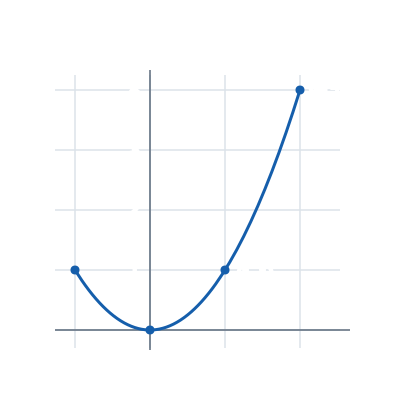
The smallest output is 0 at , and the largest is 4 at . Every value in between occurs, so the range is . Reading only the two endpoints would miss the minimum inside the interval.
Inputs −1 and 1 share output 1. That is allowed for a function: one input must not have two outputs. It will matter later when we try to reverse the rule.
2 Move an output or change an input
Worked example 2: compare two translations
For this example, let on all real numbers. Define and . In , square first, then add 2 to the output. In , add 2 to the input first, then square.
Follow the original point . For , the input remains 1 and the output becomes 3: the point moves to . For , ask which new input feeds the original input 1 into . Solve , giving . Thus the matching point is .
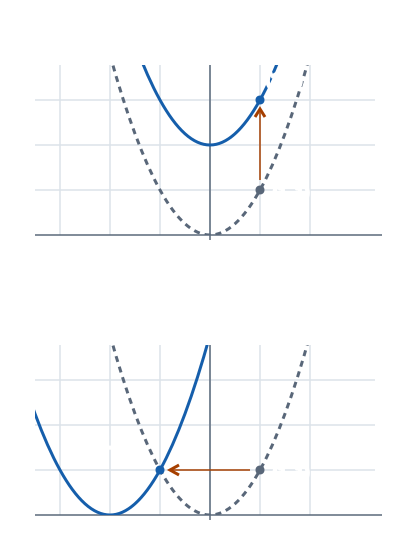
Check a common trap at the same input: , but . These are different functions. The vertex of is , with range ; the vertex of is , with range . Both have all real inputs.
Now state the pattern. Let be a real shift amount and any point on the original graph, so . For , that point becomes . For , solve : it becomes . When , the first shift is up and the second is left. A negative reverses those directions. The first keeps the original domain; the second shifts the domain along with the graph.
3 Compress or stretch horizontally
Worked example 3: squeeze or stretch the input positions
Use an asymmetric graph so that a change cannot hide behind symmetry. Let be the continuous broken line joining , and , with no graph outside these endpoints. Its domain is and its range is . Straight segments include every point between the three marked points.
First define . To reach the original input 4, solve : the new input is 2. Thus becomes . The output has not doubled. Every horizontal coordinate is divided by 2, so the graph is compressed horizontally by a factor of , toward the -axis. The three marked points become , and .
The permitted input to is still between −2 and 4, so , giving the new domain . All original outputs still occur, so the range stays .
Now define . To reach the original input 4, solve : now . The same three points become , and . This is a horizontal stretch by a factor of 2. From , the domain is ; the range is still .
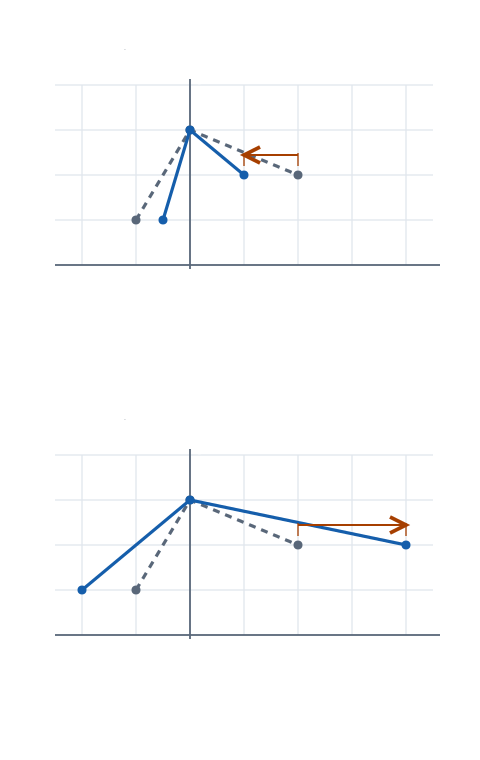
The reliable rule: for with , solve . A point becomes . The horizontal scale factor is : compresses, while stretches. It is the reciprocal of the number multiplying the input.
Compare an outside multiplier: sends to , stretching vertically by 2. It keeps this example’s domain and changes its range to . At the marked point , gives the corresponding point , whereas gives . Inside and outside multiplication affect different coordinates.
4 Reflect across the coordinate axes
Worked example 4: which coordinate changes sign?
Keep the same broken-line function from example 3. For , evaluate first, then negate the output. The point becomes . Every point becomes : this is a reflection across the -axis. The domain stays , while the range changes from to . Write interval endpoints in increasing order.
For , negate the input before applying . To reach original input 4, solve , so . The point becomes . In general, becomes : a reflection across the -axis. The range remains . The input restriction is ; multiplying by −1 reverses both inequality signs, giving , or domain .
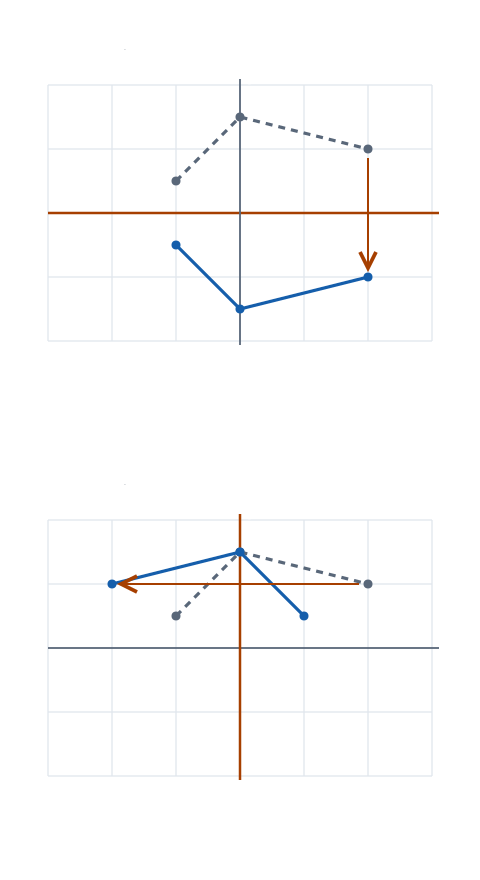
A point on the mirror axis stays fixed. Reflecting across an axis does not swap the coordinates; the inverse-function reflection across , later in this lesson, does swap them. Also, for an even function such as , the -axis reflection looks unchanged because the original graph is already symmetric. That special case does not mean .
With both negatives, , both coordinates change sign: . For a general nonzero multiplier, scales vertical distances by and also reflects across the -axis if ; scales horizontal distances by and also reflects across the -axis if .
5 Combine transformations with a point map
You can stop at the simple transformations first and return to this section when you want to combine them. The same input equation does the work; you do not need a new direction rule for every formula.
Worked example 5: combine transformations one coordinate at a time
Using the same , let . Start with the original point . For its horizontal position, require . Divide by −2, then add 1: . For its height, multiply the old output by −2, then add 1: . The corresponding point is . Check directly: .
The horizontal coordinate is reflected and halved, then shifted right 1; the vertical coordinate is reflected and doubled, then shifted up 1. Apply those shifts after the coordinate scaling. All three marked points map as follows:
| Original point | New input: | New output: | New point |
|---|---|---|---|
| (−2, 1) | 2 | −1 | (2, −1) |
| (0, 3) | 1 | −5 | (1, −5) |
| (4, 2) | −1 | −3 | (−1, −3) |
For the domain, keep . Dividing by −2 reverses the inequalities: , so . In increasing order, the domain is . The original range becomes : the old maximum 3 gives the new minimum −5. Join the transformed points in increasing input order to sketch the new broken line.
A summary to return to: the general point map
For , with and , the letters are multipliers and are shift amounts. If is on the original graph, solve and transform the output:
For an original domain , where are its lower and upper endpoints, the new domain is when , but when . A negative multiplier reverses endpoint order; an excluded endpoint stays excluded at its new location. For range , where are its minimum and maximum outputs, the new range is when , and when . For a non-interval domain, apply the point map to its permitted inputs rather than filling any gaps.
Keep the inside expression in the stated factored form. For example, has , not 6, and maps to . When in doubt, solve the inside expression equal to the original input. This also checks the order of the transformations.
6 Compose rules and keep both domain checks
Worked example 6: a square root followed by a reciprocal
Let , whose domain is , and let , whose input may be any real number except 2. The letter is simply the input name for . The composition means : apply first, then feed its output into .
First, the square root requires , so . Second, its output must not be 2, because that makes the outer denominator zero. Solve : this gives . The composition therefore has domain . The symbol joins the two intervals, and round endpoints exclude 5.
Need the steps for an equation with a square root? Practise checking restrictions and verifying each candidate.
At , the chain is , so . At , the first step works but the second fails. At , the first step already fails over the real numbers.
Reversing the order changes the process: . To find its domain, keep and require . For the fraction is negative; for it is nonnegative; for it is negative. Thus its domain is , very different from the first composition.
In general, an input is allowed in only when it is in the domain of and its output is in the domain of . Simplifying an expression never restores an input excluded by the original process.
7 Restrict a quadratic before reversing it
Worked example 7: swap the input and output roles
Consider . On all real inputs, both −2 and 2 produce 5. Reversing this would give two possible outputs for input 5, so there is no inverse function on that whole domain. A function is one-to-one when different inputs always produce different outputs.
Now restrict to . It increases from 1 to 5 and is one-to-one. Its range is . To reverse it, call the original output and solve for its nonnegative input :
We choose the nonnegative square root because the original domain requires . Rename the inverse’s input to use standard notation:
The inverse has domain and range : original outputs become allowed inputs, and original inputs become outputs. The original point becomes . This coordinate swap reflects the graph across .
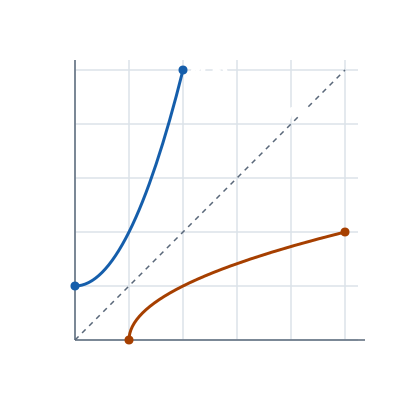
Check both directions on their own domains:
For an unrestricted real number, , not always . The restriction makes the first check work. A restriction to instead would produce the different inverse , also with domain .
An inverse is not a reciprocal
The notation names the rule that reverses . The reciprocal divides 1 by its output. For our restricted , , whereas . The inverse and reciprocal even have different domains here: and , respectively. Always read the notation in context.
8 Reverse a practical two-step process
Worked example 8: recover a rental time from its cost
In a simplified rental model, a machine costs a fixed $12 plus $8 per hour, with time billed continuously and no other charges. Let be the rental time in hours, where , and let be the cost in dollars. Then , with range .
The forward process multiplies time by 8 and then adds 12. To reverse it, subtract 12 from the cost first, then divide by 8. If is the cost in dollars,
A $44 bill corresponds to hours. Check in the original model: . A $68 bill would give 7 algebraically, but 7 hours lies outside this model’s domain. Its inverse cannot be used to justify that rental.
The inverse output has units of hours, not dollars. Dividing first and then subtracting 12 would undo the operations in the wrong order. Real billing could involve rounding or additional fees, so this inverse applies only to the stated model.
Practise in eight steps
Use an optional hint when useful, or open the explained solution to study the method. For each answer, check the permitted inputs as well as the arithmetic.
For on all real numbers, find , and , and write the three graph points.
Optional hint 1
Substitute each input in parentheses. A point has the form .
Explained solution 1
, , and . The points are , , and . The first coordinate remains the input.
Let with domain . Find its range. Is the domain just the four integers −3, −2, −1 and 0?
Optional hint 2
Check whether 0 is an allowed input. Compare its output with the endpoint outputs.
Explained solution 2
The minimum is ; the maximum is , while . Every value between 0 and 9 is reached, so the range is . The domain contains every real number between −3 and 1, including 1 and fractions such as ; it is not a finite list.
A graph of contains . Find the corresponding point on , then on .
Optional hint 3
For the horizontal translation, which new input satisfies ?
Explained solution 3
The vertical translation changes the output to , giving . The horizontal translation requires , giving . Adding inside moves this point left, not right.
Let , with domain . Find the starting point, domain and range of .
Optional hint 4
Require . The square-root output is nonnegative before subtracting 1.
Explained solution 4
The graph moves right 4 and down 1. Its starting point is , its domain is , and its range is . Check: .
Let and , both on all real numbers. Find and .
Optional hint 5
Work from the inside outward; write the intermediate output.
Explained solution 5
, so . In reverse order, , so . Equality at this one input does not make the compositions identical: at 1 their values are 3 and 9. The general rules are and .
Let , , and , . Find and its domain. Is allowed?
Optional hint 6
The inner square root must exist, and its output must be nonzero.
Explained solution 6
. The square root requires , but at −2 its output is 0, which cannot accept. Therefore the domain is . The endpoint is excluded even though exists.
Let with domain . Find its inverse, with domain and range, and check .
Optional hint 7
In , the restriction guarantees .
Explained solution 7
The range of is . Taking the nonnegative root gives , hence , with domain and range . Then , and verifies the reversal.
Let on all real numbers. Find and , and state the domains of the inverse and reciprocal functions.
Optional hint 8
To reverse , solve for . For the reciprocal, first evaluate the original function.
Explained solution 8
, so . But , so . The inverse accepts all real numbers. The reciprocal excludes , where its denominator is zero.
Transfer and retry
A graph of a function has domain , range , and contains . Define . Find the new domain, range and corresponding point. Do you need a formula for ?
Optional hint 9
Keep ; separately subtract 5 from every output.
Explained solution 9
Subtract 2 in the input inequality: the domain becomes . The range becomes . The point moves left 2 and down 5, from to . No formula is needed: the given domain, range and point are sufficient.
A simplified printing service charges dollars for an integer number of pages, . Find the inverse rule on the actual cost range. What page count corresponds to $9.40? Is $9.50 in the range?
Optional hint 10
Reverse the fixed fee and the per-page rate, then check that the result is an allowed integer.
Explained solution 10
For a cost in dollars, . Its domain is the discrete set , not every real cost between 4 and 24; its range is . A $9.40 cost gives pages. A $9.50 cost gives 27.5, not an integer, so it is not in this model’s range. A formula alone does not remove the context restriction.
Practise transformations in six steps
These six questions move from one changed coordinate to combined transformations and endpoint checks. Hints and explained solutions are available whenever they help.
The graph of contains . Find the corresponding point on . Is this a horizontal stretch or compression?
Optional hint 11
Solve ; leave the output unchanged.
Explained solution 11
The new input is , so the point is . Horizontal coordinates are divided by 3: a compression by factor , not a stretch by 3.
A function has domain and range . Find the domain and range of , and map the point .
Optional hint 12
Require . No operation is applied to the output.
Explained solution 12
Multiplying the inequality by 3 gives domain . The range stays ; becomes . The horizontal scale factor is 3.
A function has domain , range , and point . For each of and , give the reflected point, mirror axis, domain and range.
Optional hint 13
An outside minus changes the second coordinate; an inside minus changes the first.
Explained solution 13
For : , reflection across the -axis, domain , range . For : , reflection across the -axis, domain , range . Reverse the order of negated interval endpoints.
A learner says “ and both stretch the graph by 3, so they are the same.” Use an original point to explain the mistake. Can special functions ever make the two formulas equal?
Optional hint 14
Track the horizontal and vertical coordinates separately. For the final question, consider the zero function.
Explained solution 14
The first transformation maps to ; the second maps it to . They perform different transformations: horizontal versus vertical stretching. They need not produce different functions in every special case: for a different function, on all real numbers, both give the zero function. A special coincidence is not a general transformation rule.
Let have domain and contain . Find the domain of and the corresponding point. Explain which endpoint is excluded.
Optional hint 15
Keep . Dividing by a negative reverses the inequality signs.
Explained solution 15
Division by −3 gives , hence . The domain is . The excluded original endpoint 3 maps to the excluded new endpoint −2. Solving gives , so the point becomes . The horizontal scale factor is , with a reflection, then a shift left 1.
A function has domain , range , and point . Let . Find its domain, range and corresponding point. Check the point using the original input.
Optional hint 16
Solve , then change into .
Explained solution 16
The point map is . The domain is ; the range is , with the old minimum −1 becoming the new maximum 5. The point is . Check: and . This combines horizontal compression, a right shift, reflection across the -axis and an upward shift.
When the input chooses the rule
A piecewise-defined function uses different formulas on different parts of its domain. It still assigns one output to each allowed input. Read the input condition first, then use the matching formula. Do not add the formulas together.
This optional bridge uses substitution and inequalities. Read the worked steps or open an answer whenever it helps; you do not need to attempt a question first.
Choose the branch before substituting
Let be a real input and its output, with no physical units. Define
Each line is a branch. The condition on the right tells you when to use the formula on the left. The first includes −2 but excludes 1; the second includes 1 and 4. Together they give the domain .
- For , input 0 meets , so .
- For , the condition is false. Use the second branch: . Computing uses a formula outside its assigned interval.
- For , the second branch gives .
- There is no in this definition. Neither interval allows input 5, even though both formulas can be calculated there.
To sketch the function, label the horizontal axis and vertical axis . Draw the part of from a filled point at to an open point at . Draw the part of from a filled point at to a filled point at . An open point is excluded; a filled point is included. Do not join to with a vertical segment: that would assign several outputs to input 1.
Solve within each branch, then check its interval
Finding starts with an input. Solving starts with an output and asks which inputs produce it.
- First branch: gives , but 1 does not satisfy . Reject this candidate.
- Second branch: gives , which satisfies . Keep it.
The only solution is . Check: . On the graph, the horizontal line at output 4 meets the function at ; the open point does not count.
Practise one decision at a time
Using the same , find , and .
Show the branch choices and answers
The first branch applies at and : and . The second applies at 3: . Compare the input with the boundary before calculating.
Solve . Could two different inputs have this output?
Show the solution
First branch: gives , inside its interval. Second branch: gives , also inside its interval. Both work: . Different inputs may share an output; each individual input still has only one output.
Change the first branch condition to , leaving the second unchanged. Does this still define a function?
Show the boundary check
No. At input 1, both branches now apply but give different outputs: and . Restore an excluded endpoint in one branch to choose one output. Overlapping conditions are permissible if every overlapping input gives the same output, but they conflict here.
A tank starts with 6 L of water. Water enters at 2 L/min for the first 3 minutes, then at 1 L/min for the next 4 minutes. There is no outflow and the tank does not overflow. Let be elapsed time in minutes and volume in litres, for . Explain the second branch below, then find , and the time when the tank contains 14 L.
Show a hint
At the rate change, the tank already contains L. How many minutes have passed since that change?
Show the explanation and answers
After minute 3, the elapsed time at the new rate is minutes, so add litres to the existing 12 L. Using would count three extra minutes at the new rate. The boundary belongs to the first branch: L. At minute 5, L.
For 14 L, the first formula gives , or , outside its interval. The second gives , or , inside its interval. The tank reaches 14 L after 5 minutes. At the change, both formulas give 12, so the graph meets there without a jump even though the rate changes.
Keep this habit: choose by the input, calculate the output, and check the branch condition again when solving for an input. Later, this distinction helps separate a function’s value at a boundary from its nearby behaviour.
Choose your next step
If the graph is the hard part, revisit points, slope and straight-line graphs. For more on turning points and domain-aware quadratic graphs, continue with quadratic graphs. Then connect function transformations to periodic patterns in the unit circle and trigonometric graphs.
When checking your work, ask: what goes in, what comes out, and which values are allowed at each step? If a step still feels unclear, algebra and precalculus tutoring can help you work through a graph or inverse problem at your pace. Sessions are currently offered in English.
Useful for
Focused practice for functions and trigonometry in Concordia MATH 201 and Dawson 201-015-RE, and a foundation review for Sheridan MATH15382D. These lessons cover selected topics, not a complete course; use your current section’s outline for assessment scope.
Work on the step you’re missing.
Tell us the subject and your preferred time. Nablio confirms the details by text or email.
Request a lesson