Solve a triangle without a right angle
A triangle does not need a right angle for its missing lengths and angles to be found. The sine law and cosine law connect the three sides and the three interior angles. The important first step is to read which quantities are known, especially whether a known angle lies between two known sides.
This lesson assumes basic equations, square roots and inverse trigonometric functions. Review right-triangle lengths and angles for side ratios, or the unit circle for sine and cosine beyond 90°. Here every angle is in degrees: use degree mode. Keep unrounded calculator values until the final answer; round requested lengths and angles to the nearest tenth unless an exact value is available.
We work with ordinary, non-flat triangles in a plane. All three side lengths are positive, and every interior angle lies strictly between 0° and 180°. Allow about 50 minutes for the four worked examples and a first pass through the ten original practice questions. The optional area extension adds two worked examples and five questions beyond that core route. This teaches a focused skill, rather than a whole course.
1. Match each side to its opposite angle
Use capital letters for the vertices and their interior angles. Use lower-case letters for the opposite side lengths:
- is opposite .
- is opposite .
- is opposite .
The letters do not depend on which way the triangle faces. In this convention, does not automatically mean hypotenuse. Express all side lengths in the same unit before forming ratios or adding squared lengths.
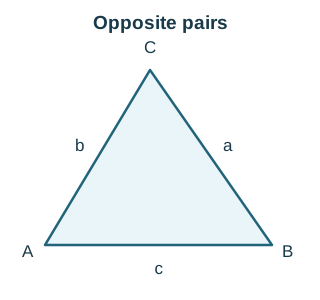
Before calculating, check that the measurements could describe a triangle:
These are strict triangle inequalities. Equality gives a flat configuration, not a triangle. With three positive lengths, it is enough to check that the two smaller lengths sum to more than the largest. The longest side is opposite the largest angle; equal sides are opposite equal angles. Use these facts to check an answer, without guessing from the apparent shape of a sketch.
2. Let the given data choose the method
- AAS or ASA: two angles and one side. Find the third angle with the angle sum, then use the sine law. AAS means angle–angle–side; ASA means angle–side–angle.
- SAS: two sides and their included angle. Use the cosine law to find the missing side. For area, use the two sides and their included angle directly in the optional area extension. The included angle lies between the two known sides; for sides , it is .
- SSS: three sides. Check the triangle inequality, then use the cosine law to find an angle. Starting with the angle opposite the longest side often makes the check easier.
- SSA: two sides and an angle opposite one of them. The sine law supplies possible angles, but there may be zero, one or two triangles. Test every candidate.
AAA is not enough to determine lengths. Three angles can fix the shape, but multiplying every length by the same positive factor preserves those angles. You need at least one length to fix the scale.
Do not use Pythagoras merely because two lengths are given: it requires a right angle. Do not label data SAS unless the supplied angle really is between the two known sides.
3. Two angles and a side: sine law
The sine law matches each side with its opposite angle:
You can also invert every ratio: . Keep the same orientation throughout an equation. Choose the complete known pair and the pair containing your unknown. Sine values have no unit: has the same unit as , while its reciprocal has reciprocal-length units.
Worked example 1: two angles give one triangle
Given , and cm, find .
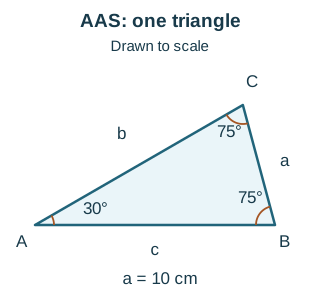
First find the third angle:
Now let denote the numerical lengths in centimetres:
Because , the opposite sides are equal, so cm too. The result is , cm and cm. The 10 cm side is shortest and is opposite the smallest angle, 30°. The sides satisfy the triangle inequality. Two valid angles and one fixed side determine one triangle size and shape.
4. Two sides and the included angle: cosine law
The cosine law uses two side lengths and the angle between them:
Here is the angle between sides , and is the side opposite that angle. Relabel cyclically to find a different side. If , then , and the formula becomes Pythagoras. For an acute , the cosine term reduces ; for an obtuse , the negative cosine makes larger than .
Worked example 2: use the included angle
Given cm, cm and , find .
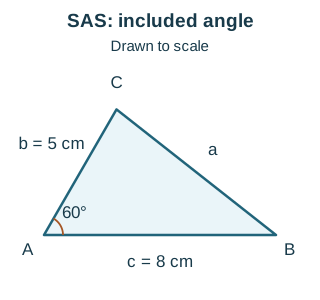
With all numerical lengths in centimetres:
The missing side is 7 cm exactly. Take the positive square root because a length is positive. Check: . The squared-length calculation has units cm²; taking its square root returns centimetres. A sine-law equation at the start would have two incomplete opposite pairs and would not isolate one unknown.
5. Three sides: find an angle with cosine
Rearrange the cosine law to find the angle opposite a known side:
The inverse cosine, , returns one angle from 0° to 180°. That covers every possible interior triangle angle. A negative cosine means an obtuse angle. An input outside cannot be the cosine of a real angle: check the data, pairing and arithmetic.
Worked example 3: let the lengths establish the obtuse angle
A triangle has cm, cm and cm. Find , the angle opposite the longest side.
The triangle exists because . Using numerical lengths in centimetres:
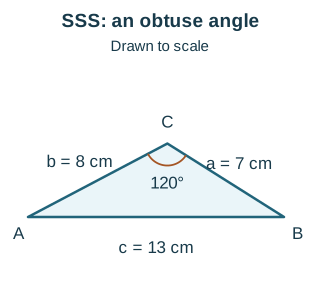
The answer is exactly. Because , the cosine is negative and this angle must be obtuse. Both 60° and 120° have sine , but only 120° has cosine . If an inverse-sine step gives 60°, do not choose it merely because it looks familiar: it contradicts the three given lengths. The data, rather than an unscaled sketch, decide which angle is valid.
6. SSA: zero, one or two triangles
Suppose are given, with opposite . This is SSA, because is not between the two known sides . Isolate the sine:
Here is a dimensionless ratio. For valid positive lengths and , it is positive.
- If , there is no triangle: a sine cannot exceed 1.
- If , the only candidate is . Test the angle sum; do not count the same 90° angle twice.
- If , the candidates are and . They have the same sine.
- For each distinct candidate, require . Then set and use . Reject a zero or negative remaining angle.
The number of candidates that survive is the number of triangles. In particular, when the given angle is obtuse, there can be at most one triangle: another obtuse angle cannot fit in the angle sum. Exact boundary data should be checked before rounding. A ratio near 1 is not automatically equal to 1.
Worked example 4: keep both valid triangles
Given , cm and cm, find every possible triangle.
The inverse-sine key gives . Its supplementary candidate is . Both sums and are below 180°, so both triangles are valid.
- Triangle 1: , , and cm.
- Triangle 2: , , and cm.
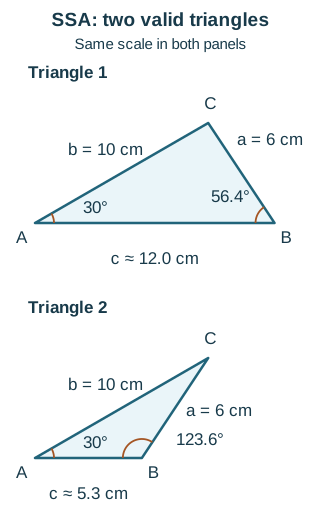
Check the side order: in triangle 1, is longest and is largest; in triangle 2, is longest and is largest. Both sets of lengths satisfy the triangle inequality. Reporting only the calculator’s first inverse-sine answer would miss the second triangle.
When counting, reflections or rotations of the same triangle are not new solutions. Two solutions here mean two different sets of remaining angles and side length.
Find a triangle’s area without a given height
You may know two sides and the angle between them, but not the perpendicular height. Sine lets you find that height and use the familiar base-times-height formula. You do not need to calculate the third side first.
Keep the lesson’s notation: a = BC, b = CA and c = AB. The angle C lies between sides a and b. Write K for the triangle’s area, so it cannot be confused with angle A. All side lengths are positive, and 0° < C < 180°. Use degree mode for the angles in this section and express both lengths in the same unit.
Why K = ½ab sin C
Choose BC, of length a, as the base. Drop a perpendicular from A to the line through B and C. Call its foot H and its length h. The height is the perpendicular distance to that line; it need not meet the base segment itself.
For an acute angle C, the right triangle ACH gives sin C = h/b, so h = b sin C. Substituting in the area formula gives:
For an obtuse angle C, H lies beyond C on the extended base line. The angle ACH is 180° − C, so h = b sin(180° − C). Since sin(180° − C) = sin C, the same area formula works. The height and area stay positive. At C = 90°, h = b and the formula reduces to ½ab.
You can choose any pair of sides, as long as the angle is the one between that pair:
Sine has no unit. Multiplying two lengths gives an area unit, such as cm² or m². For fixed a and b, K cannot exceed ½ab because sin C ≤ 1. This maximum occurs at C = 90°. Angles 0° and 180° would give a flat shape with zero area, outside the non-flat triangles considered here.
Worked example 5: two sides and an acute included angle
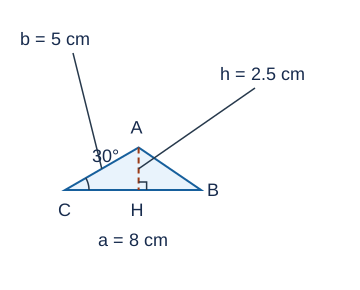
Given a = 8 cm, b = 5 cm and C = 30°, find the area.
- Sides BC and CA meet at C, so 30° is the included angle.
- The height to the line BC is h = 5 sin 30° = 2.5 cm.
- K = ½ × 8 × 2.5 = 10 cm².
Equivalently, K = ½ × 8 × 5 × sin 30° = 10 cm². The area is below the maximum ½ × 8 × 5 = 20 cm². The answer is an area, not a side length.
Worked example 6: an obtuse angle, the same height
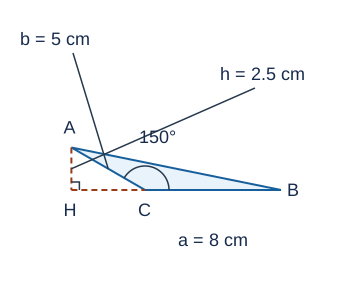
Keep a = 8 cm and b = 5 cm, but change C to 150°. Find the new area.
The perpendicular foot now lies beyond C. The small right triangle uses angle 180° − 150° = 30°. Therefore h = 5 sin 30° = 2.5 cm, and:
K = ½ × 8 × 5 × sin 150° = 10 cm².
The triangles have the same base and perpendicular height, so they have the same area. They do not have the same third side: the cosine law gives c² = 89 − 40√3 for C = 30°, and c² = 89 + 40√3 for C = 150°. Equal areas do not mean identical triangles.
Avoid using the wrong angle
In ½ab sin C, C must lie between a and b. Replacing C with a given angle A generally gives the wrong area. If you know two angles and a side, first find the third angle and use the sine law to obtain a suitable second side. If the data are SSA, follow the earlier ambiguity checks; two admissible triangles can have different areas. Do not silently choose the calculator’s first angle.
Five progressive area questions
You can start with a solution if the method is unfamiliar, then cover it and try again. Keep intermediate values unrounded; round non-exact final areas to the nearest tenth.
1. Which angle belongs in an area formula using sides b and c? Find K when b = 6 cm, c = 4 cm and that angle is 90°.
Show the solution 1
Solution: b = CA and c = AB meet at A. Use K = ½bc sin A = ½ × 6 × 4 × sin 90° = 12 cm². Here the two sides are perpendicular, so they are also a base and its height.
2. A triangular panel has sides a = 1.2 m and b = 80 cm with included angle C = 30°. Find its area in m².
Show the solution 2
Solution: convert 80 cm to 0.8 m before multiplying. K = ½ × 1.2 × 0.8 × sin 30° = 0.24 m². Alternatively, ½ × 120 × 80 × sin 30° = 2400 cm² = 0.24 m², since 1 m² = 10 000 cm². Multiplying 1.2 by 80 without conversion mixes units.
3. Two triangles have a = 10 cm and b = 6 cm. Their included angles are 40° and 140°. Find each area and explain why they match.
Show the solution 3
Solution: K₁ = 30 sin 40° ≈ 19.3 cm². Since sin 140° = sin 40°, K₂ ≈ 19.3 cm² too. With the same 10 cm base, both heights equal 6 sin 40° cm. Neither area exceeds 30 cm². The two shapes differ because their included angles differ.
4. Given A = 30°, B = 45° and a = 6 cm, find K. A student writes K = ½ × 6 × b × sin 30°. Explain the mistake and complete the calculation.
Show the solution 4
Solution: the angle between a and b is C, not A. First C = 180° − 30° − 45° = 105°. The sine law gives b = 6 sin 45°/sin 30° = 6√2 cm. Then K = ½ × 6 × 6√2 × sin 105° = 9(√3 + 1) cm² ≈ 24.6 cm². An alternative valid method finds c and uses ½bc sin A. A given angle is usable only with its adjacent pair of sides.
5. The three sides are a = 5 cm, b = 7 cm and c = 8 cm. Find K without assuming the triangle is right-angled.
Show the solution 5
Solution: the lengths form a triangle because 5 + 7 > 8. Use the cosine law to find the included angle C: cos C = (25 + 49 − 64)/(2 × 5 × 7) = 1/7. Because 0° < C < 180°, its sine is positive: sin C = √(1 − 1/49) = 4√3/7. Thus K = ½ × 5 × 7 × 4√3/7 = 10√3 cm² ≈ 17.3 cm². You could instead calculate C = arccos(1/7), keeping that value unrounded. The third side supplied the angle needed for the area formula.
Ten graduated practice questions
Try each question before opening its optional hint or explained solution. Use degree mode. Give non-exact numerical answers to the nearest tenth and keep intermediate values unrounded. Each question uses the same opposite-side convention.
In triangle , which side is opposite ? Which angle is between sides ? Write a sine-law equation connecting .
Optional hint 1
Trace the endpoints of each side before choosing its opposite angle.
Explained solution 1
Side is opposite . Sides and meet at , so their included angle is . The matching equation is . Pairing with would compare the wrong sides and angles.
Choose a first method, or explain why no unique triangle can be solved: (i) ; (ii) ; (iii) ; (iv) angles 40°, 60°, 80° only; (v) sides 3 cm, 4 cm, 8 cm.
Optional hint 2
Is the known angle included between the two known sides? Check the data before applying a formula.
Explained solution 2
(i) AAS: angle sum, then sine law. (ii) SAS: cosine law for . (iii) SSA: sine law and a check of all angle candidates; do not assume one solution. (iv) AAA fixes shape but gives no scale, so lengths are undetermined. (v) No triangle: . A formula cannot repair inconsistent measurements.
Given , , cm, find .
Optional hint 3
Find the remaining angle first. Use the known opposite pair for both side calculations.
Explained solution 3
. In centimetres, , and . The order agrees with . There is one triangle.
Given cm, cm and included angle , find .
Optional hint 4
There is no complete opposite pair yet. Start with the cosine law.
Explained solution 4
Using centimetres, cm. The positive root is required. It lies strictly between and cm, as the triangle inequality requires. Pythagoras would incorrectly treat 50° as 90°.
A triangle has sides cm, cm, cm. Find and explain why the acute supplementary angle is not valid.
Optional hint 5
Find the cosine of the angle opposite the longest side; its sign matters.
Explained solution 5
The triangle exists because . Then , so . The supplementary angle, about 68.2°, has positive cosine and contradicts the negative value forced by the three sides. A sketch is not needed to choose between them.
Given , cm and cm, how many triangles exist?
Optional hint 6
Calculate the required value of before pressing inverse sine.
Explained solution 6
, which exceeds 1. There are zero triangles. A calculator domain error here reflects impossible data; it is not a reason to switch angle modes.
Given , cm and cm, find every possible triangle.
Optional hint 7
This time the required sine equals 1 exactly. Count distinct angles, not two copies of the same angle.
Explained solution 7
, so . The supplementary angle is also 90°, so there is one triangle, not two. and cm, approximately 8.7 cm. The 10 cm side is opposite the right angle, as expected.
Given , cm and cm, find every possible triangle.
Optional hint 8
Compute both inverse-sine candidates, then add each to the given obtuse angle.
Explained solution 8
, giving and . The second fails because . There is one triangle: , and cm, using the unrounded . The 12 cm side is longest and is opposite the given obtuse angle.
Given , cm and cm, find every possible triangle, including the missing side in each.
Optional hint 9
Keep the supplementary candidate if it leaves a positive third angle.
Explained solution 9
. The candidates are and ; both are less than , so both fit with . There are two triangles:
- , , cm.
- , , cm.
For each, compute with unrounded values. Both satisfy , and the longest side lies opposite the largest angle.
Two survey stations are 42 m apart on a straight baseline. A landmark is on the other side of a river. The interior angle between and is 35°, and the interior angle between and is 70°. Model the three points in one horizontal plane. Find the straight-line distance , and explain why it is not automatically the perpendicular width of the river.
Optional hint 10
Label m and . Find angle ; the known baseline is opposite it.
Explained solution 10
. The sine law gives , so m. The baseline, 42 m, is slightly longer and is opposite the larger angle, 75°. This is the distance from station to landmark ; no data say that is perpendicular to either riverbank, so it is not necessarily the river’s width. The horizontal-plane model ignores differences in elevation.
Check your triangle and choose a next step
- Have I labelled each side opposite its matching angle?
- Is the angle between the two known sides, or opposite one of them?
- Are all angles and lengths positive, and do the angles sum to 180°?
- Do the side lengths satisfy the strict triangle inequality?
- Is the largest side opposite the largest angle?
- For SSA, did I test both distinct candidates and report every valid triangle?
- Did I use degrees, consistent length units and final-only rounding?
Retry questions 2, 5 and 9 without looking at the solutions: together they check method choice, an obtuse angle established by data and two valid triangles. For help turning your measurements into the right equation, explore algebra and precalculus tutoring. Tutoring sessions are currently offered in English.
Useful for
Work on the step you’re missing.
Tell us the subject and your preferred time. Nablio confirms the details by text or email.
Request a lesson