Stuck on a step? Text us Email us Request a lesson
Before you start. Use signed position and velocity, sine and cosine in radians, equation rearrangement and Newton’s second law. The position and velocity formulas are supplied. The optional calculus check explains their derivative relationship; it is not required for the worked problem.
1. Read the model and the question
A block of mass is attached to an ideal horizontal spring of stiffness , with the other end fixed. The spring obeys Hooke’s law throughout the motion considered. Ignore friction, damping and driving. Measure displacement from equilibrium, positive to the right. Velocity is signed: positive means moving right. Acceleration is , and time is measured from the specified initial instant.
At ,
Find the motion equation and the first time after that the block crosses equilibrium. State its velocity at that crossing.
The vertical forces balance. Horizontally, the restoring spring force is , so Newton’s second law gives
Here is the angular frequency of the oscillation; is the period, the time for one complete cycle. Initially . The block is moving right but slowing down. It must reach a right-hand turning point before returning to equilibrium. Constant-acceleration formulas do not apply: the acceleration changes with position.
2. Use both initial values
For this free simple harmonic motion, the position and velocity can be written
The constants have units of length. At , cosine is 1 and sine is 0. Therefore and , giving , .
With numerical time in seconds,
Substitute to check both initial values. Using only would give zero initial velocity, contrary to this question.
Optional calculus check:
differentiating the supplied position equation gives the velocity equation. Differentiating again gives , so the expression satisfies Newton’s law for this model.
3. Recover amplitude and phase
We can also write . The amplitude is the greatest displacement magnitude from equilibrium; is the phase at the chosen initial instant. Use the cosine addition formula:
Compare the coefficients with : and . The minus sign comes from the cosine addition formula. Since , we have , so
Here and , so choose a phase in the fourth quadrant. The reference angle is . Taking gives
The starting displacement is not the amplitude when the initial velocity is nonzero. Using alone would give a positive phase and the wrong initial velocity. Phases differing by describe the same motion.
4. Select the first future crossing
Equilibrium means . For with , cosine is zero whenever , where is any integer. Here and , so, with in seconds,
Choose the smallest , not just any root. Here gives a negative time; gives the first future crossing:
At this crossing,
The block is moving left. Its first right-hand turning point occurs earlier, at ; that matches the initial direction we predicted.
5. Check what energy can tell you
For this ideal system, mechanical energy stays constant:
At a turning point, the block is momentarily at rest, so all the energy is stored in the spring. Thus . At equilibrium, spring potential energy is zero and , giving . Because energy contains , it gives the speed but not the direction. The motion equation tells us that the first crossing is leftward and occurs at .
6. Try two independent changes
Question 1 — Reverse the initial velocity.
Keep the original position, mass and spring stiffness, but set . Predict whether amplitude and first-crossing time change, then calculate the first crossing time and its signed velocity.
Hint: change the sine coefficient.
Only changes sign. Check both the sine and cosine of the new phase.
Solution: the same amplitude, a different starting direction.
The new motion is
Amplitude remains , period remains , and energy remains . The block now moves directly toward equilibrium:
It crosses with . Equal energy and amplitude do not imply equal crossing times.
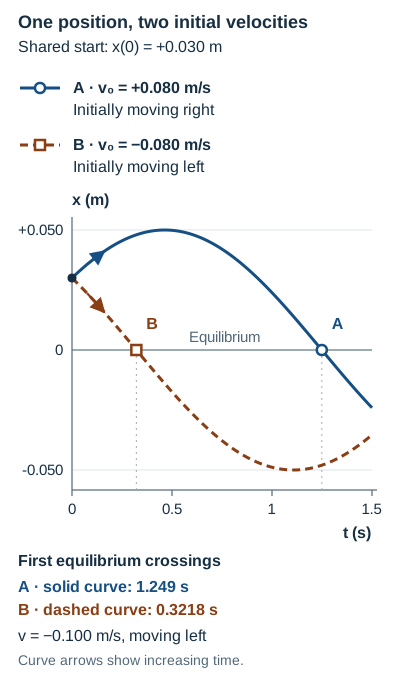
Question 2 — Start on the other side.
In a separate run with the same mass and spring, use and . Find amplitude, a valid phase, and the first future equilibrium crossing with its velocity. Explain why automatically choosing in the crossing equation would fail.
Hint: choose the quadrant before the time.
Find , then the signs of and . The block starts left of equilibrium and moves right toward it.
Solution: the earliest root can use a negative integer.
Here , , and . Let . One valid phase is , with cosine and sine . The first future zero occurs at phase , corresponding to :
The velocity is . Choosing would find a later crossing; it would miss the word “first.”
Work through the starting point with a tutor
Start with an oscillation question you’re stuck on, or ask to review what position, velocity and phase mean. Your tutor can help you choose the equilibrium reference, interpret the initial direction, build the two initial-value equations and check the first event against a sketch. Then try a changed initial state with guidance where needed. Your current course outline can help choose the appropriate algebra or calculus approach. Sessions are currently offered in English. Topic support and availability are confirmed before booking.
Useful for
Optional practice when spring oscillations or simple harmonic motion are in your current outline. This lesson uses algebra and trigonometry; differentiation is optional. Follow your current section’s outline for required topics and assessments.
Work on the step you’re missing.
Tell us the subject and your preferred time. Nablio confirms the details by text or email.
Request a lesson