Université de Montréal PHY1902 tutoring
Electricity and Optics: send your chapter so we can check whether we can help before you book.
Course overview
PHY1902 develops electricity and optics across several models: charges and fields, steady-current circuits, magnetism and light. Its official scope includes both ray-based and wave-based optics, so a circuit-only revision plan would leave out a substantial part of the subject.
Topics include Electric fields and electrostatics, Direct-current circuits, Magnetism, Geometrical and wave optics.
PHY1902 topics to review
Common difficulties
- Recognizing which components share a current and which share a voltage
- Keeping field directions and optics sign conventions tied to a labelled diagram
Preparing for this course
Review scientific notation, vector components, trigonometry and rearranging equations. Attach a unit and a physical meaning to charge, current, voltage and resistance. Redraw a circuit using its connections rather than its appearance.
Registration requirements
Consult the official course description for prerequisites, restrictions and section details.
Check the official course catalogueTry a course problem
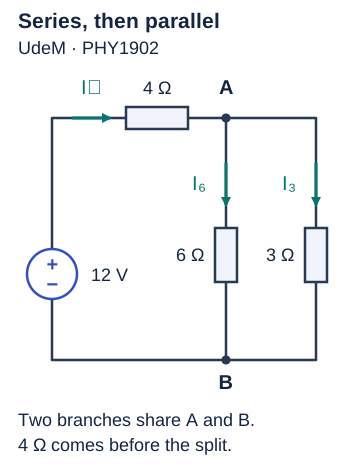
An ideal source maintains a voltage of . It supplies a resistor in series with a parallel pair of and resistors. Find the current supplied by the source and the current in each parallel branch. Explain a check that would catch a connection error.
Circuit for the practice question
Show the reasoning
1. Identify the connections. The parallel resistors connect to the same two points, called nodes, so the voltage across them is the same. Let be their equivalent resistance. Then , hence . The series resistor adds directly, giving total resistance . 2. Find the source current. Ohm’s law states , where is current, the voltage across a resistance, and that resistance. Thus the source current is . It also flows through the series resistor, whose voltage drop is . 3. Find the branch currents. The remaining voltage across the parallel pair is . Let and be the currents through the resistors of and , respectively. Then and . 4. Check that the branch currents add up to the source current at the junction: . The loop voltage check is . Applying the full source voltage to each parallel branch would fail these checks because it would ignore the series voltage drop. The smaller branch resistance carries twice the current at the same voltage. Doubling the source voltage would double every current in this ideal resistive model.
For the optics part of your course, practise measuring ray angles and interpreting real and virtual images. Review reflection, refraction and lens images
How tutoring can help
You can start with the problem statement, a concept you want explained or a diagram you have already drawn. Your tutor can help draw or interpret a circuit or ray diagram, identify the physical model and explain the connections or sign convention. You can then build the relevant equation together and compare its result with the direction or behaviour you expected.
Exam preparation for PHY1902
Use the current section outline to choose among electrostatics, circuits, magnetism and optics. Practise identifying the physical quantity requested before selecting a formula. In each solution, include a diagram, units and a conservation or limiting-case check; a numerical answer alone can hide an incorrect model.
Use your section’s outline to choose the chapters to review. We work through permitted practice and comparable problems, without completing graded assignments or exams on your behalf.
Need help with PHY1902?
Send your topic and preferred times. We’ll confirm whether we can help and, if so, agree on a time by text or email before payment.
Request PHY1902 tutoringNablio is an independent service and is not affiliated with this institution.