Choose your starting point
An exponential rule tells you the output after repeated multiplication. A logarithm answers the reverse question: how many multiplicative steps produced this output? We will build that connection rather than memorize a list of rules.
Beginner route: work through sections 1–2, then questions 1–4. You can model growth and decay, read exponential graphs and solve same-base equations without logarithms. Advanced route: continue through sections 3–6 and questions 5–12 to derive log laws, interpret inverse graphs and find unfamiliar thresholds. There are six worked examples and twelve original practice questions.
Use the algebra prerequisites for rearranging equations and exponents, and functions, transformations and inverses for domain, range and point mapping. All quantities here are real. In a mathematical expression, logarithm inputs and exponents are dimensionless numbers; in a model we use a ratio of like units or time divided by a time interval.
1. Add the same amount or multiply by the same factor?
Worked example 1: distinguish two models
Two idealized storage processes start with 80 MB of data. After each hour, process L adds 40 MB; process E increases its current total by 50%. Let be elapsed time in hours and let and be the numerical amounts in MB.
| Time (h) | L (MB) | E (MB) |
|---|---|---|
| 0 | 80 | 80 |
| 1 | 120 | 120 |
| 2 | 160 | 180 |
| 3 | 200 | 270 |
For L, consecutive differences are 40, 40, 40 MB. For E, differences are 40, 60, 90 MB, but ratios are . Thus , while at whole hours. The first two data points do not distinguish these rules; the third does.
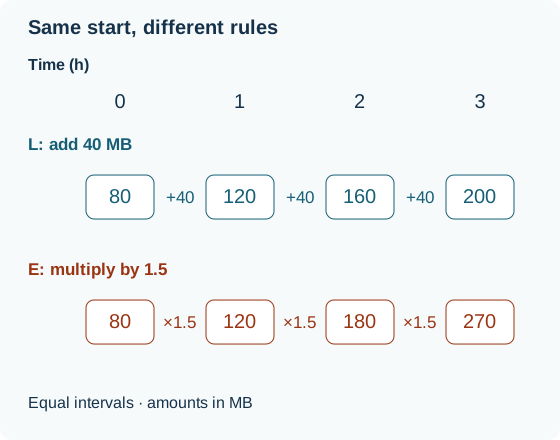
The general model is , where is the initial amount, the factor per interval, and the interval duration in the same units as . For a fractional rate , growth has ; decay has , with . A 20% loss means multiply by 0.80, not by 0.20. A constant ratio over two-hour steps is a two-hour factor, not an hourly factor.
The formulas assume the factor stays fixed and no separate additions or removals occur. If growth happens only at hourly updates, use integer times. Extending to fractional hours requires a continuous exponential assumption. A short table may fit a model without proving that it continues forever.
2. Exponents, exponential graphs and a common base
For a positive base , repeated multiplication gives . Dividing gives , so and . Also . Rational exponents extend the pattern: for a positive integer , and . Positive bases avoid the real-domain complications of negative bases. These laws extend to real exponents.
For , assume and . The domain is all real numbers, the range is , and the graph passes through . If , it increases; if , it decreases. The horizontal asymptote is : the output approaches zero in one direction but never equals it. Base 1 would be constant, so it could not have a logarithmic inverse.
Worked example 2: solve without a logarithm
Solve . Both sides are powers of 3:
Why can we equate exponents? The function is strictly increasing, so two inputs cannot produce the same output. Check: . The exponent is not : the entire is multiplied by 2.
Beginner checkpoint: try questions 1–4 now. If an equation cannot easily be written with a common base, a graph can estimate the answer. The next section develops the exact inverse tool.
3. A logarithm is an exponent, and its laws follow
For , and , define to mean . Read it as “the exponent on base that gives .” Thus , , and . A negative logarithm is allowed; a nonpositive real logarithm input is not.
Worked example 3: derive, then use, the laws
Let and , with . Then and . Their product is . Taking the exponent that produces it gives . Division similarly gives , and raising to a real power gives . Therefore:
Use these laws on : . Check directly: . Keep every original log input positive when applying a law to variables.
There is no analogous sum law: , whereas . Nor is valid for negative ; for any nonzero real , the matching formula is .
On a calculator, here means base 10; means base , where . Change of base follows by writing and taking natural logs: , hence . The denominator is nonzero because . Use the same log base in numerator and denominator.
4. Inverse graphs exchange domain, range and asymptotes
The functions and undo one another: for every real , and for . Their graph points exchange coordinates. For base 2, become . This is reflection across , not across an axis.
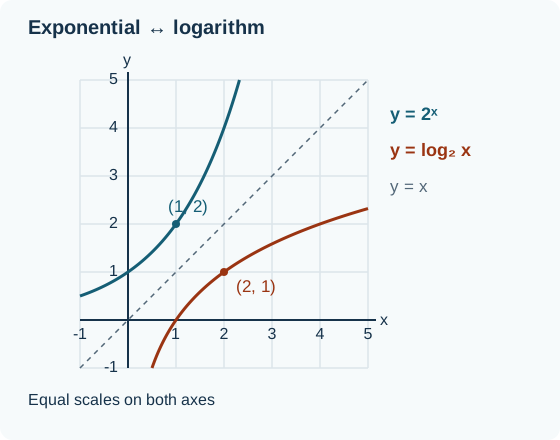
The logarithm has domain , range all real numbers and intercept . For , it increases; for , it decreases. An asymptote describes approach, not a graph point.
Worked example 4: a transformed logarithm and its inverse
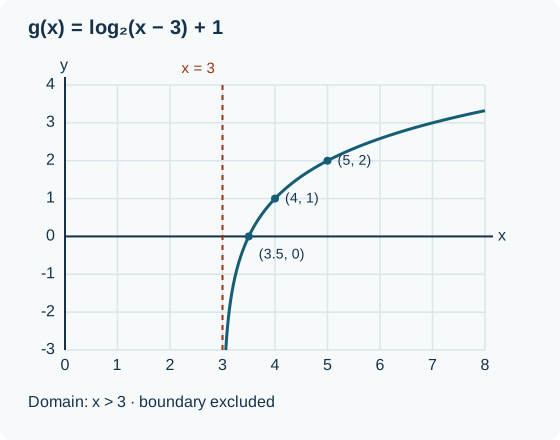
Let . Its argument requires , so the domain is . Its range is all real numbers and its vertical asymptote is . The parent point moves to . For its x-intercept, gives , so .
To reverse it, write , then . Thus , with domain all real numbers, range and horizontal asymptote . Check , then .
5. Solve an equation without losing the original domain
Worked example 5: combining logarithms can hide a restriction
Solve . Before combining, require and , hence . On this domain, the product law gives
The algebraic candidates are 5 and −1. Only 5 lies in the original domain. Check: . At −1, both original inputs are negative, even though their product is positive. The combined expression has a larger domain than the original sum unless we carry the restrictions along.
For exponential equations with no convenient common base, first isolate the exponential, then take a logarithm. For instance, the equation becomes , giving . If isolation instead produces , there is no real solution because a positive base has positive outputs. A calculator error is not a substitute for this domain reasoning.
A useful order is: record restrictions → isolate or combine appropriately → solve → check in the original equation. A logarithm is a function, not a factor you can cancel across a sum.
6. Thresholds: solve, interpret and check the interval
Worked example 6: decay to a threshold, then contrast growth
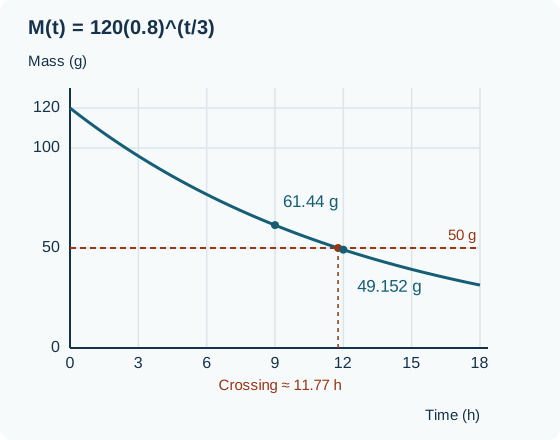
An idealized sample starts at 120 g and retains 80% of its mass every 3 hours. Assume continuous exponential decay with a constant factor and no added material. Let be elapsed hours and be mass in grams. The exponent counts three-hour intervals. When is the mass at most 50 g?
Natural log is increasing, so taking it preserves the inequality. But , so division reverses the inequality:
The equality is the crossing time; all later times satisfy the condition. If the sample is checked only every 3 hours, the first qualifying check is at 12 hours: g, but g. Do not round 11.77 down or confuse 3.92 intervals with 3.92 hours.
For comparison, a storage amount of 80 MB growing by 50% per hour reaches at least 250 MB when . Thus hours under a continuous model. Here , so no reversal occurs. With whole-hour updates, the first qualifying update is hour 3: 180 MB at hour 2, 270 MB at hour 3.
In either case, divide the target by the initial amount before taking logs: 50 g / 120 g and 250 MB / 80 MB are dimensionless ratios. Check the factor, time unit, direction of change, and observation schedule. Real growth can slow as resources run out; use the model only over the interval where its assumptions are reasonable.
Twelve practice and transfer questions
Try each problem before opening a hint. Questions 1–4 use only the beginner route; 5–10 add logarithms; 11–12 transfer the ideas to a new model.
At equal two-hour intervals, an amount is 50, 60, 72, 86.4 L. Is a linear or exponential model supported? Give its factor and a rule using time in hours.
Optional hint 1
Compare successive ratios. The factor belongs to two hours.
Explained solution 1
The ratios are all 1.2; differences are 10, 12, 14.4 L. An exponential model fits: L, initially at . A continuous extension needs an additional assumption; the observations alone do not establish one.
Evaluate exactly. Explain both the denominator 4 and the negative sign in the exponent.
Optional hint 2
Take a fourth root, raise to the third power, then take a reciprocal.
Explained solution 2
, so . The negative exponent means reciprocal, not a negative output.
For , state the domain, range, y-intercept and horizontal asymptote. Is it increasing or decreasing?
Optional hint 3
The base is between 0 and 1. Test x = −1, 0, 1.
Explained solution 3
The values 3, 1, 1/3 decrease. Domain: all real numbers. Range: . Intercept: . Asymptote: , approached as x increases; zero is never reached.
Solve using a common base.
Optional hint 4
Use base 2 and multiply each entire exponent.
Explained solution 4
, so and . Check: .
Evaluate and . Why are both answers allowed?
Optional hint 5
Translate each question into a power equation.
Explained solution 5
Both are −3: and . Each argument is positive, and each base is positive and different from 1. A negative output causes no domain problem.
For , expand . Then explain why replacing by changes the expanded form.
Optional hint 6
Apply the product, quotient and power laws, and check the input of every new log.
Explained solution 6
For , the result is . For any , the original is defined but may not be; use .
Find the domain, range, vertical asymptote and x-intercept of .
Optional hint 7
The argument must be positive. For an intercept, set the entire output equal to zero.
Explained solution 7
Domain: ; range: all real numbers; asymptote: . From , , so the intercept is . The asymptote is excluded.
Find the inverse of , state its domain and range, and check one paired point.
Optional hint 8
Reverse the output shift, the logarithm and the input shift, in that order.
Explained solution 8
From , get . Hence , domain all real numbers, range . Since , the inverse gives .
Solve . Give an exact answer and a decimal to three places.
Optional hint 9
Take the same logarithm of both sides, then use the power law.
Explained solution 9
, so . Both sides are positive; substitution in the exact expression returns 17.
Solve , checking the original domain.
Optional hint 10
Require each argument to be positive before forming the product.
Explained solution 10
The original domain is . The product equation gives , hence and candidates ±2. Only remains: . At −2 the original logs are undefined.
Transfer: a model doubles an initial 30 MB every 4 hours. Assuming continuous exponential growth, when does it first reach 200 MB? If observations occur only at whole hours, which observation first meets the target?
Optional hint 11
Use . Solve for time, not for the number of doubling intervals.
Explained solution 11
h. Since the model increases, it meets the target for later times. The first whole-hour observation is hour 11. At hour 10 it is about 169.71 MB; at hour 11 about 201.82 MB.
Transfer and retry: a sample retains 90% of its mass every 2 hours. Initially it is 200 g. Assuming continuous exponential decay, when is it at most 100 g, and what is the first qualifying two-hour check? Retry with a threshold of 80 g.
Optional hint 12
Use . Dividing by reverses the inequality; a scheduled check must be a multiple of 2 hours.
Explained solution 12
For 100 g, h; first check: 14 h. At 12 h the mass is 106.2882 g; at 14 h it is 95.65938 g. For 80 g, h; first check: 18 h. At 16 h it is about 86.09 g; at 18 h about 77.48 g. A smaller decay threshold takes longer.
Readiness check: can you explain why equal intervals matter, why log inputs must stay positive, and why a continuous crossing time may differ from the first scheduled check? Revisit sections 1, 5 or 6 if one of these needs another pass.
Course context and your next step
The Ontario mathematics curriculum separates Grade 11 MCR3U exponential functions (printed pages 48–49) from Grade 12 MHF4U exponential and logarithmic functions (pages 87–89). The beginner route targets selected exponential foundations; the advanced route adds logarithm laws, inverse graphs, equations and applications. It does not imply that logarithms are required in the Grade 11 exponential strand.
The official Concordia calendar lists exponential and logarithmic functions and transformations in MATH 201, Elementary Functions. This is original selected-topic practice, not an official handout, complete course review or guarantee of exam coverage. Use your current section’s outline for assessment scope.
If you would like help connecting a graph, an equation and its domain, algebra and precalculus tutoring can help you work through the steps at your pace. Tutoring sessions are currently offered in English.
Useful for
Focused practice for exponential and logarithmic functions in Concordia MATH 201. Start with exponential models; continue to logarithms when they are on your topic list. This is not a complete course review.
Work on the step you’re missing.
Tell us the subject and your preferred time. Nablio confirms the details by text or email.
Request a lesson