Return to McGill MATH 206 course guide
Stuck on a step? Text us Email us Request a lesson
Matrices and vectors become easier to use when each calculation has a clear meaning. Row operations preserve a system’s solutions. A dot product measures alignment. Span describes what combinations of vectors can produce.
Use this guide to review the main matrix and vector concepts for Concordia MATH 204. Check your course outline for the topics on each assessment, including later topics such as eigenvalues.
1. Translate a system into an augmented matrix
Use the same variable order in every row. A coefficient matrix contains the variable coefficients; an augmented matrix includes the constants as a final column. A missing variable has coefficient zero.
Worked example
For and , the augmented rows are The first column represents in both equations; the second represents .
Common mistake. Putting a constant in a coefficient column, or changing variable order between rows.
Try it yourself
Write the augmented rows for and .
Show answer and reasoning
Keep , , constant in that order.
2. Row operations preserve the solution set
You may swap rows, multiply a row by a nonzero number, or add a multiple of one row to another. State the operation so someone else can follow the argument. Each permitted operation is reversible: swap back, divide by the same nonzero number, or subtract the same multiple of the unchanged source row. This is why the shared solutions stay the same. and mean rows 1 and 2; means “replace by.”
Worked example
Starting with use to get . Divide row 2 by , then use . The final rows are giving , . Check: and .
Common mistake. Operating only on the coefficient side, forgetting the augmented entry. Multiplying a row by zero also destroys information.
Try it yourself
Solve and .
Show answer and reasoning
Add the equations to get . Thus and . Both original equations are satisfied.
3. Interpret the result, not just the arithmetic
A row of zeros can represent a redundant equation. A row such as means , so the system is inconsistent. Free variables may describe infinitely many solutions; identify them explicitly. In a consistent system, meaning one with at least one solution, free variables may be assigned real values independently. After values have been chosen for all free variables, the remaining equations determine the other variables. In the example, choose any real number as the value of . A zero row guarantees neither no solutions nor infinitely many by itself: check the other rows.
Worked example
and describe the same line. The solution is , for any real , not just one convenient pair.
Common mistake. Treating every zero row as proof of no solution, or setting all free variables to zero without explaining that other values are possible.
Try it yourself
Can and both hold?
Show answer and reasoning
No. Doubling the first equation gives , contradicting 5. Row reduction produces a row .
4. Distinguish a dot product from a projection
A plane vector has two components: horizontal and vertical. A scalar is a single number. For another vector , define the dot product by : multiply corresponding components, then add. In particular, is its squared length. The projection of onto nonzero is the part of along the line through . Write it as , where is a number to find. Two nonzero vectors are perpendicular exactly when their dot product is zero; a zero remainder also has zero dot product. The remainder must be perpendicular to , so . Expanding gives . Therefore , and the projection is .
Worked example
For and , and . The projection is The remainder is perpendicular to .
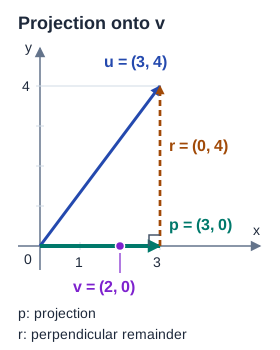
Common mistake. Returning a vector for a dot product, using the wrong denominator for projection, or projecting onto the zero vector.
Try it yourself
Project onto .
Show answer and reasoning
The dot product is 5 and the squared length of is 2. The projection is
For a proof that the orthogonal projection is the closest vector, try the MATH 206 residual argument. This is a deeper topic example, not a statement of course equivalence.
5. Use linear combinations to explain span
A linear combination multiplies vectors by real-number coefficients and adds the results component by component. For two vectors and , write , where and are any real numbers. Their span is the set of all vectors these choices can produce. They are independent if the only way to produce the zero vector is to choose .
Worked example
For and , . If , then and , forcing both coefficients to zero. The vectors are independent and span the plane. To verify the entire plane is spanned, take an arbitrary target . The equations and give and . These choices work for every real .
Common mistake. Assuming different vectors must be independent. One may still be a multiple of another.
Try it yourself
Are and independent? What do they span?
Show answer and reasoning
They are dependent because . Their span is the line of all , not the whole plane. Here ranges over all real numbers.
6. Connect multiplication, determinant and inverse
Reuse the preceding vectors: put and into the columns of a matrix . The column vector holds their two coefficients; is the resulting vector. Multiplication builds the result from the coefficients. An inverse, when it exists, recovers the coefficients from the result. Here all entries are real numbers.
Worked example
1. Multiply row by column. A matrix has two rows and two columns. The column vector has size , so each row of can pair with its two entries. Multiply corresponding entries and add. The product has two rows and one column. This is the same linear combination as :In any matrix product, the number of columns in the first factor must equal the number of rows in the second.
2. Test whether recovery is possible. For a matrix, its determinant is the top-left entry times the bottom-right entry, minus the top-right entry times the bottom-left entry. The notation means this scalar:A square matrix has an inverse exactly when its determinant is nonzero. Thus this can recover one unique input for every output. A zero determinant would mean that some input information is lost; a unique recovery would not be possible for every output.
3. Check the inverse with matrix multiplication. The identity matrix leaves a vector unchanged. The inverse is a matrix satisfying both and . Here means multiplied by : apply the same row-by-column rule to each of the second matrix’s columns. Let denote the entry in row , column of , with each equal to 1 or 2.Therefore half of undoes in either order:The factor multiplies every entry. This shortcut works for this matrix because ; it is not a general formula for inverses.
4. Recover the original coefficients. Apply to the output , written as a column:The recovered entries 3 and 1 are the coefficients of the two original columns, not the output coordinates 4 and 2.
Common mistake. Matrix multiplication is row by column, not entry by entry. The inverse is not obtained by taking the reciprocal of each entry. Check the nonzero determinant condition before claiming that an inverse exists.
Try it yourself
Keep the same matrix , but now the output is , written as a column. Recover , verify row by column, and explain why there is only one answer.
Show answer and reasoning
Use the same inverse because has not changed:
Check the forward calculation:Since , the inverse exists. Applying it to both sides of forces , so no other input can give this output.
From a basis to coordinates: keep the vector, change its description
Later-course workshop. Once you can solve a system and explain span and independence, use those skills to find coordinates in an ordered basis. Then convert between two bases and check the direction of the conversion. Allow extra study time beyond the core guide above. These original examples and six progressive exercises cover selected topics, not a complete final-exam syllabus.
For Concordia MATH 204, coordinates, bases, dimension and linear transformations appear in the later part of the Fall 2026 outline. The early-course midterm mock remains limited to weeks 1–6. Use your current section instructions to choose what to practise.
What a coordinate column means
We work over the real numbers. An ordered basis of is an ordered pair of independent vectors that spans the plane. Every vector has exactly one representation
The entries of tell you how much of each basis vector to use, in the stated order. They need not equal the usual horizontal and vertical components of . Swapping the basis vectors swaps the entries of its coordinate column. A basis need not be perpendicular or made of unit vectors.
Spanning guarantees that coefficients exist. Independence guarantees that they are unique: subtracting two representations gives a zero combination, so the differences of their coefficients must all vanish. Without both properties, coordinates for every vector would not be well defined.
Put the usual components of the basis vectors into columns, not rows:
Here and below, an unbracketed vector in a matrix product denotes its standard coordinate column. Multiplying by reconstructs the vector. To recover its basis coordinates, solve . For a basis of the whole plane, is invertible, so ; you can solve the system directly without calculating the inverse.
Worked example 1: solve, then reconstruct
Let , , , and . First verify the basis:
A nonzero determinant means the columns are independent and span . To find the coefficients, equate components in :
Subtract twice the first equation from the second. This gives , hence and . Therefore
Check the meaning: . The vector has not moved; its two coefficients describe it using different building blocks. Writing would confuse standard components with basis coefficients. Multiplying would also answer a different question: it treats the standard components as if they were basis coefficients.
Worked example 2: label the direction of a change of basis
Keep , and let , with and . We want a matrix that takes B-coordinates as input and C-coordinates as output. Define its direction explicitly:
Find each column by asking how to express each old basis vector in the new basis. Since and ,
The first column is the output for the input in B-coordinates, which represents , not necessarily the standard first unit vector. The second column does the same for . For the vector from example 1:
Reconstruction checks the answer: . Both coordinate columns describe the same vector.
Derive the formula instead of memorizing an order. Reconstruct from B-coordinates, then solve for C-coordinates:
Matrix products act from right to left. The right factor reconstructs; the left factor recovers the target coordinates. Equivalently, solve for each column , rather than explicitly inverting .
For the reverse direction, use the inverse matrix:
Indeed, multiplying this matrix by gives . Do not assume the reverse matrix is the transpose; for example, the inverse equals the transpose when both bases are orthonormal. Here the inverse is visibly different from the transpose.
Worked example 3: two coordinates for a vector in three-dimensional space
Let , and take the ordered pair , where , . Every member of can be written as
These vectors are independent because the first two components of a zero combination force both coefficients to zero. Thus is a basis of , and , although its vectors have three standard components.
For , we get . The matrix with columns has size . It reconstructs members of the plane from two coefficients, but has no ordinary two-sided inverse.
For , the first two components would force coefficients ; their third component would then be , not . Therefore and does not exist. Always name the space your proposed basis spans.
Six progressive exercises
Keep the bases and from the worked examples unless another basis is specified. Try each question with its solution closed. Questions 1–2 build fluency, 3–4 practise conversion, 5 diagnoses a failed basis, and 6 is an optional connection to linear transformations.
1. Reconstruct and reorder
If , find in standard components. What are its coordinates in the reversed basis ?
Hint for question 1
The first coefficient multiplies the first vector in the stated ordered basis.
Full solution to question 1
Reversing the basis order requires . The combination is still the same vector. Keeping the coefficients in their old order would generally change the reconstruction.
2. Recover coefficients and reject a shortcut
Find for . A student uses as the first coordinate. Is that valid here?
Hint for question 2
Solve the two component equations. The projection formula does not generally isolate a coefficient in a nonorthogonal basis.
Full solution to question 2
Elimination gives , so , , and . Check: .
The proposed projection coefficient is , not . Because , taking a dot product with includes a contribution from the second basis vector. For an orthogonal basis, division by each basis vector’s squared length would recover the coefficients; this basis is not orthogonal.
3. Convert and check both reconstructions
For , find using . Then reconstruct using each basis.
Hint for question 3
The input column is already in B-coordinates. Multiply by the conversion matrix, then use the appropriate basis for each reconstruction.
Full solution to question 3
Using B gives . Using C gives . The agreement checks both arithmetic and direction. Applying the inverse instead would convert C-coordinates to B-coordinates, the opposite task.
4. Build a new conversion matrix
Let . Find by expressing the two B basis vectors in D. Use it to convert , then check against question 1.
Hint for question 4
For a vector , solve , . The answers become a column, not a row.
Full solution to question 4
The equations give , . Thus and .
Multiplying by gives . Reconstruction gives , agreeing with question 1. The conversion changes coefficients, not the vector.
5. Explain why a proposed basis fails
Someone proposes as a basis of . Describe all coefficients representing , and decide whether has a representation. What fails about treating those coefficients as coordinates?
Hint for question 5
The second vector is twice the first. Write any combination as a multiple of the first vector.
Full solution to question 5
Every combination is . For , the equation is , so every coefficient pair is , with . There are infinitely many, for example and .
The vector has no representation: a first component of 3 forces the second to be 6. The list is dependent and spans only a line. It therefore gives neither unique coefficients on that line nor a representation for every vector in the plane. It is not a basis of either that line or the plane; the single vector would be a basis of the line.
6. Optional transfer: the same linear transformation in a different basis
Let . Find the matrix satisfying . Use the B-coordinates of and as columns. Check the result with .
Hint for question 6
First apply the transformation to each basis vector in standard components. Then solve for each output’s B-coordinates. This matrix changes the vector through T, not merely its description.
Full solution to question 6
We have , and . Therefore
Since , multiplication gives . Reconstructing gives , exactly .
The standard matrix is . The calculation follows the three-step route
Read from right to left: reconstruct the input, apply the transformation, then express the output in B. Compare this with , which represents the same unchanged vector in a new basis. These formulas solve different problems.
Check your result and choose the next step
- Write the ordered source and target bases beside your work.
- Decide whether you are reconstructing a vector, finding its coordinates, changing its basis, or applying a transformation.
- Label conversion arrows and put coordinate columns in the correct order.
- Reconstruct the original vector in both bases. This helps detect a reversed matrix even when the arithmetic is consistent.
- Check the space: two independent vectors may be a basis of a plane in three-dimensional space, not of all of space.
If existence or uniqueness is unclear, revisit subspaces, span and independence. To see why some bases simplify a transformation, continue with eigenvectors and eigenspaces. Return to the MATH 204 revision route to choose other later-course topics from your outline.
Ready to choose an eigenbasis? Build and check a factorization in the diagonalization and matrix-powers workshop.
Your next revision session
- For each question, name the required output: a scalar, vector, solution set, or statement about a span.
- Mix calculations with interpretation. Identify which variables are determined and which can be chosen freely, and verify any proposed solution in the original equations.
- Use your own outline to extend this first look at determinants and inverses, and add transformations, bases or eigenvalue topics when required. This foundational guide is not an exhaustive exam syllabus.
Useful for
Work on the step you’re missing.
Tell us the subject and your preferred time. Nablio confirms the details by text or email.
Request a lesson