Return to Humber Polytechnic CALC 1500 course guide. Tutoring coverage for this course must be confirmed before booking and payment.
Stuck on a step? Text us Email us Request a lesson
For course topics and one-to-one help, see Concordia MATH 205 tutoring.
A power series can converge for one value of and diverge for another. The task is to find all the values that work. A radius of convergence describes the distance from the centre; it does not decide whether either endpoint belongs in the answer.
By the end of this lesson, you should be able to find that radius, test both endpoints in the original series, and distinguish absolute from conditional convergence. The first part has two examples and four questions; the optional construction section adds three worked examples and six questions with separate hints and explained answers.
You should already know geometric series, the ratio test, p-series and the alternating-series test. For a short review of ratio-test reasoning, comparison and conditional convergence, try three convergence decisions to explain. Here is real, and the examples in sections 1–7 start at ; the construction examples in section 8 start at unless indicated otherwise.
1. What a radius does and does not tell you
A power series centred at has the form
The coefficients and the centre are fixed; the input varies. Once you choose , you get an ordinary numerical series. Convergence means that its partial sums approach a finite number. For the general form above, the constant term is ; at the centre, all positive powers vanish, so the series converges to . In the examples in sections 1–7, which start at , the value at the centre is zero.
Absolute convergence means the series of absolute values converges. It implies convergence of the original series. Conditional convergence means the original series converges but its series of absolute values diverges.
For a finite positive radius , the power-series convergence theorem gives three regions:
- Inside: if , the series converges absolutely.
- Outside: if , the series diverges.
- At the endpoints: if or , a separate test is needed.
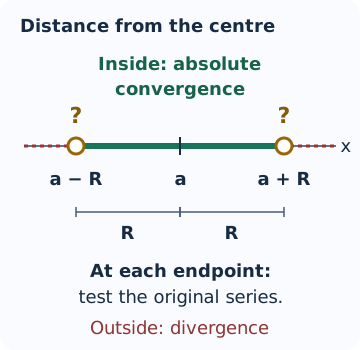
The interval of convergence is the full set of real inputs for which the series converges. For a finite positive radius, it can be open, closed, or include just one endpoint. A square bracket includes an endpoint; a parenthesis excludes it. The radius is half the distance between the endpoints, regardless of the brackets.
2. A routine that keeps endpoint work separate
- Name the centre and the term. Write the term as . If a ratio would divide by zero at the centre, handle that input directly.
- Find the open interior. For a fixed input where the ratios are defined, calculate . The ratio test proves absolute convergence if and divergence if , including an infinite limit. It is inconclusive if . If the ratio limit fails to exist or the ratios are undefined, choose another test, such as the root test.
- Solve the inequality for . Express it as , or as an open interval, and identify the centre and radius.
- Substitute each finite endpoint into the original term. Simplify the resulting numerical series before choosing a convergence test. A ratio limit of one does not settle either endpoint.
- Write the complete answer. Give the interval, the radius, and any conditionally convergent endpoints. Check the centre is included and the endpoint distances from it are equal.
Useful endpoint patterns: a p-series converges exactly when . An alternating series with positive magnitudes decreasing to zero converges; to decide whether that convergence is absolute, test the magnitudes as a separate series.
3. Worked example: one endpoint included
Find the radius and interval of convergence of
Recognize the centre and compute the ratio
The centre is . At , every term is zero, so the series converges. For , use . Cancel factors in the absolute-value ratio:
For a fixed , the factor is constant as grows, while .
Find the open interval and the radius
Absolute convergence follows when
Thus . The series diverges for and . At either endpoint, the ratio limit is one, so it is still too early to choose the brackets.
Test the left endpoint in the original series
At , the factor is . The series becomes
The magnitudes are positive, decrease because , and tend to zero. The alternating-series test proves convergence. Their absolute values give the divergent harmonic series, so convergence at this endpoint is conditional.
Test the right endpoint and assemble the answer
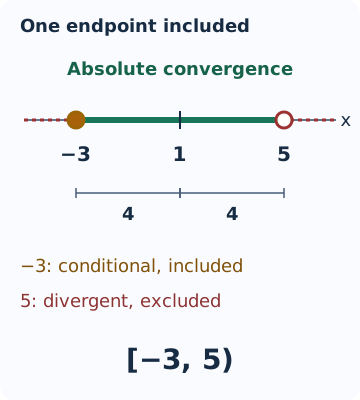
At , the factor is . The resulting series is the harmonic series, so it diverges. Include the left endpoint and exclude the right:
Convergence is absolute for , conditional at , and absent elsewhere. The endpoint distances from the centre are both four.
4. Worked example: both endpoints included
Now find the convergence interval for
Read the centre from the whole expression
Since , the centre is , not one. At that input, every term is zero. For , the ratio is
Solve the inequality before naming the radius
The interior is , so its midpoint is and its radius is . The coefficient two changes the radius; the right-hand side of the first inequality is not itself the radius.
Check both endpoints for absolute convergence
At , the series is . At , it is . At either endpoint, the absolute values form the convergent p-series with . Therefore both endpoints converge absolutely.
The series converges absolutely throughout the closed interval and diverges outside it. Here there are no conditionally convergent inputs.
5. When the radius is zero or infinite
Not every power series has two finite endpoints. If it converges absolutely for every real input, write and the interval . Infinity is not an input to substitute, and it never gets a square bracket.
If the series converges only at its centre, write and give the set . Do not create two different endpoint tests for the same point. Question 4 lets you recognize both cases from factorials.
6. Four questions to try
Keep the answers closed at first. The questions move from interpreting an inequality to handling endpoint signs and exceptional radii. Each answer explains the conditions needed, not only the final brackets.
Question 1: separate the radius from the brackets
For a power series, the ratio-test limit away from the centre is . Solve to find the centre, radius and open interval. Does this inequality alone decide whether either endpoint is included?
Show a hint for question 1
Factor out two, then solve the double inequality. Keep “where the test proves convergence” separate from “where the original series converges.”
Show the answer and reasoning for question 1
Since , the inequality is . Thus , , and the open interval is .
No endpoint conclusion follows from the inequality alone. You still need the original series at and . A ratio-test limit of one is inconclusive; do not add or remove an endpoint without another argument.
Question 2: can alternation fail to help?
Find the radius and interval for the geometric power series
Show a hint for question 2
Its geometric ratio must have absolute value less than one. At each endpoint, check whether the terms tend to zero before trying any other test.
Show the answer and reasoning for question 2
The geometric ratio is . Its absolute value is less than one exactly when , so and . The centre is included because all terms are zero there. For or , the magnitudes of the terms grow rather than tend to zero.
At , the terms are ; they alternate but do not tend to zero. At , the terms are all one. Both endpoint series diverge by the necessary condition that a convergent series has terms tending to zero.
The interval is , with absolute convergence everywhere inside and no included endpoints. Alternating signs alone never suffice for the alternating-series test.
Question 3: which endpoint is conditional?
Find the radius, interval and any conditionally convergent inputs for
Show a hint for question 3
The extra alternating factor does not change the absolute-value ratio. It does change what happens when you substitute an endpoint: simplify both sign factors together.
Show the answer and reasoning for question 3
The centre is , where all terms vanish. For ,
Absolute convergence holds when , or . Thus , and the series diverges outside the endpoints.
At , the two factors multiply to one. The resulting positive series is , a divergent p-series with .
At , the series is . Its positive magnitudes decrease because , and tend to zero. The alternating-series test proves convergence. The series of magnitudes is the divergent p-series just identified, so this endpoint is conditional.
The answer is and : absolute convergence on , conditional convergence only at . The left endpoint is not automatically the alternating one.
Question 4: factorials change the whole interval
Compare these series. Find the centre, radius and convergence set for each:
Here , so .
Show a hint for question 4
Cancel the factorials in each absolute-value ratio. Hold the input fixed as the index grows, and check each centre directly.
Show the answer and reasoning for question 4
For , the centre is , where all terms vanish. Away from it, the ratio is , which tends to zero for every fixed real . The ratio test proves absolute convergence for every input: and . There are no finite endpoints to test.
For , the centre is , where all terms vanish. At every fixed , the ratio is , which tends to infinity. The series diverges at each of those inputs. Only the centre remains: and the convergence set . It converges absolutely there because all terms are zero.
7. Check your reasoning and choose a next step
- Before choosing brackets: did you substitute each finite endpoint into the original series?
- Before using alternation: did you check positive magnitudes, decrease and a zero limit?
- Before saying “absolute”: did you test the series of absolute values?
- Before reporting the radius: did you measure from the centre, after accounting for any factor multiplying ?
If the algebra was difficult, redo question 1. If an endpoint was unclear, close the answers and redo question 2 or 3, writing the resulting numerical series first. If you automatically expected two finite endpoints, revisit question 4.
For more practice choosing tests for a numerical series, use Series Convergence: Three Decisions to Explain. The Concordia MATH 205 guide places this topic alongside integration and other course material. A convergence interval tells you where a series converges; it does not by itself give its sum or an approximation-error bound.
8. Build a Maclaurin series, then integrate it
You can now find where a given series converges. The next task runs in the other direction: start with a function and construct a series that represents it. You will reuse one geometric identity, carry its restrictions through substitutions, and integrate to obtain new functions. These are original practice questions, not predictions of a college exam.
Before starting: know geometric sums, powers, basic antiderivatives and the endpoint tests above. All inputs and outputs here are dimensionless. Allow about 30–40 minutes for this extension, or split it into two sessions. If you are stuck at the first line, open the worked explanation immediately; an attempted solution is not a prerequisite for getting help.
The three questions to keep separate
- Representation: does this infinite sum equal the function?
- Convergence: at which inputs does the sum exist?
- Approximation: how far is a finite sum from the function?
A ratio test can answer convergence without identifying the sum. A polynomial is defined for every real input, even when the infinite series it comes from represents the function only on a small interval. Keep the equality, its conditions and any approximation sign together.
Worked example 3: make a geometric pattern visible
Find a Maclaurin representation of , the first four nonzero terms, and the full convergence interval. A Maclaurin series is a power series centred at zero.
Start with the geometric identity, including its condition:
Factor the denominator before substituting. Here , and the factor stays outside the sum:
At , every term is . At , the terms alternate between and . Neither sequence of terms tends to zero, so both series diverge. The full interval is , with radius 2. The function itself exists at , where its value is ; this does not make the series converge there.
A finite-sum check: for , the exact geometric remainder is
At , four terms give . Since , the omitted remainder is . Adding it gives exactly . This remainder is an exact difference, not merely an upper bound.
Worked example 4: integration changes coefficients and endpoints
Construct a series for around zero. Instead of repeatedly differentiating the logarithm, begin with its derivative:
A power series can be integrated term by term on a closed segment entirely inside its open convergence interval. For any fixed , the segment between 0 and meets that condition. The variable is the integration variable; is the endpoint.
There is no unknown additive constant because the lower endpoint is fixed and both sides equal zero at . With an indefinite integral, include a constant and use a value such as to determine it. Do not change to in the denominator without also changing the index and signs.
Integration preserves the radius of convergence, but endpoints must be checked again. At , the series becomes , which diverges. At , it is the alternating harmonic series: it converges conditionally. Thus the interval is .
Does the sum at 1 actually equal ? Convergence alone does not prove that identity. Here we can use a finite identity without integrating an infinite sum at the boundary:
Integrate this finite equality from 0 to 1. The absolute value of the remainder integral is at most , which tends to zero. Therefore the alternating harmonic sum equals . The endpoint equality has now been justified separately.
Worked example 5: a new function from an even-power series
Represent by integrating a series for . Substitute into the geometric identity:
Integrate from 0 to , initially with . Since ,
The new denominator is , because that is the exponent after integration. The radius remains 1. At either endpoint, the absolute-value series is the divergent sum of reciprocals of odd positive integers; the alternating signs give conditional convergence. The convergence interval is .
To identify the endpoint sums, integrate the finite geometric remainder. On , the absolute remainder is at most , tending to zero. Thus the series at 1 equals . Oddness gives the value at −1.
For an interior estimate, the first three nonzero terms at give . The next omitted term has magnitude . The positive magnitudes decrease to zero, so the alternating-series estimate bounds the absolute truncation error by . This is an optional accuracy check; your class may ask only for the representation.
Six questions: from substitution to an independent integral
You may use the hints or read the solutions first, then close them and reconstruct the reasoning. For each representation, give its interval as well as its terms.
Guided substitution. Find the first four nonzero terms and interval for .
Hint
Factor out 3. Your geometric ratio is .
Solution and check
. The condition is , giving . At each endpoint the terms have constant magnitude , so both diverge. At zero the sum starts at , matching the function.
Repair a substitution. A student writes “for every real , since is never zero.” Which part is right, and what must be repaired?
Hint
Test the geometric ratio and then the series at .
Solution and check
The coefficients are right. The representation holds only for , because the ratio is . At , terms alternate between 1 and −1 and do not tend to zero. At , their magnitudes are , although the function has finite value . The function’s domain and its Maclaurin series’ convergence interval are different sets.
Scale a logarithm. Represent by a Maclaurin series. Give four nonzero terms and the full interval.
Hint
Replace the whole input of the logarithm series by . Test both endpoints after substitution.
Solution and check
, on . The left endpoint gives a negative harmonic series; the right gives the alternating harmonic series with sum . The first derivative at zero is 2, matching the linear coefficient. Each power must include its own factor .
Recover the constant. Suppose for and . Find a series for and a closed-form check.
Hint
Integrate from 0 to , and keep on the left.
Solution and check
. On , the closed form is . Differentiate it and evaluate at zero to verify both conditions. The series itself converges on : its left endpoint is an alternating harmonic tail, its right endpoint harmonic. The original conditions defined only for ; they do not themselves assign a value to . Its continuous extension there would be .
Terms versus degree. Find the first three nonzero Maclaurin terms of . Is the resulting polynomial of degree three?
Hint
Multiply every power by , not every coefficient.
Solution and check
. Three nonzero terms produce a degree-seven polynomial, not a degree-three polynomial. The representation is valid on ; multiplication by preserves the previously justified endpoint equalities. For , the terms do not tend to zero. At zero both sides vanish.
Independent transfer. For , find a series, its full convergence interval, and an estimate of using its first two nonzero terms. Bound the truncation error.
Hint
Multiply the geometric series by , then integrate. Check your result against .
Solution and check
Inside , . The closed form verifies the derivative and the value at zero. Both endpoints converge conditionally and agree with that function by the endpoint identities already proved, so the full interval is . At , the two-term estimate is . Decreasing alternating magnitudes give error at most , and the omitted first term is positive, so the exact value is larger than the estimate. If you round the reported number, allow for that extra rounding error separately.
Choose what to practise next
If factoring the denominator caused trouble, repeat question 1. If your interval came from the function’s domain, use question 2. If you lost a constant or exponent, redo question 4 or 6 and differentiate your result inside the open interval. For a finite approximation with a general derivative-based guarantee, use Taylor polynomials and error bounds if that method is in your course.
For course-specific help, use the Dawson 201-SN3-RE integral calculus guide or the Marianopolis Science 201-SN3-RE guide. Share your current outline and the step that is unclear; you can start without an attempted solution. Live tutoring is in English. This written resource is available in English and French.
Course scope and sources: Dawson’s official course list includes power-series representations and Maclaurin expansions in Science 201-SN3-RE. The Marianopolis January 2026 description includes an introduction to series and power series; that document covers Fall 2024–Winter 2026 and does not establish a current section’s assessment. Check your present outline for the operations and error methods expected. Course names alone do not establish equivalence across programmes. For the mathematical theorem behind the interior operations, see OpenStax: Properties of Power Series. All examples here are original Nablio practice.
Course context and source
Concordia’s official MATH 205 calendar description includes convergence tests and power series. Check your current outline to see when to study these topics. These examples and exercises are original Nablio material. Nablio is independent of Concordia.
Useful for
Work on the step you’re missing.
Tell us the subject and your preferred time. Nablio confirms the details by text or email.
Request a lesson