Return to Concordia MATH 201 course guide
From a right triangle to a full turn
You already know sine and cosine as side-length ratios in a right triangle. Here we extend them to any rotation, including negative angles and several turns. Review right-triangle lengths and angles if choosing opposite and adjacent sides is still difficult.
You will need fractions, square roots, coordinates and simple equations. Allow about 45 minutes for the lesson and a first practice pass. This is focused preparation, not a claim to cover a whole course. Angles are in radians unless a degree symbol is shown. Put your calculator in radian mode.
The Greek letter names an angle. A point has horizontal coordinate and vertical coordinate . Positive rotation is counterclockwise from the positive horizontal axis; negative rotation is clockwise. The horizontal variable in a graph will be labelled explicitly: an angle and a time are different quantities.
1. Radians measure arc length per radius
For a circle of radius , an arc of length subtends an angle with magnitude . Use matching length units. The sign comes from the direction of rotation; ordinary arc length is nonnegative. A full circumference is , so one positive turn is radians, or . Thus radians.
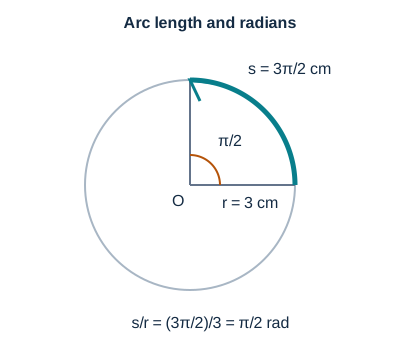
Worked example 1: keep the direction
A wheel of radius 4 cm turns clockwise through an arc length of 6 cm. Find the signed angle.
This is about . Dividing two lengths cancels their units; “rad” identifies the angle convention. The angle is not radians: the radius matters. Adding a full turn gives the same final direction: , but describes a different rotation.
2. Coordinates, signs and exact values
The unit circle is centred at the origin and has radius 1. At angle , define
In the first quadrant, dropping a perpendicular gives a right triangle with hypotenuse 1, so these definitions agree with the side ratios. In other quadrants, coordinates carry signs; triangle lengths do not. In quadrants I, II, III, IV, the signs of are respectively . Axis points lie on quadrant boundaries.
For a point off the axes, its reference angle is the acute angle to the nearest horizontal half-axis. In one positive turn, the four positions associated with are . Use the quadrant to restore signs.
A 45°–45°–90° triangle gives . Bisecting an equilateral triangle gives , , and swaps these values at .
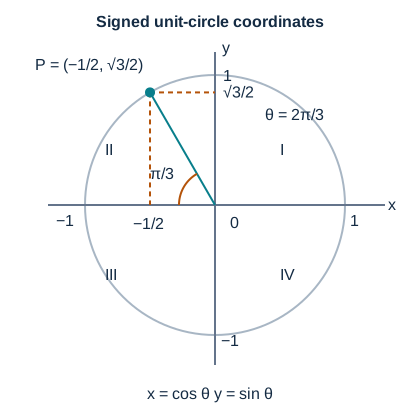
Worked example 2: reduce, locate, then sign
Find and exactly. The angle is in quadrant IV, with reference angle . Therefore
Check: . The coterminal angle reaches the same point. At axis angles, read the coordinates directly: gives , gives , and returns to . Also only when ; tangent is undefined at for every integer .
3. Describe directions and add displacements
A displacement vector records a change in position, with a magnitude and a direction. Its signed horizontal and vertical components describe that same change along two perpendicular axes.
Worked example 3: a displacement vector
A robot moves 8 m in a straight line at angle , measured counterclockwise from east. Take east as positive horizontal and north as positive vertical. Scaling the unit-circle coordinates by the length gives
The displacement is 4 m west and m north. These are signed components, not two additional trips. Check the length: m. This coordinate method describes direction without introducing any force model.
Add a second leg on the same axes
Call that first displacement . The robot then moves 8 m east, so its second displacement is . Keep east positive and north positive for both vectors. Draw the second arrow from the tip of the first. The resultant is the arrow from the original start to the final position.
Add horizontal components to horizontal components and vertical components to vertical components, preserving their signs:
Thus : 4 m east and m north overall.
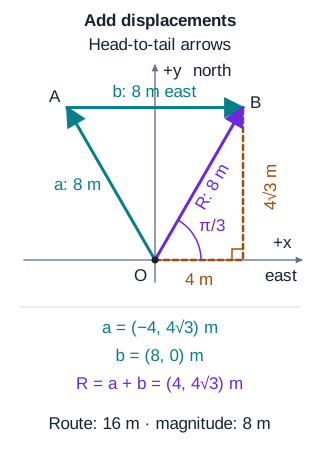
Recover magnitude and direction
The resultant’s horizontal and vertical components are perpendicular, so Pythagoras gives its magnitude :
Both components are positive, placing the resultant in quadrant I. Dividing its components by its magnitude gives
Hence , measured counterclockwise from east, or 60° north of east. The robot travelled , while its start-to-finish displacement has magnitude 8 m. Do not use for the two travelled legs: those legs are not perpendicular. Add their signed components first, then use the resultant’s right triangle.
Your tutor can help you choose axes, draw the arrows, explain a negative component and work through a changed route with you. Try question 11 with a shorter second leg.
Ready to apply components to forces? Find a net force and the acceleration it produces.
4. Trace sine and cosine from a rotating point
Let the angle increase steadily. Plotting the point’s height against angle traces ; plotting its horizontal coordinate against angle traces . In these graphs, the horizontal axis is the angle in radians, not the point’s horizontal position.
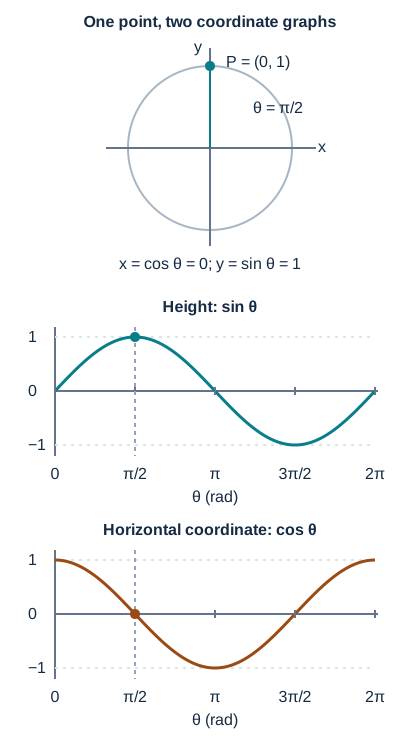
Both graphs repeat after . Sine starts at 0 and initially increases; cosine starts at 1. Their ranges are . Since opposite rotations preserve the horizontal coordinate and reverse the vertical one, and . These identities also check signs for negative angles.
5. Amplitude, period and horizontal shift
For a sinusoidal model
assume and . The same features apply with sine in place of cosine.
- is the midline; amplitude is , the absolute value of , or its distance from zero. It is always nonnegative.
- The range is . A negative reflects the graph about its midline.
- The period is , because the angle must increase by .
- is a horizontal shift: positive means right, negative means left. Factor the coefficient of before reading it.
If is in seconds, is in radians per second, and in seconds, and use the same output unit. If the input is an angle , the period and shift instead describe changes in angle. When or , the model is constant and has no least positive period; the usual nonconstant-sinusoid description does not apply.
Worked example 4: interpret a periodic height
An ideal marker’s height in centimetres is modelled by
where is the numerical time in seconds. The midline is 7 cm, amplitude 3 cm, range cm, period s and shift 1 s right. At , the angle is zero, so cm, a maximum. At , the angle is , so cm, a minimum. Expanding the angle gives ; the shift is still 1 s, not s.
This ideal model repeats without damping. A time trace of one point on a sinusoidal wave uses the same graph idea. In waves in space and time, distinguish this period in seconds from a wavelength measured along a spatial axis; this lesson does not model the travelling wave itself.
6. Find every solution on the stated interval
An inverse trigonometric function returns one principal angle, not automatically every solution. In radians, returns a value in , in , and in . Real arcsine and arccosine require . The notation on a calculator means arcsine, not the reciprocal .
Worked example 5: find all solutions, including endpoints
Solve for . The calculator gives the principal answer , which is outside the requested interval. Sine is negative in quadrants III and IV. The reference angle is , giving
Both substitute to . Neither endpoint works: . Over all real angles, add to each solution, where is any integer; then keep only values in the requested interval.
Boundary check: on has two angle values, 0 and , even though they represent the same circle point. On , exclude . At extrema, do not count the same angle twice: has only in one turn. A request such as has no real solution.
For a transformed graph, first isolate the sine or cosine, solve for its entire angle, and then recover the original variable. Translate the interval too, or check each recovered value against the original interval.
Eight graduated practice questions
Try each question before opening its hint. Check the quadrant, unit and interval in every answer.
Convert and to radians.
Optional hint 1
Multiply each degree measure by .
Explained solution 1
, and . The negative sign preserves clockwise rotation.
A circle has radius 5 cm. Find the arc length for a counterclockwise angle .
Optional hint 2
Use , with the angle in radians.
Explained solution 2
cm. This is an arc length, not a chord. It is positive because this arc has nonzero length.
Find the unit-circle coordinates at .
Optional hint 3
Locate the quadrant and subtract to get the reference angle.
Explained solution 3
The reference angle is in quadrant III, so both coordinates are negative: . Their squares sum to 1.
Find , , and explain whether exists.
Optional hint 4
Reflect the positive angle across the horizontal axis; tangent needs nonzero cosine.
Explained solution 4
and . At , the circle point is , so tangent would divide by zero and is undefined.
A unit-circle point rotates from to . State the sine and cosine values at , and say which graph decreases throughout this half-turn.
Optional hint 5
Read the coordinates of the right, top and left points.
Explained solution 5
Sine has values ; cosine has values . Cosine decreases throughout the half-turn. Sine first increases, then decreases; matching endpoints alone would miss its peak.
For , with in seconds and in centimetres, find amplitude, midline, period, shift and range.
Optional hint 6
Write . The amplitude uses an absolute value.
Explained solution 6
Amplitude 4 cm; midline 2 cm; period s; shift 1 s left; range cm. The coefficient −4 reflects the sine curve about the midline; it does not make the amplitude negative.
Solve on . Compare with the principal arccosine answer.
Optional hint 7
Cosine is negative in quadrants II and III.
Explained solution 7
The reference angle is , giving . The principal answer supplies only the first. Neither endpoint has cosine .
Solve on , then on .
Optional hint 8
Zeros of sine occur at integer multiples of ; inspect the brackets.
Explained solution 8
The closed interval includes . The half-open interval includes only . Although and reach the same circle point, they are distinct angle values and each is kept when its endpoint is included.
Three transfer and retry questions
A 12 m displacement has horizontal component m and vertical component m. Find its direction in , measured counterclockwise from the positive horizontal axis.
Optional hint 9
Divide each component by 12; find a reference angle and then its quadrant.
Explained solution 9
, . Both are negative, so the direction lies in quadrant III with reference angle . Thus , or . Using only would lose the quadrant. The length check is m.
For the height model , find every time when cm for s.
Optional hint 10
Isolate cosine. Its zeros are . Recover before filtering the interval.
Explained solution 10
gives . Therefore , so seconds. The allowed integers give s. Both endpoints count. Substitution makes the cosine zero at each time. The midline is crossed twice per 4 s period, with the shared interval boundaries counted only once each.
Changed-data retry: keep the robot’s first 8 m displacement at from east, but change the second leg to 4 m east. Find the resultant’s signed components, magnitude and direction in . Also find the total distance travelled.
Optional hint 11
Keep the same axes. Add and . If the horizontal components cancel, read the remaining axis direction directly.
Explained solution 11
Thus , with magnitude . Since and , the vector points due north: . Read the positive vertical axis; would divide by zero. The distance travelled is . The shorter eastward leg cancels the first leg’s westward component without changing its northward component.
Before moving on, explain why a principal angle is not always enough, why amplitude is nonnegative, and why interval endpoints can change the answer. If a step remains difficult, retry the matching question with a circle sketch or explicit units.
Optional extension: prove trigonometric identities
Prove an identity, rather than find an angle
An identity says that two expressions have equal values for every input in their common domain. The domain matters: an expression with a zero denominator is undefined, even if a later simplified expression has a value there.
By contrast, solving an equation asks which allowed inputs make it true. For example, holds for every real angle . The equation holds only at particular angles. Here is a real angle; use radians when an interval is stated. The notation means .
Start with these known facts:
- , for every real .
- , where .
- , where .
A useful proof starts with one side and transforms it into the other using justified equalities. State restrictions first; rewrite tangent or secant using sine and cosine; then use common denominators, factoring or the Pythagorean identity. Checking a numerical angle can expose an error, but cannot prove a claim for every angle.
Identity example 1: rewrite before cancelling
Prove on its domain.
The original left side requires . For these angles,
.
The cancelled factor is nonzero because of the original restriction. At , the right side equals 1 but the original left side is undefined. The identity therefore does not give a value to that left side at .
Identity example 2: use a common denominator
Prove .
Both sides require . Transform the left side:
.
The number 1 was rewritten as ; it did not disappear. This is an identity on , not an equation whose task is to find .
Identity example 3: factor while keeping the original domain
Simplify , and explain where the result agrees with .
The original denominator requires . Factor the numerator:
, provided .
At , the original quotient is and undefined. The simplified expression has value 2, but this does not remove the original restriction. We have equivalent values on the original domain, not identical domains for the two formulas.
Practise in four steps
Open the hint or solution whenever it helps. You do not need to finish a question before asking for help.
Prove . State the domain.
Optional hint 12
Replace the numerator before cancelling.
Explained solution 12
Require . The numerator equals , so the quotient is on that domain.
Prove . State the domain and explain how the second term joins the fraction.
Optional hint 13
Rewrite tangent; give both terms denominator .
Explained solution 13
Require . The left side becomes . Multiplying by preserves its value on the allowed domain.
Simplify . Is the original expression defined at ?
Optional hint 14
Factor as a difference of squares and retain the denominator restriction.
Explained solution 14
Require . Factoring gives . At the original denominator is zero, so the original expression is undefined. The value 2 from the simplified formula is not a value of the original quotient there.
On , solve . Explain why this task is different from Identity example 1.
Optional hint 15
First retain the domain of tangent, then use Identity example 1.
Explained solution 15
The original equation requires . On this domain it becomes , giving or in the stated interval. Both have nonzero cosine and satisfy the original equation. Identity example 1 established an equality for every allowed angle; this equation selects the angles at which the common value is .
A tutor can help you identify the permitted angles, choose a useful first transformation and explain why each step preserves the expression. We can begin with the basic identities or an unstarted question.
Optional extension: solve quadratic trigonometric equations
Sometimes the unknown angle appears inside a squared sine or cosine. There are then two jobs: solve an ordinary quadratic for the trigonometric value, then find every angle with that value. This extension adds about 20 minutes, with two worked examples and four questions. Use the unit-circle values and the interval-solving method above.
Use a temporary variable, then return to the angle
Here is a real angle in radians. The notation means , not . If every term uses sine, set ; if every term uses cosine, set . The temporary variable is a number between −1 and 1, not an angle.
- Put zero on one side. If both sine and cosine occur, first see whether lets you rewrite everything using one function.
- Solve for . Factor the quadratic. A product is zero when at least one factor is zero, so solve each factor equation separately. If factoring is not convenient, the quadratic formula is another option; keep exact values until the angle step.
- Check the range. Keep only real values of in . An algebraic root such as 2 cannot be a real sine or cosine value.
- Undo the substitution. Write or for each retained value. Use signs and reference angles to find every allowed angle, adding full turns when needed.
- Check the interval and original equation. Include a closed endpoint if it works; exclude an open endpoint. List each angle once, then substitute to check it.
Do not divide away a possible zero. Dividing by , or any expression that might equal zero can remove solutions. Keep that expression as a factor and solve its zero case. Also, the zero-product rule applies to a product equal to zero, not to a sum or to a product equal to another number.
Equation example 1: two sine values, three angles
Solve on .
Set . The equation becomes
Thus or , giving or . Both lie in . These are sine values, so we still need angles:
- : sine is negative in quadrants III and IV. The reference angle is , giving and .
- : the top of the unit circle gives only in this interval. Do not count that angle twice.
The complete answer, in increasing order, is
Check: for sine , the left side is ; for sine 1, it is . At both endpoints, sine is 0 and the left side is −1, so neither endpoint works. The two factor equations exhaust the possible sine values, and the circle supplies every angle for each value.
Equation example 2: reject an impossible cosine value
Solve on .
Set , then factor:
Reject : cosine is a horizontal coordinate on the unit circle and cannot exceed 1. This is a valid root of the quadratic in , but it gives no real angle. There is no need to enter into a calculator.
For , the reference angle is . Cosine is positive in quadrants I and IV, so
Check: substituting cosine gives . At , cosine is 1 and the left side is −1. The endpoint is excluded by the interval; it would not satisfy the equation anyway. A calculator's principal answer alone would miss the fourth-quadrant angle.
Four progressive questions: values first, angles second
For each question, state the temporary variable, solve for its possible values, and give all angles in the stated interval. The last question combines an identity with more than one full turn. Open a hint whenever you need a starting point.
-
Solve on .
Optional hint 16
Set . A square equal to allows two signs. Each retained sine value has two angles here.
Explained solution 16
With , write . Thus or , both in . Positive sine gives ; negative sine gives . Therefore
Each sine value squares to . The endpoint 0 has sine 0 and fails; is excluded and would fail too. Taking only the positive square root would miss two solutions.
-
Solve on . Explain why the interval endpoints need separate attention.
Optional hint 17
Set , factor, then check each root against . Which angles have cosine 1?
Explained solution 17
Set . Then , so or . Reject −2 because cosine cannot be less than −1. The remaining equation is , giving
Both endpoints are included. They reach the same circle point but are distinct angle values in the requested closed interval. At each, the original left side is . On , only 0 would remain.
-
Solve on . Explain which answers would be lost by dividing both sides by .
Optional hint 18
Move all terms to one side and factor out . Keep the zero-factor case. Then look for both angles in the interval whose sine is .
Explained solution 18
With , the equation becomes . Therefore or , both allowed. Sine is zero at ; it equals at . There are no positive-sine angles strictly between and 0. The complete list is
Both endpoints are included and work. For sine 0, both sides of the original equation are 0; for sine , both are . Dividing by would assume it is nonzero and lose . Factoring keeps those three solutions.
-
Solve on . Use one trigonometric function before factoring, and include every allowed turn.
Optional hint 19
Replace by , then set . List the angles from each factor across two full turns.
Explained solution 19
The identity holds for every real angle. Substitution gives . Set , subtract 1 and multiply by −1:
Hence or . Both values are in range. Cosine is zero at , giving here. Cosine is 1 at , giving . In these formulas, is any integer; only the displayed angles lie in the requested interval. Combining and ordering the two lists gives
Check in the original equation: when cosine is 0, , so the left side is . When cosine is 1, sine is 0, so it is . Both closed endpoints work. Stopping at the end of the first turn, at , would miss three answers; dividing by cosine would lose the four zero-cosine answers.
Before moving on: can you distinguish a root in from an angle in , explain every rejected value, and show why no allowed angle was missed? If factoring is the sticking point, revisit algebra skills before calculus. If the values are right but the angles are incomplete, return to interval solving.
For domain restrictions, inverse functions and graph shifts beyond sine and cosine, continue with functions, transformations and inverses.
For help with a unit-circle or trigonometric-graph problem, explore algebra and precalculus tutoring. Tutoring sessions are currently offered in English.
Modelling workshop: from observations to time intervals
Reading a supplied formula is one skill; building and checking a model is another. This optional 20–30 minute workshop adds two worked examples and four questions. Review amplitude, period and shift and all solutions on an interval first. Use radians throughout; no derivatives are needed.
Assume the motion is sinusoidal with constant amplitude and period. A few measurements alone do not prove this assumption. For a maximum value , minimum value , with , and period , choose a positive amplitude:
Here is an instant of maximum height, not necessarily the first instant observed. Consecutive maxima are one period apart; a maximum and the next minimum are only half a period apart. Equal heights at two instants need not be a full period apart. If only a midline crossing is given, its rising or falling direction distinguishes two possible phases. Different sine/cosine expressions can describe the same motion: verify observations rather than demanding one particular formula.
Worked example 11: reconstruct and check a model
An ideal moving marker reaches consecutive maximum heights of 10 cm at 2 s and 14 s. Its intervening minimum is 2 cm at 8 s. Model its height during the observation window , where is the numerical time in seconds and the numerical height in centimetres.
The midline is , amplitude , period , and one maximum occurs at . Therefore
The angle advances by radians per second. Check the whole cycle in the table below. The height falls after 2 s and rises after 8 s. The range is ; the observed domain is , even though the ideal formula is defined for all real inputs. Do not use 6 s as the period: it takes the marker from a maximum to a minimum.
| Time (s) | Height (cm) |
|---|---|
| 2 | 10 |
| 5 | 6 |
| 8 | 2 |
| 11 | 6 |
| 14 | 10 |
An equivalent sine model is
Its angle is the cosine angle plus , so confirms equivalence. The different-looking shift does not describe a different motion.
Worked example 12: crossing instants are not durations
During that same observation window, when is the marker at least 8 cm high, and for how long altogether? First find the boundary instants:
In this angle interval the boundary values are . Recovering time with gives . Now test the intervals, not just these instants: at 2 s the height is 10 cm (above the threshold), at 8 s it is 2 cm (below), and at 13 s it is above 8 cm. Thus
The symbol joins the two allowed time intervals; it does not fill the gap between them. Their total duration is s. The second interval stops at the observation boundary, not at the next crossing at 16 s. Subtracting the first crossing from the last would wrongly count time below 8 cm.
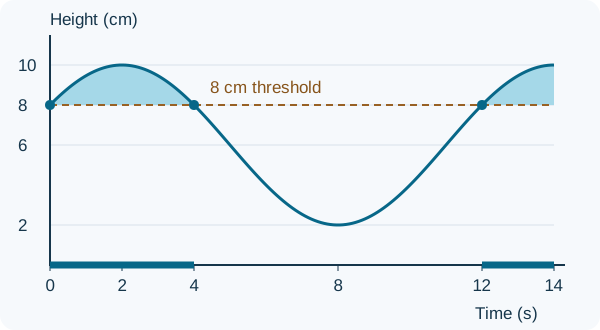
For strictly above 8 cm, exclude equality at 0, 4 and 12 s: . The instant 14 s stays included because it is in the observation window and its height is 10 cm. These isolated endpoint changes do not change the duration.
Check the range before using inverse cosine
For a nonconstant model with range , a condition holds throughout the observation window if , and never if . If , only maxima in the window qualify: isolated instants, with zero total duration. For , find crossings and test the intervening intervals. For a strict inequality, handle equality separately. If , the model is constant: compare that single value with the threshold instead of dividing by a zero amplitude. Never feed a value outside into real inverse cosine.
Four questions: construct, choose, solve, clip
Try each question before opening its hint. Give units and check a test instant in every proposed interval. Equivalent models earn the same result if they satisfy all the stated conditions.
A sinusoidal height has consecutive minima of 3 cm at 1 s and 9 s, and a maximum of 11 cm between them. Build a model for , then locate that maximum.
Optional hint 20
A negative cosine coefficient can place a minimum at the chosen shift. Find the midline and the distance from it to either extreme.
Explained solution 20
The midline is 7 cm, the amplitude 4 cm, and the period 8 s. One model, with height in centimetres and time in seconds, is
Its amplitude is 4, not −4. At , cosine is 1 and the height is 3. Halfway between the minima, , cosine is −1 and the height is 11. This maximum is the only one in the observation window; the next is at 13 s.
A height ranges from 2 to 10 cm with period 12 s. At , it crosses its midline while rising. Choose between and , and check the heights at 3 s and 9 s.
Optional hint 21
Both formulas begin at 6. For a small positive time, sine is positive: which formula puts the marker above the midline?
Explained solution 21
Choose . It rises from the midline, reaches , and later reaches . The minus-sign model initially falls and reverses these two heights. Range and period alone cannot choose between these phases.
For the marker in worked example 11, find every time when on , and the total duration. Would any time qualify for ?
Optional hint 22
The boundary equation has cosine −1/2. Locate the low part of the cycle and test the minimum.
Explained solution 22
The boundary angles and give and . Since , the answer is , with duration s. Both crossing instants are excluded by the strict inequality. The range ends at 10 cm, so has no solution.
An ideal height in centimetres is , with time in seconds. On , find the time intervals for and their total duration. Give an exact answer before rounding.
Optional hint 23
Let . The period is 8 s; maxima are at 1 s and 9 s. Find the half-width around each maximum, then intersect the intervals with the observation window.
Explained solution 23
Define in radians and , the numerical half-width in seconds. Here . The two uncut windows are and . Their outer ends lie outside the observation window, so the answer is
Numerically, the intervals are approximately and s. Their total duration is
seconds. Check the retained boundaries: . The internal boundaries give exactly 7. Using the full two windows would overcount time outside the stated domain.
Scope: this original workshop supports Ontario MHF4U work on constructing sinusoidal functions and solving applications (B2.6–B2.7, with related equation work in B3.4). The interval-duration questions are a teaching extension, not an official assessment or a prediction of a teacher’s coverage. Ontario curriculum, printed page 90.
Retry: close the solutions and explain why a crossing is an instant, why a duration is a difference of times, and why the proposed intervals must be restricted to the observation window. Return to the model-building example if a sign or phase choice is still uncertain.
Useful for
Focused practice for functions and trigonometry in Concordia MATH 201 and Dawson 201-015-RE, and a foundation review for Sheridan MATH15382D. These lessons cover selected topics, not a complete course; use your current section’s outline for assessment scope.
Work on the step you’re missing.
Tell us the subject and your preferred time. Nablio confirms the details by text or email.
Request a lesson