Turn several angled forces into one acceleration, then work backward to find a balancing or unknown force. Three worked examples and six practice questions take you from a force inventory to a checked answer.
Before you start: you should be able to resolve a vector and identify the forces on one object. Review components, vector addition and direction and free-body diagrams if needed. This lesson applies those tools to forces; allow about 40 minutes including practice.
1. Choose the object and the plane
Choose one object, model it as a particle of constant mass, and use an inertial reference frame: one in which Newton’s laws apply without adding inertial forces. Here the laboratory frame is treated as inertial. We study horizontal pulls on a puck or small ring on a level air table, with negligible resistance and no rotation to track.
Every diagram is a top view: is east, is north, and angles are measured counterclockwise from east in degrees. North is a direction along the table, not vertically upward. Weight and the table’s support act perpendicular to this plane and balance separately because there is no vertical acceleration. They are part of the full force inventory, but neither contributes to these horizontal component sums.
List each external interaction acting on the selected object. A rope’s pull on the puck belongs in the inventory; the puck’s pull on the rope acts on another body and does not. Use newtons (N) for forces, kilograms (kg) for mass and for acceleration.
The resultant is a mathematical sum of those forces. It is not an additional force to add to the original arrows. When constructing the sum head-to-tail, you may translate a vector without changing its components; this does not relocate the physical contact point. For an extended rigid body, where application points and rotation matter, use force and moment balance. Zero resultant alone does not establish rigid-body static equilibrium.
2. Build and interpret the resultant
- Name the object, list its external forces, and state your axes.
- Convert each angle to the chosen reference. Set your calculator to degree mode. For a magnitude at angle , write signed components.
A force pointing west has a negative x component; one pointing south has a negative y component. An angle given from north cannot be inserted unchanged into a formula that measures from east.
- Add x components together and y components together. The symbol means “sum over the forces on this object.”
- Apply Newton’s second law using the object’s positive mass .
The acceleration points in the direction of a nonzero resultant. The velocity need not point that way: the resultant tells you how velocity changes, not which way the object is already travelling.
Magnitude and direction need different checks
Pythagoras applies to the perpendicular x and y components of the resultant. You cannot generally add force magnitudes, or apply Pythagoras directly to two forces at arbitrary angles.
For nonzero components, find the acute reference angle , then choose the quadrant from the component signs: , , , or in quadrants I, II, III, or IV respectively. A calculator or program with can do the quadrant selection; check its argument order and angle units, and add to a negative degree result when reporting an angle from 0° to 360°.
- If and , the direction is north (90°) or south (270°). Do not divide by zero.
- If and , the direction is east (0°) or west (180°).
- If both components vanish, the magnitude is zero and the direction is undefined. Newton’s law gives zero acceleration, not necessarily zero velocity.
3. Worked example 1: two pulls and an acceleration
A puck receives a horizontal pull at 30° and an horizontal pull at 150°. Find the resultant and acceleration. Use the horizontal air-table model and axes defined above.
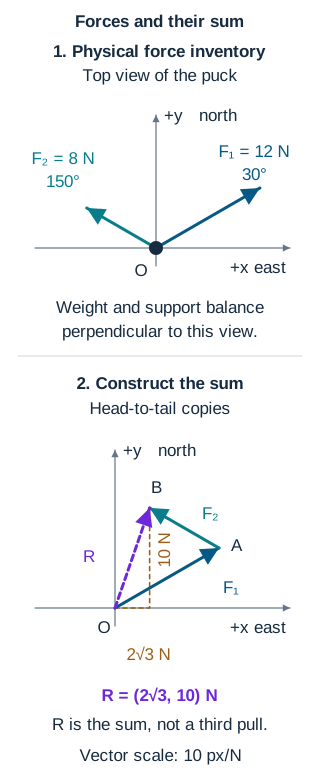
Read the diagram in words
The top panel shows both horizontal forces starting on the same puck, with +x east and +y north. Vertical weight and support balance outside this view. In the lower panel, a translated copy of F₂ begins at the head of F₁. The dashed resultant joins the starting point O to the final point B. Its signed components are 2√3 N east and 10 N north. The vector scale is 10 pixels per newton in the original 320-pixel image.
Resolve each physical pull
The horizontal components partially cancel; the northward components add. Keep exact values until the final rounding.
Divide each component by the mass
The acceleration magnitude is about . Both components are positive, so the resultant and acceleration lie in quadrant I:
Check: the answer points mostly north, consistent with a 10 N northward component and only about 3.46 N eastward. Multiplying each acceleration component by 4 kg recovers the force components. The 12 N and 8 N pulls are 120° apart, so their resultant is neither nor . Its magnitude lies between their difference, 4 N, and their sum, 20 N.
4. Worked example 2: a force that balances
A small ring, modelled as a particle, receives two horizontal pulls: at 60° and west. Find a third horizontal force that makes the total resultant zero.
The equilibrant is the additional force on the same ring that cancels the existing resultant. Therefore : equal magnitude, opposite direction.
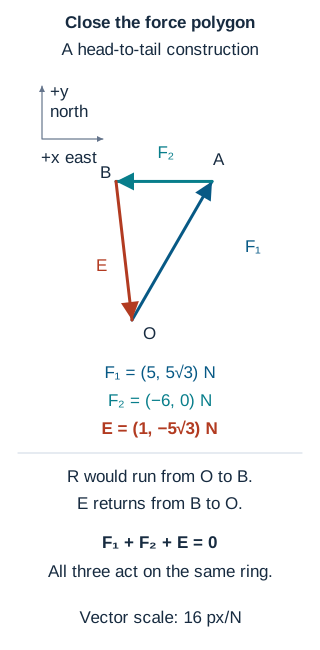
Read the diagram in words
All arrows are a vector construction, not a picture of rope positions. Starting at O, F₁ goes northeast to A; F₂ goes 6 N west to B. E goes slightly east and mostly south from B back to O. The existing resultant would point from O to B; it is omitted so that the opposite arrows do not overlap. The small compass sets +x east and +y north. Closing the polygon means the components of the three forces sum to zero on each axis.
The equilibrant points east and south, so it is in quadrant IV. Its acute angle below east is:
Report 83.41° south of east, or counterclockwise from east.
Check by substitution: the total x component is ; the total y component is . The vector polygon closes, and the acceleration is zero.
If the ring starts at rest, these balanced forces keep it at rest. If it is already moving, zero resultant keeps its velocity constant within this ideal model. An equilibrant does not automatically stop a moving object.
Why this is not a third-law partner
The equilibrant and the existing pulls all act on the ring. The third-law partner of a rope’s pull on the ring is the ring’s pull on that rope. Those two interaction forces act on different bodies and cannot balance one another in the ring’s equation.
5. Worked example 3: recover an unknown force
A puck has acceleration . One horizontal pull is at 60°. The only other horizontal force is unknown. Find its components, magnitude and direction.
Start with the resultant required by the measured acceleration. Then subtract the known force, component by component. The unknown force is not generally by itself.
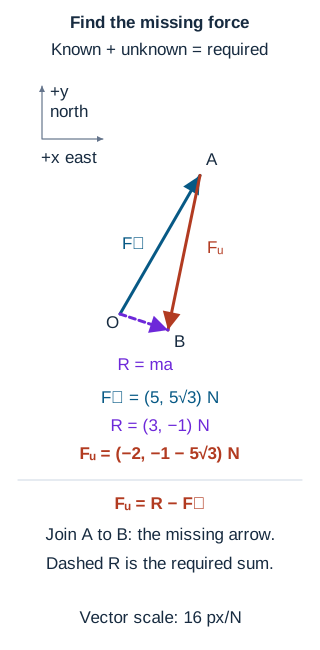
Read the diagram in words
At 16 pixels per newton, the known force goes from O to A with components (5, 5√3) N. The dashed required resultant goes from O to B with components (3, −1) N. The unknown arrow goes from A to B: 2 N west and 1 + 5√3 N south. It is a subtraction construction, not an extra force beyond the known and unknown pulls. The resultant is m times the prescribed acceleration.
The unknown force must overcome the known northward pull and leave a 1 N net force south. It also leaves 3 N east after cancelling 2 N of the known eastward pull.
Both components are negative, so the direction is in quadrant III:
That is 78.30° south of west. The unknown force points southwest even though the required acceleration points southeast.
Check: adding known and unknown forces gives . Dividing by 2 kg recovers . Subtraction order matters: known minus required would reverse the unknown force.
6. Try six questions
Use the same top-view axes, degree convention and particle model. Attempt each question before opening its hint or solution. Give force components in N and acceleration components in .
1. An angle measured from north
A horizontal force has magnitude 8 N and points 30° west of north. Express its angle counterclockwise from east and find its signed components.
Optional hint 1
North is 90° from east. Turning toward west adds another 30°. Predict the signs before calculating.
Explained solution 1
The angle is , so:
Check: west means negative x, north means positive y, and . The angle is nearer north than west, so the northward component is larger.
2. A guided resultant
A 2.0 kg puck receives 6 N east and 8 N north. Find the resultant components, its magnitude and direction, and the acceleration components and magnitude.
Optional hint 2
Write the forces as (6, 0) N and (0, 8) N. Their nonzero components are perpendicular. Divide the resultant by 2 kg, not by the number of forces.
Explained solution 2
Both vectors point at north of east. Check: in force units. Pythagoras applies directly here because these particular forces are perpendicular.
3. Two angled pulls, new data
A 2.0 kg puck receives 10 N at 30° and 6 N at 150°. Find the acceleration components, magnitude and direction.
Optional hint 3
Both y components are positive. The x components have opposite signs. Add the force components before dividing by mass.
Explained solution 3
The direction is north of east, in quadrant I. Check: multiplying the acceleration by 2 kg gives ; the northward component is larger than the eastward one.
4. An equilibrant on an axis
Change the westward pull in worked example 2 to 5 N; keep the 10 N pull at 60°. Find the equilibrant components, magnitude and direction. Explain why the usual ratio for an angle is unnecessary.
Optional hint 4
The 10 N pull has an eastward component of 5 N. What happens to the x sum now?
Explained solution 4
The equilibrant has magnitude and points due south, at 270°. The x component is zero, so computing would divide by zero; the signs already identify the axis. Check: .
5. Work backward independently
A 3.0 kg particle has acceleration . One horizontal force is . Find the only other horizontal force, including magnitude and direction.
Optional hint 5
First find . The unknown equals the required resultant minus the known force. Its signs will choose the quadrant.
Explained solution 5
It lies in quadrant II. The reference angle is , so its counterclockwise direction is , or 33.69° north of west. Check: , which gives the specified acceleration after division by 3 kg.
6. Diagnose a zero-resultant answer
A puck moving east at 2 m/s receives four constant horizontal forces: (3, 0), (−3, 0), (0, 4), and (0, −4) N. A student says, “The resultant points east at 0 N, so the puck stops.” Correct the magnitude, direction, acceleration and motion claims.
Optional hint 6
Add both component sums. Distinguish a zero vector from an eastward vector, and acceleration from velocity.
Explained solution 6
The resultant is , with magnitude 0 N and undefined direction. Its acceleration is . The puck continues east at 2 m/s for as long as these assumptions hold; it does not stop. Check: both force sums vanish, so neither velocity component changes. A calculator’s numerical output for does not give the zero vector a physical direction.
7. Check your method and choose the next step
- Did every force in your sum act on the same object?
- Did you convert the angle reference and predict component signs?
- Did you add forces once, without adding the resultant a second time?
- Does the reported direction agree with the quadrant or axis, and did you handle the zero vector?
- Can you substitute your answer into both component equations?
Work through your force setup with a tutor
Bring your force inventory and the first component equation that feels uncertain. A tutor can help you identify the receiving object, check the angle convention, compare the vector sketch with your signs, and use substitution to locate an error. Then try a changed-angle or unknown-force question yourself. Explore mechanics tutoring. Tutoring sessions are currently offered in English only.
If choosing the interactions is the hard part, return to free-body diagrams. If an application point, lever arm or possible rotation matters, continue to torque and static equilibrium. These examples are a shared topic resource; your current course outline determines the models and assessment requirements you need.
Useful for
This shared lesson supports selected force-component and Newton’s-law topics in the course guides below. It is not a complete course review; use your current section’s outline for assessment scope.
Work on the step you’re missing.
Tell us the subject and your preferred time. Nablio confirms the details by text or email.
Request a lesson