Work with an online tutor on limits, derivatives and applications in Dawson 201-SN2-RE. Start with a question that is blocking you or a basic concept you want to understand better. Your tutor can help you choose a first step, build the function for an application and explain the result. If you have an attempt, you can review it together.
Choose only topics listed for your assessment. The course description supports this subject, but does not establish your section’s exam date or chapter cutoff.
Get help with a step.Ask about 201-SN2-RE tutoring Include the chapter, assessment date and question; attempted work is useful but not required. Sessions are currently in English.
Official course source Your section outline and instructor announcements take priority. These are Nablio study routes and exercises, not official exams.
Curve-analysis workshop: when the asymptote is a line
This original Dawson 201-SN2-RE practice extends the existing curve-sketching lesson with a slant asymptote and a derivative-graph transfer. It is a topic-based study option, not a prediction of your exam. Check your section’s outline before including curve applications or slant asymptotes in a timed review.
If your next assessment covers only early topics: work through domains and limits, then choosing derivative rules. Return here when your outline includes applications. For the earlier three-branch example, use domain breaks and derivative signs; this workshop does not replace that lesson or the printed-panel problem above.
A complete investigation
Investigate f(x)=x2/(x−1). Find its domain, intercepts, asymptotes, variation, extrema and concavity. Sketch separate branches and justify whether any inflection point exists. Try an initial sketch before reading the explanation.
Read the complete investigation
1. Record the domain and intercepts
The denominator excludes x=1: D=R∖{1}. The only zero of the numerator is x=0, which is allowed, so the x- and y-intercepts coincide at (0,0). Do not erase the excluded input when making sign tables.
2. Separate the polynomial part
Polynomial division gives f(x)=x+1+x−11. As x→1−, the last term tends to −∞; as x→1+, it tends to +∞. Thus x=1 is a vertical asymptote. Since f(x)−(x+1)→0 at both infinities, the slant asymptote is y=x+1, not a horizontal line. The graph stays below this line for x<1 and above it for x>1, because the difference is 1/(x−1). It never crosses the line in this example.
3. Use signs, not just stationary inputs
f′(x)=1−(x−1)21=(x−1)2x(x−2). The denominator is positive wherever defined. Split at both zeros, 0 and 2, and at the excluded input 1.
x<0: f′>0, increasing toward (0,0).
0<x<1: f′<0, decreasing toward −∞.
1<x<2: f′<0, decreasing from +∞.
x>2: f′>0, increasing away from (2,4).
The sign change + to − proves a local maximum at (0,0); − to + proves a local minimum at (2,4). Neither is global on the full domain: values are unbounded above and below. Do not describe the curve as decreasing “from 0 to 2” without the break at 1.
4. Keep concavity separate from increasing/decreasing
f′′(x)=(x−1)32. It is negative on (−∞,1), so the left branch is concave down; it is positive on (1,∞), so the right branch is concave up. The change happens across a missing point, so there is no inflection point. A point of inflection must lie on the graph.
5. Assemble and check the sketch
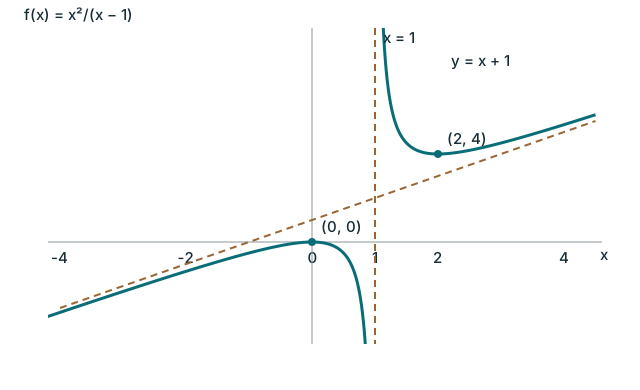
Schematic sketch; dashed lines are asymptotes, not parts of the curve.
Text equivalent: the left branch approaches the slant line from below as x tends to negative infinity, rises to (0,0), then falls to negative infinity at 1 from the left. The right branch starts at positive infinity at 1 from the right, falls to (2,4), then rises while approaching the slant line from above. The left branch is concave down throughout; the right is concave up throughout.
Check f(−1)=−1/2, f(1/2)=−1/2, f(3)=9/2. Sample points help catch plotting errors, but the derivative signs justify the complete branch behaviour.
Three transfer problems
Keep the answers closed. For each conclusion, write the evidence: domain, a sign change, a limit or a slope on the derivative graph.
1. Build a fresh sign table
Let g(x)=(x+1)2/(x−2). Without graphing software, find the domain, slant asymptote and all increasing/decreasing intervals. Locate and classify the local extrema; explain whether they are global. You may use g′(x)=(x+1)(x−5)/(x−2)2, but verify it by rewriting g first.
Show a sign-table hint
Divide to obtain a line plus a remainder. Put −1, 2 and 5 in order; one is excluded rather than stationary.
Check the sign table
D=R∖{2} and g(x)=x+4+9/(x−2), so the slant asymptote is y=x+4. Differentiating gives 1−9/(x−2)2=(x+1)(x−5)/(x−2)2.
The derivative signs are + on (−∞,−1), − on (−1,2), − on (2,5), and + on (5,∞). Thus g increases on the first and fourth intervals and decreases on the second and third. There is a local maximum (−1,0) and a local minimum (5,12). Neither is global, since g is unbounded below as x→2− and above as x→2+. The excluded input 2 is not an extremum.
2. Read the derivative’s graph, not the function’s height
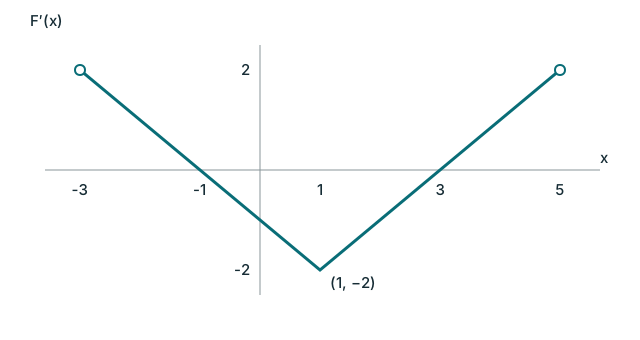
A differentiable function F on (−3,5) has the continuous derivative shown below: straight segments join (−3,2), (1,−2), and (5,2). In particular, the derivative crosses zero at −1 and 3. Given F(1)=2, find the increasing/decreasing intervals, local extrema by input, concavity intervals and inflection point. No integration is needed; the function value at 1 is supplied. Do not mistake a vertex of F′ for an extremum of F.
This graph is F′, not F. Endpoint dots are open because the stated domain is (−3,5).Show a derivative-graph hint
F increases where F′ is above the axis. F is concave up where F′ increases. The supplied value F(1)=2 gives the height once you have justified the inflection input.
Check the derivative-graph reasoning
F increases on (−3,−1) and (3,5), and decreases on (−1,3). The derivative changes + to − at −1, giving a local maximum there; it changes − to + at 3, giving a local minimum there. F′ decreases on (−3,1) and increases on (1,5), so F is concave down and then concave up. F is defined and continuous at 1, so it has an inflection point there even though F″ does not exist at that corner of F′.
Using the supplied value, the inflection point is (1,2). It is not a local extremum: F′(1)=−2, and F is decreasing on both sides. The heights of the local extrema are not needed to classify them.
3. Diagnose an inflection-point claim
A student says: “If the second derivative is zero or changes sign at an input, that input is an inflection point.” Test the claim at 0 for p(x)=x4, q(x)=1/x, and r(x)=x3. State which graph, if any, has an inflection point there, and give a reason for each decision.
Show an inflection-point hint
Ask two separate questions: is there a point on the graph at the input, and does concavity change there? A zero second derivative is only a candidate test.
Check the three diagnoses
For p, p′′(x)=12x2: it is zero at 0 but positive on both sides. There is no concavity change and no inflection point. For q, q′′(x)=2/x3 has opposite signs on the two sides, but q is not defined at 0, so there is no point of inflection there. For r, r′′(x)=6x changes from negative to positive, and r is continuous at 0. Thus (0,0) is an inflection point of r. The derivative-graph problem above also shows that F″ need not exist at an actual inflection point.
Choose your next attempt: if an excluded input disappeared from your table, revisit domains and limits; if you confused increasing with concave up, repeat problem 2 with separate statements about F′ and F″. For tutoring, bring your section’s scope, your sketch and the first step you cannot justify. Keep using the course’s existing tutoring request rather than assuming an exam topic or a confirmed appointment.
201-SN2-RE topics to review
Limits and continuityDerivative rulesOptimizationCurve analysisAntiderivatives
Common difficulties
Turning a geometric constraint into a function of one variable with a valid domain
Justifying a maximum or minimum instead of stopping whenever a derivative equals zero
Differential calculus: check continuity and rule selection
Make a function continuous, then combine the product and chain rules. Explain each step before opening the solutions.
Before you start: Allow 20–25 minutes to try both questions, then 15 minutes to check and retry any missed steps.
1. Repair a discontinuity
For x=3, let f(x)=(x2−9)/(x−3), and set f(3)=k. Find the value of k that makes f continuous at 3. Then find f′(3) for that choice.
Show the explained solution
Factor first: x2−9=(x−3)(x+3). Thus f(x)=x+3 only when x=3.
The limit is limx→3f(x)=6. Continuity requires the defined value to match it, so k=6.
With that value, the completed function equals x+3 for every real input. Therefore f′(3)=1. Cancelling alone did not define the missing value.
Factor without cancelling the condition on the input; write the limit and function value on separate lines.
If a derivative term is missing
Mark the two factors, name the first rule, then differentiate the inner logarithm. Redo the question without looking.
You can start 201-SN2-RE tutoring with either question above or a concept you want to understand better. Your tutor can explain the algebra, limit or derivative rule and help you begin. If you have an attempt or your current topic list, you can use it to choose what to work on next.
Practise factoring, rational expressions, function domains and trigonometry before concentrating on derivative rules. Connect a secant slope to average change and a tangent slope to instantaneous change. When an optimization problem feels difficult, separate its algebraic model from the calculus used to solve it.
Registration requirements
The guidance above is study preparation, not an eligibility decision. Confirm current prerequisites, restrictions and availability with Dawson College.
A rectangular printed panel must have area 96cm2. A surrounding border adds 2cm on both the left and right and 3cm at both the top and bottom. Find the printed width and height that minimize the area of the outside rectangle, including the border. Show that your dimensions give a global minimum: the smallest outside area among all allowed dimensions.
Show the reasoning
1. Define the dimensions and constraint. Let x be printed width and y printed height, measured in centimetres. Both are positive, and the fixed printed area gives xy=96, so y=96/x for x>0. The outside width is x+2+2=x+4, and the outside height is y+3+3=y+6.
2. Express the outside area using only the width. Let A(x) be outside area in square centimetres. Substituting the constraint gives A(x)=(x+4)(96/x+6)=96+6x+384/x+24=120+6x+384/x. The constraint is imposed on the printed region, not on the outside rectangle.
3. Find the width where the area’s derivative is zero. A prime denotes differentiation with respect to x. Then A′(x)=6−384/x2. Setting this to zero gives 6x2=384, hence x2=64. Only the positive solution x=8 is admissible. Its printed height is y=96/8=12.
4. Prove and check the minimum. For 0<x<8, 384/x2>6, so A′(x)<0; for x>8, A′(x)>0. Thus area decreases throughout the first interval and increases throughout the second, proving a global minimum at x=8. The printed dimensions are 8cm by 12cm, whose product is 96cm2. The outside dimensions are 12cm by 18cm, giving 216cm2. Each border occurs twice; counting it once changes the model.
Your turn: change the borders
Keep the printed area at 96cm2, but use borders of 3cm on the left and right and 2cm at the top and bottom. Let x>0 be the printed width and y>0 the printed height, both in centimetres. Before calculating, predict whether the previous printed width of 8 cm still minimizes the outside area. Rebuild the constraint and the outside-area function, then find the printed and outside dimensions and justify the global minimum. Keep the answer closed while you try. Start by labelling each border separately.
Check your reasoning
1. Rebuild the model
The printed-area constraint remains xy=96, so y=96/x for x>0. The outside dimensions are now x+6 and y+4. With A(x) denoting outside area in square centimetres,
A(x)=120+4x+x576.
This comes from (x+6)(96/x+4). The changed borders belong in the outside dimensions; they do not change the printed-area constraint.
2. Find and justify the minimum
A prime means differentiation with respect to x. Thus A′(x)=4−576/x2. The positive root is x=12. The derivative is negative for 0<x<12 and positive for x>12, proving a global minimum over the entire physical domain. Then y=96/12=8.
3. Check the dimensions
The printed region is 12cm wide and 8cm high; the outside rectangle is 18cm by 12cm. Its area is 216cm2. Keeping the old printed width of 8 cm would instead give (8+6)(12+4)=224cm2. The minimum area happens to equal the original minimum, but its width and height have exchanged roles. Reusing the old dimensions would miss that change.
How tutoring can help
Your tutor can help you choose a first step for a limit or derivative, or examine a calculation you have started to find where a rule or algebra step went wrong. For optimization, they can help you turn the constraint into a function of one variable, check its domain and explain why the chosen dimensions give a maximum or minimum.
Exam preparation for 201-SN2-RE
Use your section’s outline to choose limit, derivative and application questions for the next exam. Include continuity, curve analysis and basic antiderivatives when assigned. In optimization, state the function’s domain, check relevant endpoints and use derivative signs to justify a maximum or minimum. Explain the final result in terms of the original problem.
We work through permitted practice and comparable problems, without completing graded assignments or exams on your behalf.
Related courses
Useful links for preparation or further study—not transfer equivalencies or a required registration sequence.
Choose the first derivative rule in three core questions, then explore an optional logarithmic-differentiation example and retry when both base and exponent vary.
Build a three-branch rational-function graph from its domain, one-sided limits and derivative signs. Compare local and global extrema, diagnose false inflection points and try two explained checks.
Need help with 201-SN2-RE?
Send your topic and preferred times. We’ll confirm whether we can help and, if so, agree on a time by text or email before payment.