Row Operations: Why the Solutions Stay the Same
Practise reversible row operations and use the final rows to distinguish one, no or infinitely many solutions.
Linear Algebra and Vector Geometry: one-to-one online tutoring and exam preparation.
Dawson 201-SN4-RE links linear systems and matrix calculations to vector geometry and basic mathematical arguments.
Practise solving simultaneous equations, keeping fractions exact and multiplying a matrix by a column vector. Review coordinates, vector components and dot products. Move between equations and an augmented matrix without changing variable order.
The guidance above is study preparation, not an eligibility decision. Confirm current prerequisites, restrictions and availability with Dawson College.
Check the official course catalogueLet be the real unknowns in , , and . Here is a fixed real parameter specifying the right-hand side of the third equation. For which values of does the system have solutions? Use an augmented matrix to justify your answer, then express every solution as a point plus a multiple of a direction vector. Define the free parameter used in that expression.
1. Eliminate with the right-hand side included. Let denote the augmented matrix rows; each contains the coefficients of , followed by the right-hand side. Initially the rows are , , and . The operations and give and . Subtracting the new second row from the third gives . 2. Interpret the last row. It says . If , this is false and the system has no solution. If , it is the identity , imposing no extra restriction. The two remaining equations are and . 3. Introduce a free parameter explicitly. Let , which may be any real number because neither remaining equation fixes . Then . The second equation gives ; the first then gives . Thus every solution for is , with . The vector locates a point on the solution line, while gives its direction. The free parameter selects points on that line; it is different from the fixed parameter in the original system. 4. Check all three equations. Substitution gives , , and . All dependence on cancels. A zero coefficient row is contradictory only when its right-hand side is nonzero.
Can you turn a geometric condition into equations, then explain what the answer means? These four original Nablio questions progress from intersecting lines to perpendicular distances and parameter cases. Each has a hint, a worked solution and a changed problem to retry.
Dawson’s official mathematics course list places linear systems, vectors, lines and planes, areas, volumes, distances and basic mathematical arguments within 201-SN4-RE. This is a selected practice set, not an official exam or a complete course review. Use your current section outline to choose the topics and assessment rules that apply.
Attempt each question before opening its solution. Record the first step you cannot justify, use the relevant review link, then close the answer and try the changed question. All coordinates and parameters are real. The three coordinate axes are perpendicular and use the same length unit; distances, areas and volumes use the corresponding units. A direction vector is nonzero. The symbols , and denote the dot product, the right-handed cross product and a vector’s Euclidean length.
Two lines have vector equations
where are independent parameters. Do the lines intersect? Set up a system for and , check all three coordinates and explain whether the intersection is unique. A student says that different direction vectors guarantee an intersection. Is that reasoning sufficient in three dimensions?
A common point must have the same x-, y- and z-coordinates on both lines. The parameters label points on different lines; they do not have to be equal. Solve two coordinate equations, then test the third.
Equating coordinates gives , and . Therefore,
From the first equation, . The second becomes , so and . These are candidate parameter values, not yet a verified space intersection.
The third equation holds: . Substituting into the original vector equations gives
The intersection is the single point . Any common point must satisfy the first two equations, which force this one pair ; the third equation confirms that the candidate works. This establishes uniqueness, not just existence.
The vectors and are not scalar multiples: the x-components would require a factor of 2, but the y-components would then disagree. Thus the lines are not parallel. That alone is not enough for an intersection in three dimensions: nonparallel lines can be skew, meaning they do not meet. Also, merely being different vectors would not prove nonparallelism, since one could be a multiple of the other.
First error to watch for: setting , or treating a match in two coordinates as a match in space.
Replace M by , leaving L unchanged. Decide whether the new pair intersects, is parallel or is skew. Explain why checking a third coordinate matters.
The x- and y-equations have not changed, so the only candidate remains . But now the z-coordinates are on L and on . They disagree. No other pair can satisfy the first two equations, so there is no intersection. The direction vectors are unchanged and are not parallel: the lines are skew, not parallel. In the new system, the third equation is , while the first two force .
If the equation setup or solution test was difficult, review reversible operations and checking a system. For systems whose unknowns are coordinates rather than line parameters, return to the parameterized system already on this page.
Let , and . Find the closest point H to P on the whole line through A and B, then find the distance from P to that line. Explain why your point is closest. This is a line problem, not a problem about the segment from A to B.
Set , , and . The shortest connecting segment is perpendicular to the line, so . Solve for the scalar t before computing the point.
The line direction and the displacement from A to P are
The vector , not the position vector , is what we resolve along this line from A. Since , its squared length is positive.
Expanding the perpendicular condition gives . Hence
Thus . The displacement from H to P is , and its dot product with is . The point lies on the line and the connecting segment is perpendicular to it. The distance is
For any other point Q on the line, is parallel to , while is perpendicular to it. Pythagoras therefore gives
The second term is nonnegative and vanishes only when Q=H. Thus H is the unique closest point. The distance is 3 coordinate length units. The coefficient t=1 and the projection vector are not themselves this distance.
First error to watch for: dividing by instead of , or forgetting to add A after finding the projected displacement.
Keep A and B, but replace P by . Find the closest point on the whole line and the distance. Is the foot between A and B?
Now . Its dot product with is , so . The foot is . The remainder again has zero dot product with and length 3.
A corresponds to t=0 and B to t=1; t=2 lies beyond B, outside the segment. It is still a valid closest point on the whole line because t may be any real number. A restriction to the segment would be a different question.
For a shorter explanation of the dot product and projection coefficient, review dot product versus projection. That is a reusable concept section in a MATH 204 guide, not a statement that the courses have identical requirements.
Take , , and . Find a Cartesian equation for the plane through A, B and C, and the area of triangle ABC. Then find the volume of the parallelepiped whose three edges from A are , and . Explain why the three points determine a plane.
Form and . The cross product is perpendicular to both directions; its length is the area of their parallelogram. A triangle uses half that area. The parallelepiped volume is .
For components in x,y,z order,
Here the three components are , and . Thus . This is nonzero, so the two directions are not parallel and A, B, C are not collinear. They determine one plane.
We may use as a normal. A point lies in the plane exactly when its displacement from A is perpendicular to :
Check A, B and C: their left-hand sides are respectively , and . Also and .
The parallelogram area is . Therefore triangle ABC has area square coordinate units. The parallelepiped volume is
cubic coordinate units. This is a parallelepiped, not a tetrahedron. As an independent check, D is distance from the plane: base area 6 times height 1 gives volume 6.
First error to watch for: replacing the cross product by a simpler normal before computing area. Multiplying a normal by a nonzero scalar gives a normal to the same plane, but generally changes its length. Here is not the parallelogram area.
Keep A, B and D, but use . Without recomputing every component, predict the plane, triangle area and parallelepiped volume. Justify the factors by comparing with .
Since , the new cross product is , whose length is 12. The new triangle area is 6 and the parallelepiped volume is . The plane remains : its two independent directions span the same plane through A. Check : . Doubling an edge in the base doubles the area and volume here, not the height.
If the normal-vector meaning is unclear, use the plane-intersection guide to connect plane equations, normals and solution sets. The cross-product area and volume calculations are developed here.
Let and consider the family of lines
Here a is a fixed real number that selects a line, while t selects a point on that line. For which a does the line meet the plane, and where? If there is no intersection, find the distance from the line to the plane. Explain why a line direction perpendicular to the plane’s normal does not by itself tell you whether the line lies in the plane.
Substitute x=2+2t, y=t and z=at into the plane equation. Before dividing by a coefficient, decide whether it can be zero. When a line runs parallel to a plane, test its starting point to distinguish containment from no intersection.
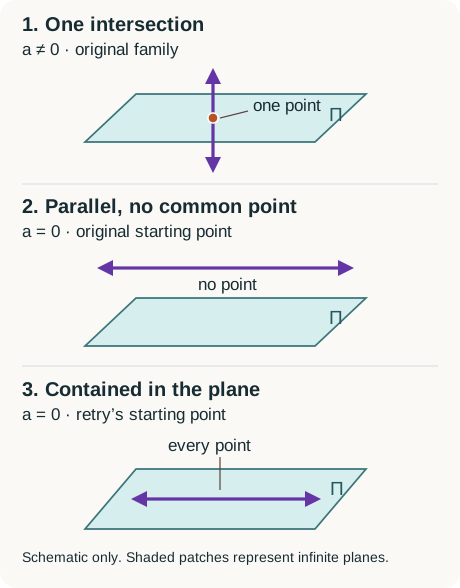
The normal is , and the direction is nonzero for every a. Substitution gives
The coefficient measures whether travelling along the line changes the left-hand side of the plane equation.
Division is now valid: . The intersection point has coordinates
The plane check is . There is one parameter value and hence one intersection. For example, a=1 gives .
The equation becomes , which is impossible. The direction is , perpendicular to the normal, but the starting point is not in the plane. The line is parallel to the plane and disjoint from it.
Find the perpendicular foot from P by writing . Requiring H to lie on gives , so . Therefore,
Check the plane: . The vector is perpendicular to it. For any point on the line, , so subtracting the same normal vector reaches the plane; this displacement has length 1. Thus the distance from the entire line to the plane is 1 coordinate unit, not just a distance computed from a conveniently chosen point. A perpendicular segment is shortest by the same Pythagorean reasoning used in question 2.
First error to watch for: dividing by a before checking a=0, or calling a line contained merely because its direction is perpendicular to the normal.
Replace the starting point by , keeping direction and plane . Classify the intersections for a=0 and a≠0. State the line–plane distance in both cases.
Now , so Q lies in the plane. Substitution gives , or . If a=0, every real t works: the whole line lies in the plane, so there are infinitely many common points. If a≠0, only t=0 works: the unique intersection is Q. The distance between the line and plane is zero in both cases because they have common points. Zero distance alone does not distinguish crossing from containment.
If you lost the fixed/free parameter distinction, revisit the original system example. If the geometric classification was difficult, compare the two-plane solution sets; two planes and a line–plane pair have different possible intersection shapes.
For tutoring, bring your first attempted setup and the step you cannot explain. You can also start without an attempt. Work through one example together, then use the changed problem to check whether you can choose and justify the method yourself.
Your tutor can follow your row operations and help you translate the final rows into a solution set. For line and plane problems, you can revisit your diagram together to distinguish a point, a direction vector and a normal vector before choosing a calculation.
Check your section’s outline for the assessed topics and evaluation rules. Practise systems with one solution, no solution and infinitely many solutions, together with the assigned matrix and vector-geometry questions. For each system, connect the final matrix rows to the solution set. For a geometry problem, identify the points, directions or normals used and explain what the result represents.
We work through permitted practice and comparable problems, without completing graded assignments or exams on your behalf.
Practise reversible row operations and use the final rows to distinguish one, no or infinitely many solutions.
Connect an augmented matrix to the intersection of two planes, using free parameters to describe every shared point.
Send your topic and preferred times. We’ll confirm whether we can help and, if so, agree on a time by text or email before payment.
Request 201-SN4-RE tutoringNablio is an independent service and is not affiliated with this institution.