Work with an online tutor on motion, forces, energy and momentum in Dawson 203-SN1-RE. Start with a question or concept you want explained. Your tutor can help you draw the situation, identify the forces and choose the physical law to use. If you have a diagram or calculation, you can review it together.
Choose only topics listed for your assessment. The course description supports this subject, but does not establish your section’s exam date or chapter cutoff.
Get help with a step.Ask about 203-SN1-RE tutoring Include the chapter, assessment date and question; attempted work is useful but not required. Sessions are currently in English.
Official course source Your section outline and instructor announcements take priority. These are Nablio study routes and exercises, not official exams.
Practise the reasoning between steps
Choose a workshop when the topic is included in your instructor’s announced material. These original exercises are not an exam reproduction or a complete course review.
When rigid-body equilibrium is in your assigned material, practise force diagrams, torques and the friction limit in one model. This supplement is not a complete course review or an exam prediction.
This original practice develops two-dimensional mechanics. Use it if projectile motion is on your course outline. It is not a prediction of your section’s midterm questions or coverage. Keep the existing collision-and-spring example for a separate conservation-law review.
Model each projectile as a particle near Earth’s surface. Neglect air resistance, take constant g=9.8m/s2, and consider motion only from release until the specified first contact. Set t=0 at release, positive x to the right and positive y upward. Distances are in metres and times in seconds. Record the launch and landing heights in the same coordinate system.
For a launch speed v0 at angle θ above the positive horizontal, v0x=v0cosθ and v0y=v0sinθ. Horizontal velocity stays constant; vertical velocity changes. Both components use the same elapsed time. At the highest point, only vy=0; the projectile need not be at rest.
The vertical component is drawn at the tip of the horizontal component to form a vector triangle. It does not represent a second stage of the flight.
Worked example 1: horizontal launch from a ledge
A ball leaves a ledge horizontally at 12m/s, from 19.6m above level ground. Find its flight time, horizontal displacement, and velocity just before impact. Predict the sign of its vertical impact velocity first.
Show the horizontal-launch solution
Set x0=0, y0=19.6, v0x=12, v0y=0, and ground height y=0. Vertical motion determines the landing time:
0=19.6−4.9t2⟹t=±2s.
Use t=2s. The negative root is before release and lies outside our model interval. Horizontal motion then gives Δx=12(2)=24m.
vimpact=(12i^−19.6j^)m/s.
The speed is 122+19.62≈22.98m/s. Its direction is arctan(19.6/12)≈58.52∘ below the positive horizontal. Report the reference direction, not just an unsigned angle. The vertical velocity is negative, as predicted.
Check independently: v2=v02+2g(19.6). This confirms the speed, but does not determine the direction by itself. A horizontal launch has zero initial vertical velocity, not zero vertical acceleration.
Worked example 2: an upward launch lands lower
A projectile is released from y0=24.5m with components v0x=14.7m/s and v0y=19.6m/s. The ground is at y=0, with no obstacle before impact. These components correspond to speed 24.5m/s and launch angle arctan(4/3). Find the landing time, horizontal displacement and impact direction.
Show the unequal-height solution0=24.5+19.6t−4.9t2⟹t2−4t−5=(t−5)(t+1)=0.
The roots are 5s and −1s. Only 5s belongs to the post-release flight. Thus Δx=14.7(5)=73.5m.
vx=14.7,vy=19.6−9.8(5)=−29.4(m/s).
The impact speed is 14.72+29.42≈32.87m/s, at arctan(29.4/14.7)≈63.43∘ below the positive horizontal.
The apex occurs at t=19.6/9.8=2s, at height 44.1m. The projectile returns to launch height at 4s, then continues to the lower ground until 5s. Therefore 2v0y/g is not the total flight time here. Likewise, the equal-height range formula is inapplicable. The energy check gives v2=24.52+2(9.8)(24.5)=1080.45m2/s2.
Four graduated transfer problems
Use the same ideal model and g=9.8m/s2. For every problem, write the target height equation before calculating. Keep roots until you have checked the event they describe.
1. Separate launch speed from fall time
A ball leaves a 4.9m-high ledge horizontally at 6m/s, landing on level ground. Find its flight time and horizontal displacement. If the launch speed doubles, which answer changes?
Hint for problem 1
There is no horizontal velocity in the vertical landing equation.
Solution to problem 1
0=4.9−4.9t2 gives the physical time t=1s. Then Δx=6m. Doubling the horizontal launch speed leaves the fall time at 1s and doubles the displacement to 12m. This conclusion uses the no-drag model and the unchanged launch height.
2. Two positive roots do not mean two landings
A projectile starts at (0,0) with v0x=10m/s, v0y=14.7m/s. A thin horizontal platform at height 9.8m begins at x=15m and extends to the right. There is no obstacle for x<15m. At which time and position does the projectile first contact the platform?
Hint for problem 2
Find both times at the platform’s height, then check the horizontal position and vertical velocity at each one.
Solution to problem 2
9.8=14.7t−4.9t2 gives (t−1)(t−2)=0. At t=1s, the projectile is at x=10m, rising with vy=4.9m/s, where no platform exists. At t=2s, it is at x=20m, descending with vy=−4.9m/s. First contact is therefore (20,9.8)m at 2s. At the platform’s leading edge, t=1.5s and y=11.025m>9.8m, so it clears the edge. Both time roots are physically meaningful height crossings; geometry identifies the landing.
3. Reject a root for a reason
A projectile starts at height 9.8m, with v0x=8m/s and v0y=4.9m/s. Find the ground-impact time and displacement. Explain why one algebraic root is excluded.
Hint for problem 3
Divide the landing equation by 4.9. The coordinate value y=0 is not the launch position.
Solution to problem 3
0=9.8+4.9t−4.9t2 gives (t−2)(t+1)=0. The root −1s lies before the specified release at t=0; use t=2s. Thus Δx=16m. As a check, vy=4.9−9.8(2)=−14.7m/s, consistent with downward impact.
4. Reconstruct an impact velocity
A projectile travels 30m to the right and lands 9.8m below its launch point after 2s. Find its initial velocity components, then the speed and direction just before impact.
Hint for problem 4
Use displacement equations to recover the initial components. The vertical displacement divided by time is an average velocity, not the impact velocity.
Solution to problem 4
v0x=30/2=15m/s. Vertically, −9.8=2v0y−4.9(2)2, so v0y=4.9m/s. At impact, vx=15 and vy=4.9−9.8(2)=−14.7, in m/s. The speed is 152+14.72≈21.00m/s, at arctan(14.7/15)≈44.42∘ below the positive horizontal. The average vertical velocity is −4.9m/s; using it as the final component would be an error.
Choose your next attempt from the first error
Wrong component or sign: redraw the launch triangle and axes before retrying problem 1.
Wrong root: list time, horizontal position and vertical direction for each candidate in problem 2.
Wrong flight-time formula: compare the launch and landing heights in worked example 2.
Wrong impact angle: draw the final velocity vector, then state the angle’s reference direction as in problem 4.
Bring your course outline, test date, component sketch and first height equation to tutoring. Ask for help with the first decision you cannot explain, then solve a fresh problem without the worked solution. Tutoring is offered in English; this French/English material does not imply French-language tutoring.
203-SN1-RE topics to review
KinematicsNewton’s lawsWork and energyMomentumRotation and torque
Common difficulties
Choosing forces, momentum or energy from the physical interaction rather than a familiar formula
Recognizing that momentum conservation in a collision does not imply kinetic-energy conservation
Mechanics: choose forces or momentum
Find the acceleration of a sliding block, then analyse a sticking collision. Choose the physical principle before substituting numbers.
Before you start: Allow 20–25 minutes to try both questions, then 15 minutes to check and retry any missed steps.
1. Net force on a sliding block
A 4.0kg block is already sliding right on a horizontal surface. A horizontal 18N pull acts right. The coefficient of kinetic friction is μk=0.20. Use g=9.8m/s2. Find the acceleration.
Show the explained solution
Vertically, N=mg=39.2N. Kinetic friction is leftward because the block slides right.
fk=μkN=7.84N.
With right positive, ma=18−7.84, so a=2.54m/s2 to the right. The pull itself is not the net force.
A 0.60kg cart moving right at 3.0m/s hits and sticks to a stationary 0.90kg cart. Neglect external horizontal impulse during the collision. Find their shared velocity and the kinetic energy lost.
Show the explained solution
For both carts together, horizontal momentum is conserved: (0.60)(3.0)=(1.50)vf.
Thus vf=1.20m/s to the right. With K=21mv2, Ki=21(0.60)(3.0)2=2.70J,Kf=21(1.50)(1.20)2=1.08J.
The loss is 1.62J. Momentum conservation does not imply kinetic-energy conservation in a sticking collision.
Draw only forces acting on the selected body, choose axes and write the net-force equation before inserting values.
For a collision error
Name the system and collision interval. State the external-impulse assumption before conserving momentum.
You can ask for help with either question above, even if you are unsure how to begin. Your tutor can help you draw the forces, choose a system and explain when to use Newton’s laws or conservation of momentum.
Review vector components, trigonometry, equation rearrangement and SI units. Read position, velocity and acceleration graphs by distinguishing height, slope and area. Before solving a mechanics problem, identify the system and time interval; conservation laws can apply during one stage of an event and fail during another.
Registration requirements
The guidance above is study preparation, not an eligibility decision. Confirm current prerequisites, restrictions and availability with Dawson College.
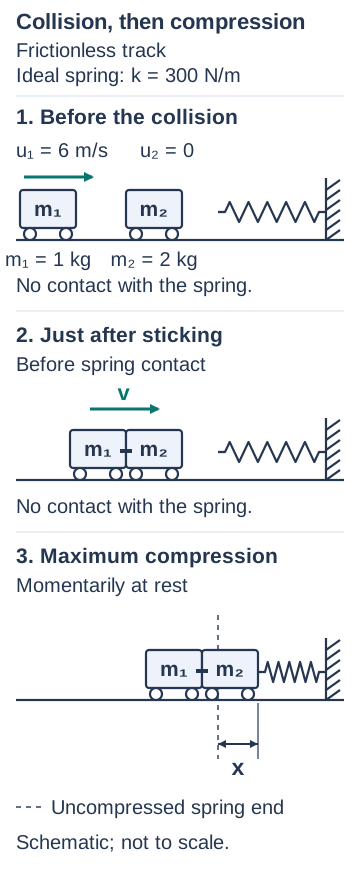
On a horizontal frictionless track, a cart of mass m1=1kg, initially moving at u1=6m/s, strikes and sticks to a stationary cart of mass m2=2kg, whose initial velocity is u2=0. After the brief collision, the pair reaches an initially uncompressed ideal spring of stiffness k=300N/m, fixed at its far end to a wall. Find the joined carts’ speed just after impact, their maximum spring compression and the kinetic energy lost during impact. Neglect external horizontal impulse during the collision.
Read the stages in time order. The collision happens before spring contact. Here v is the common speed just after impact. The dashed reference marks the spring’s uncompressed free end; x measures spring compression, not the carts’ travel since impact. Arrows above the carts show velocity, not force; their lengths are not to scale.
Show the reasoning
1. Treat the collision first. Choose the incoming direction as positive and let v be the common velocity just after impact. For the two-cart system, negligible external horizontal impulse means total momentum is conserved: m1u1+m2u2=(m1+m2)v. Substitution gives (1)(6)+(2)(0)=3v, so v=2m/s.
2. Account for the impact energy loss. Let Ki and Kf be the total kinetic energies immediately before and after the collision. Then Ki=21m1u12+21m2u22=18J, and Kf=21(m1+m2)v2=21(3)(22)=6J. The kinetic energy lost is Ki−Kf=12J, converted to internal energy and other forms during sticking. Momentum conservation does not imply kinetic-energy conservation in this inelastic collision.
3. Start a separate spring-compression stage. Let x≥0 be the maximum compression. At that instant the carts momentarily stop, so their post-impact kinetic energy has become spring potential energy. With no friction and an ideal spring, 21(m1+m2)v2=21kx2. Therefore x2=(m1+m2)v2/k=(3)(22)/300=0.04m2, giving x=0.20m.
4. Check which energy is available. The spring stores 21(300)(0.20)2=6J, matching the energy after the collision. Using the original 18J would ignore the impact loss.
Your turn: double the incoming speed
Use the same frictionless track, sticking collision and ideal spring, but change the incoming speed to u1=12m/s. Keep m1=1kg, m2=2kg, u2=0 and k=300N/m. Neglect external horizontal impulse during the brief collision. Find the common speed just after impact, the maximum spring compression and the kinetic energy lost during impact. Before calculating, predict which answers double and which quadruple. Name the conservation law for each stage, with the answer closed.
Check your reasoning
1. Use momentum during impact
Let v denote the common velocity, positive in the incoming direction. Momentum conservation gives (1)(12)+(2)(0)=3v, so v=4m/s. The speed doubles.
2. Compare the kinetic energies
Let Ki and Kf be the kinetic energies immediately before and after impact. They are Ki=21(1)(12)2=72J and Kf=21(3)(4)2=24J. The impact loss is Ki−Kf=48J, four times the original loss. The two kinetic energies also quadruple.
3. Start a new energy stage
Only the post-impact 24J is available for spring compression. With x≥0 denoting maximum compression, 21(300)x2=24 gives x=0.40m, twice the original compression. Check: the spring energy is 150(0.40)2=24J. If you used 72 J here, you carried energy lost during impact into the next stage. The track removes frictional loss, but it does not make the sticking collision elastic.
For angular-momentum problems in your current chapter, name the system and rotation axis before checking the external angular impulse. Work through a sticking collision, then check kinetic energy separately.
How tutoring can help
Your tutor can help you draw a force diagram or check one you have started for missing forces. Together, you can decide whether Newton’s laws, energy or momentum applies to each stage of a problem. For rotation, your tutor can explain how the chosen axis determines the lever arms and torque signs, then check your torque equation against the diagram.
Exam preparation for 203-SN1-RE
Use your section’s outline to choose kinematics, Newton’s-law, energy, momentum and rotation questions for the next exam; check laboratory requirements there too. Split multi-stage problems into time intervals and state which physical principle applies in each. Check the units of your answer and whether its size and direction make sense for the situation.
We work through permitted practice and comparable problems, without completing graded assignments or exams on your behalf.
Related courses
Useful links for preparation or further study—not transfer equivalencies or a required registration sequence.
Choose work, energy or momentum by system and interval. Solve collisions, read force–position and force–time graphs, and distinguish impulse from work.
Translate a motion story into position, velocity and acceleration graphs. Read slopes and signed areas, choose valid kinematics equations, and try six explained questions.
Find perpendicular lever arms, balance forces and torques, and test sliding, tipping and ladder friction limits. Six worked examples and fourteen questions with explained solutions.
Use force diagrams for circular motion, conical pendulums, banked turns and vertical-loop contact, then explore gravitational orbits. Nine worked examples and sixteen questions with hints and solutions.
Connect translation and rotation through unequal tensions. Moment-of-inertia scope is supported by Dawson’s Summer 2026 description; check your current section outline.
Resolve angled forces into components, find the resultant and acceleration, and recover an equilibrant or unknown force. Three worked examples and six questions with hints and solutions.
Need help with 203-SN1-RE?
Send your topic and preferred times. We’ll confirm whether we can help and, if so, agree on a time by text or email before payment.