Get help choosing a method for John Abbott 203-SN1-RE Mechanics. Work through a pendulum question that uses energy to find speed, then forces to find string tension.
John Abbott’s Science program describes Mechanics through forces, acceleration, energy, momentum, rotational motion and the gravitational field. The example below focuses on connecting energy and forces in one problem.
Review the cosine of an angle, square roots and force diagrams. You will also use the inward acceleration Lv2 of an object moving along a circular path of radius L at speed v.
If you want to practise force diagrams before combining energy and circular motion, start with the six force-setup questions.
What to watch for
Choosing energy for an interval and forces at an instant
Distinguishing speed from velocity direction
Mechanics: connect projectile motion and energy
Separate horizontal and vertical motion for a launched ball, then use energy to find the speed of a spring-launched block.
Before you start: Allow 20–25 minutes to try both questions, then 15 minutes to check and retry any missed steps.
1. A horizontal launch from a bench
A small ball leaves a horizontal bench at 3.0m/s, from a height of 1.25m. Ignore air resistance and use g=9.8m/s2. Find its flight time and horizontal range.
Show the explained solution
The initial vertical velocity is zero. The vertical drop gives 1.25=21gt2, hence t=2(1.25)/9.8≈0.505s.
Horizontal velocity stays constant, so R=vxt≈1.52m.
Horizontal speed does not appear in the flight-time equation for this fixed-height horizontal launch.
A 0.50kg block is released from rest against an ideal spring compressed by 0.10m. The spring’s other end is fixed to a wall, and its constant is 200N/m. On a frictionless horizontal surface, find the block’s speed as the spring returns to its natural length.
Show the explained solution
Let c=0.10m be the compression, k=200N/m the spring constant and m=0.50kg the block’s mass. For the block–spring system, the initial spring energy becomes kinetic energy: 21kc2=21mv2.
Take the nonnegative root because the question asks for speed: v=ck/m=0.10200/0.50=2.0m/s.
The initial spring energy is 1.0J, matching the final kinetic energy. A constant-acceleration equation would fail because the spring force changes as it expands.
Give each direction its own initial velocity and acceleration; use the common time to connect them.
Choose the system
For energy, list initial and final stores and any work transferring energy across the system boundary.
Bring the point where you had to choose between motion equations, forces and energy. We can practise that decision with your current 203-SN1-RE review topics.
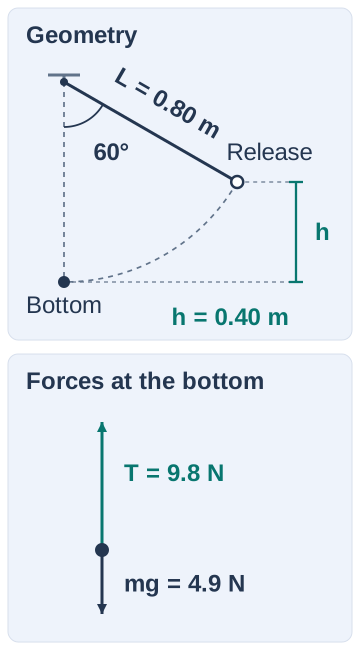
A small mass m=0.50kg hangs from a string of length L=0.80m. It is released from rest with the taut string at θ=60∘ to the downward vertical. Treat the mass as a single point, ignoring its size. The string has no mass and does not stretch; the pivot is fixed. Neglect air resistance and friction. Use gravitational acceleration g=9.8m/s2. Find the speed and the string tension as the mass passes through the lowest point. First decide which quantity an energy equation can find.
Show a hint
Find the vertical drop, then use conservation of mechanical energy. At the lowest point, the net force toward the pivot supplies the inward acceleration.
Show the reasoning
1. Find the vertical drop
Let h be the release height above the lowest point, in metres. The initial vertical distance below the pivot is Lcosθ; at the bottom it is L.
h=L−Lcosθ
h=L(1−cosθ)
h=(0.80m)(1−cos60∘)
h=(0.80m)(1−0.50)
h=0.40m
Use the vertical height, not the distance travelled along the arc.
2. Use energy to find speed
Let v be the speed at the lowest point, in m/s. Choose zero gravitational potential energy at that point. With the mass and Earth as the energy system, the initial gravitational potential energy becomes kinetic energy. The string’s tension is perpendicular to motion and does no work.
mgh=21mv2
v2=2gh
v2=2(9.8)(0.40)m2/s2
v2=7.84m2/s2
Taking the positive square root gives:
v=2.8m/s
3. Change to a force equation at the bottom
Let T be the string tension in newtons. At the lowest point, draw T upward toward the pivot and mg downward. The path is circular, so the inward acceleration is ar=Lv2; the subscript r denotes the radial direction. Here that direction is upward.
ar=0.80m7.84m2/s2
ar=9.8m/s2
Even though the velocity is horizontal at this instant, its direction is changing.
4. Solve for tension
Newton’s second law toward the pivot is:
T−mg=Lmv2
Thus:
T=mg+Lmv2
Calculate the two terms using SI values:
mg=(0.50)(9.8)N
mg=4.9N
Lmv2=0.80(0.50)(7.84)N
Lmv2=4.9N
T=4.9N+4.9N
T=9.8N
5. Explain why T=mg would fail
The weight is 4.9N, so tension is twice the weight here. If T equalled mg, the net inward force would be zero, which would not keep this moving mass on its circular path. Tension can do zero work while still changing the direction of velocity.
The same mass is shown at release and at the lowest point. The 60° angle is measured from the downward vertical; h is the vertical drop. The separate force diagram is for the lowest point: T’s arrow is twice as long as mg’s.
Change the length, keep the release angle
Use the same mass and release angle, but replace the string with one of length 1.60m. Keep the same assumptions. Predict whether the speed and the tension at the lowest point increase, decrease or stay the same, then check your prediction.
Check your answer
Find what changes in the energy calculation
The height doubles:
h=(1.60m)(1−cos60∘)
h=0.80m
v2=2gh
v2=15.68m2/s2
v≈4.0m/s
The speed increases by a factor of 2, not by a factor of 2.
Keep the radius in the force equation
Both v2 and L have doubled, so:
Lv2=1.60m15.68m2/s2
Lv2=9.8m/s2
The inward acceleration remains unchanged.
T=(0.50)(9.8+9.8)N
T=9.8N
This is the same tension as before. A greater speed alone does not determine tension; the radius also matters.
Use the energy lesson to choose a system and a time interval. Use the force-diagram lesson to identify interactions before writing the equation at the lowest point.
How a tutor can help
A tutor can help you label the height on a sketch, explain why tension does no work and decide where to switch from an energy equation to a force equation. You can compare an attempted T=mg solution with the curved path, then try the longer-string check to see which quantities change.
Prepare for an assessment
Bring your current topic list and a practice question. You can start it with your tutor or review a solution you could not finish. For each practice problem, state the system, the interval and the unknown before choosing a law. Include a short explanation of why the method applies, then check units and the physical meaning of the answer.
Use force diagrams for circular motion, conical pendulums and frictionless banked turns. Five worked examples and eight questions with hints and solutions.
Connect three force and torque diagrams to explain unequal pulley tensions. Check rotational energy, recover the ideal limit and retry with a different moment of inertia.
Send the topic you want help with and your preferred times. Start with a problem you’re stuck on or a concept you’d like to understand better. Your tutor can help you build confidence from the basics. You can include a practice question or any work you have started. We’ll confirm whether we can help and agree on a time before payment.
Does this guide match my section?
Use your current course outline and your instructor’s announced topics to decide which parts of this guide to practise. Follow your section’s assessment instructions.
Need help with 203-SN1-RE?
Choose a topic or send the step where you get stuck.
When rigid-body equilibrium is in your assigned material, practise force diagrams, torques and the friction limit in one model. This supplement is not a complete course review or an exam prediction.