Stuck on a step? Text us Email us Request a lesson
Find the landing time from the actual height condition, then use that same time horizontally. Follow an upward launch, locate its apex and test what changes when the ball is launched downward.
Before you start: you should be able to solve a quadratic equation and use sine, cosine and Pythagoras. Review right-triangle methods or constant-acceleration kinematics if needed. No calculus is required.
1. Set the model and define the quantities
A small ball leaves a ledge above horizontal ground. Treat it as a particle: ignore its size, spin and air resistance. Gravity is the only force during flight, and its downward acceleration has the constant magnitude . There are no obstacles before the ground. Our equations describe the flight up to the instant just before contact; they do not describe the bounce.
Choose to the right and upward. Put the origin on the ground directly below the launch point. Set at launch.
- : elapsed time since launch, in seconds (s).
- : horizontal and vertical coordinates, in metres (m). The position vector is .
- : initial coordinates; the subscript 0 means “at launch.” The landing height is , where the subscript f means “final.”
- : signed velocity components, in m/s. The velocity vector is ; its magnitude, or speed, is .
- : acceleration components, in m/s². Here . The positive number is a magnitude; the minus sign comes from our upward-positive axis.
- : flight time to the ground. Here the horizontal range is ; since motion is rightward, this displacement is positive.
Our worked question: the ball starts at , with . Find its flight time, range, apex position and velocity just before landing. Treat the stated values as the model inputs and round only final decimal results.
2. Convert a speed and angle to components
If a question gives initial speed and an angle measured from the positive horizontal direction, use the right triangle formed by the velocity components:
For a rightward launch above horizontal, both components are positive. For a rightward launch below horizontal, use a negative angle or explicitly give the vertical component a minus sign. If the angle is measured from vertical, identify the adjacent and opposite sides again instead of reusing these formulas blindly.
Quick independent check: a ball is launched at 20.0 m/s, 30° above horizontal. Find its components before opening the answer. Use degree mode.
Show the component answer
Check: . The components do not add directly to give the speed.
Return now to the worked question’s components, 12.0 m/s and 9.8 m/s. They correspond to , at above horizontal. Use the given components in the calculations, rather than converting these rounded values back.
3. Use the landing height to find time and range
Each component follows a constant-acceleration equation. Horizontal acceleration is zero, so horizontal velocity stays constant. Vertical velocity changes because gravity acts downward:
Both components describe the same ball at the same instant. Their equations are separate, but their elapsed time is shared. You cannot choose one time for horizontal motion and another for vertical motion.
Write the physical endpoint first
The ground is . The downward displacement from launch is . Substitute the position condition, keeping the initial height:
In this numerical equation, enter time in seconds and all terms represent metres. Divide by 4.9 and rearrange:
The roots are and . We are modelling motion after launch, so keep . The negative root belongs to a backward mathematical extension of the parabola; it is not an earlier event in this ball’s specified flight. In a quadratic that does not factor easily, use the quadratic formula and check each root against the event and the model interval.
Use that time horizontally
The landing point is . Range here is horizontal displacement, not the curved distance travelled. Substitution checks the endpoint: .
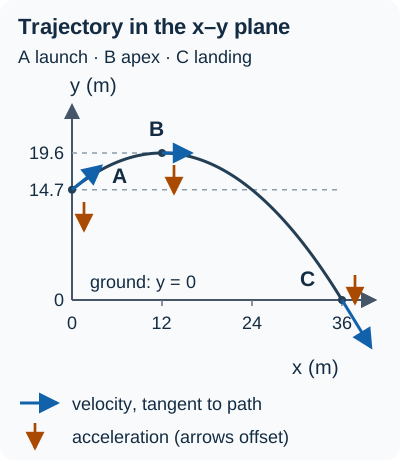
4. Locate the apex and find the landing velocity
The apex occurs when the vertical component is zero
Here means time to the highest point. Use this time in both position equations:
At the apex, , so speed is 12 m/s. The ball keeps moving right. Its acceleration is still ; gravity does not turn off when .
Landing uses the later time, 3 s
The velocity is ; the speed is about 23.0 m/s. A vector answer includes direction. Since and , the landing direction is rightward and downward, about below horizontal.
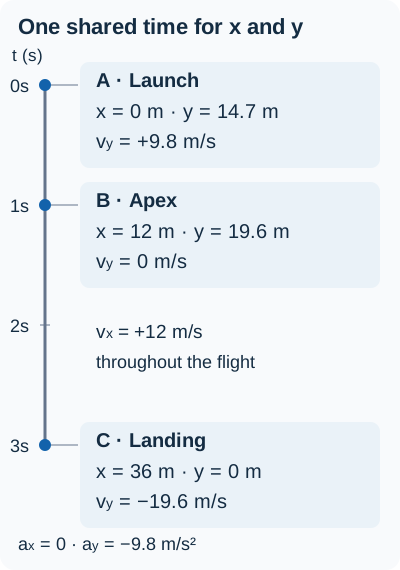
5. Check the speed with energy
For the ball–Earth system, ignoring air resistance, kinetic energy plus gravitational potential energy is conserved. Let be the ball’s mass in kilograms; take zero gravitational potential energy at the ground:
Cancel the same nonzero mass and rearrange:
This agrees with the component result. The ball lands faster than it was launched because it finishes lower. This energy balance checks speed, but does not by itself give flight time, range or the velocity direction. A correct energy check can therefore coexist with a wrong range. With appreciable air resistance, this two-term mechanical-energy balance would need to include energy transferred out of mechanical form. Review choosing a mechanics balance if the system or interval is unclear.
6. Diagnose the equal-height shortcut
Plausible wrong solution: “Flight time is , so range is 24 m.” The time 2 s is real, but the ball is back at its launch height then:
It has not reached the ground. For an upward launch, the shortcut , and the related range formula , require the final and initial heights to be equal under this model. For different heights, write the actual landing condition.
Another mistake: “Velocity is zero at the apex.” Only is zero. Setting the whole vector to zero would also erase the unchanged horizontal component.
Short axis check: keep right positive, but put the vertical origin at launch and define a new coordinate , positive downward. What are the ground coordinate, initial vertical velocity and vertical acceleration? Write the landing equation before opening the answer.
Show a hint for the axis check
What coordinate describes the ground in your chosen axis? Solve that condition for time, then use the same time horizontally. A coordinate change also changes the signs of vertical velocity and acceleration.
Show the axis-check solution
Here , so , , and . Upward launch now has a negative component.
This gives the same roots, −1 s and 3 s, and the same 36 m range. At landing , which describes the same downward motion previously written as . Coordinates changed; the flight did not.
7. Try a downward launch independently
Keep the height 14.7 m, the rightward component 12.0 m/s and all model assumptions. Reverse only the initial vertical component: . Use the original ground-based, upward-positive axes.
- Before calculating, predict whether flight time, range and landing speed increase, decrease or stay the same.
- Find the flight time and range.
- Find both landing-velocity components and the speed. Explain the speed comparison using energy.
- Does the ball reach an apex after launch?
Show a hint for the downward launch
What y-coordinate describes the ground in your chosen axes? Solve that condition for t, then use the same t in the horizontal equation. Changing the sign of one initial component does not change its square in the initial kinetic energy.
Show the full downward-launch solution
The ball starts downward, so it reaches the ground sooner. With unchanged horizontal velocity, its range is smaller. Initial speed and initial height are unchanged, so energy predicts the same landing speed.
Reject , which precedes launch. Keep , so .
Thus and . The full landing velocity happens to match too: the horizontal component is unchanged, and both balls are descending at the same ground level. Energy alone establishes only the speed equality.
For , . There is no later rising phase or interior apex during this flight. Its highest point in the modelled interval is the launch point at 14.7 m. Solving would give , outside this interval.
8. Decide when two positive roots are valid
Return to the original upward launch. A horizontal reference line is 18.0 m above ground; it is not a platform or obstacle. At what times does the ball cross this line? Find each horizontal coordinate and say whether the ball is rising or falling. Try this without using the worked answers.
Show a hint for the two crossings
Use , not . Compare every root with the interval from launch to ground contact. Use the sign of to distinguish the crossings.
Show the full two-crossing solution
Both are between 0 s and 3 s, so both are valid crossings of the reference line.
- At : , and . The ball is rising.
- At : , and . The ball is falling.
Rejecting a root is a physical decision, not a rule to always keep only the larger root. A real obstacle at the first crossing would change the later motion; this question explicitly has no obstacle.
9. Check your method and choose a next step
- Did you define the origin, positive directions and launch time?
- Do the given angle and component signs agree?
- Did you put the actual final height into the vertical equation?
- Does each accepted root belong to the specified event and interval?
- Did you use the same time in x and y?
- Can you distinguish position, velocity, speed and acceleration at the apex?
- Does the energy check agree with the speed without being used to claim a time or range?
For focused help through Nablio’s mechanics tutoring page, bring your sketch and your first attempt at the downward-launch retry. A tutor can check your axes, watch how you convert launch information to components, and help you justify the landing condition and root choice. Then try a new height or direction on your own. Use your current course outline to decide which topics to prepare.
References and course scope
The examples, questions and diagrams here are original. For the underlying model, see OpenStax College Physics 2e, section 3.4, Projectile Motion. For the energy balance, see section 7.3, Gravitational Potential Energy.
This is a topic lesson for introductory two-dimensional kinematics. It can follow the horizontal-launch starters on the John Abbott and Marianopolis mechanics guides when projectile motion is in your section’s outline. It is not an institution’s exam or a prediction of assessment questions; the course guides retain their own source and term qualifications.
Useful for
Use this as a two-dimensional kinematics application when your section includes projectile motion. Concordia PHYS 204 and McGill PHYS 101 establish broad kinematics relevance, not a particular assessment. The Marianopolis continuation follows its existing horizontal-launch practice and retains the guide’s dated-source and term qualifications.
Work on the step you’re missing.
Tell us the subject and your preferred time. Nablio confirms the details by text or email.
Request a lesson