A moving object can keep the same speed while its velocity changes direction. That is the first decision in a circular-motion problem. The next is to identify which real forces make the path curve.
This lesson develops those two decisions through a puck on a string, a token on a turntable and a bead crossing a curved track. You will draw a force diagram, choose the inward direction, calculate the required force and check whether the contact or string can supply it.
Before starting, review free-body diagrams and friction. That lesson explains weight, normal force, tension and the static-friction limit. The motion-graphs lesson helps distinguish velocity from acceleration. The explanations and questions below are original Nablio practice, independent of any college assessment.
1 Why constant speed can mean acceleration
Speed tells you how fast an object moves. Velocity also includes its direction. On a circle, the velocity points along the tangent, perpendicular to the radius. Even if its length stays the same, the velocity arrow turns as the object moves.
Acceleration measures the change in velocity per unit time. For motion at constant speed around a circle, it points toward the centre. This is called centripetal acceleration, meaning centre-seeking acceleration. Let be the speed in metres per second, the circle's radius in metres, and the inward acceleration in metres per second squared:
Why this combination? Over a short time , the object travels a short arc of length . Its velocity turns through the same small angle as its radius. For a very small turn, the size of the velocity change is approximately . Dividing by , then taking shorter and shorter intervals, gives . Here means the size of the change in the velocity vector; the speed itself has not changed.
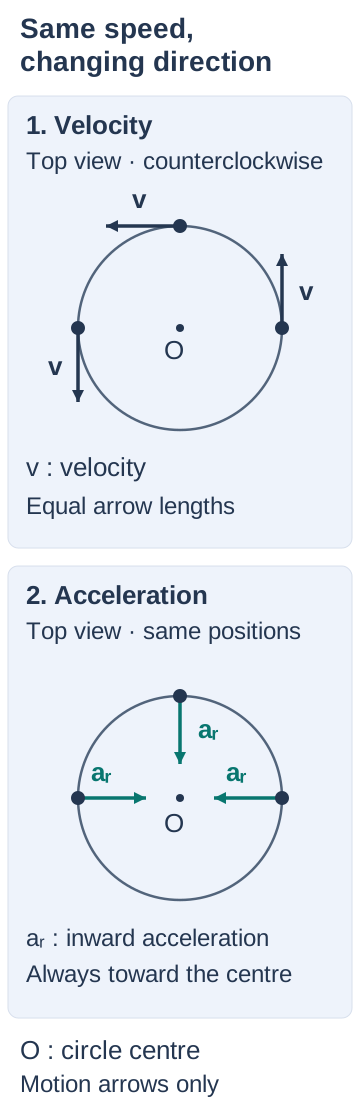
Doubling speed at the same radius multiplies the inward acceleration by four. Doubling radius at the same speed halves it. The units also fit: .
What if the speed changes? The inward component still has size on a fixed circular path, using the speed at that instant. There is also a tangential acceleration along or opposite the motion. The total acceleration, and therefore the net force, need not point straight inward. The worked examples specify a constant speed or ask about one particular point.
Even at constant speed, the inward direction keeps turning. The acceleration vector is therefore not constant, so straight-line constant-acceleration formulas cannot describe a whole turn.
2 Choose the inward axis and the real forces
Observe the motion from the stationary room or ground, treated as an approximately inertial frame: a frame where an object subject to zero net force has constant velocity. Isolate one object. Draw only forces exerted by identifiable interactions, such as Earth's gravity, a string or a surface.
At the position being studied, choose inward as the positive radial direction. Newton's second law then gives
Here is mass in kilograms, is a signed inward force component, and means add those components. An outward component has a negative sign. The right side gives the required net inward force.
“Centripetal force” describes the inward radial result of the forces already on your diagram. Adding another arrow labelled would count the same effect twice. Likewise, an object's velocity is not a force. Keep motion arrows separate from the force diagram.
Use this order: mark the centre → isolate the object → draw its real forces → choose inward → write the radial equation → check any other direction → test the model. A taut string can pull, a surface can push, and static friction has a maximum.
For every numerical question, use , neglect air resistance and treat the object as a particle. denotes the normal force; is the unit newton. Keep unrounded values until the final answer.
3 Worked example 1 A puck pulled by a string
A puck moves at a constant speed of on a frictionless horizontal table. A light, taut horizontal string connects it to a fixed point, making a circle of radius . Find the acceleration and the string tension .
The forces are weight downward, normal force upward and tension horizontally inward. The table keeps the puck at a fixed height, so and . Tension is the only inward force:
The puck accelerates even though its speed is constant: tension changes the direction of its velocity. A separate “centripetal” arrow is unnecessary. The vertical forces balance; the horizontal forces do not.
As a check, doubling the speed to at the same radius would require . That prediction assumes the string can withstand the greater tension. Its breaking strength was not supplied.
4 Worked example 2 Will a token slip
A small token turns with a horizontal turntable without sliding. It is from the centre and moves at the constant speed . The coefficient of static friction is . Check whether the claimed no-slip motion is possible, then find the largest constant speed this model allows.
The token moves relative to the room but does not slide relative to the turntable. Static friction applies. The real forces are weight downward, normal force upward and static friction horizontally inward.
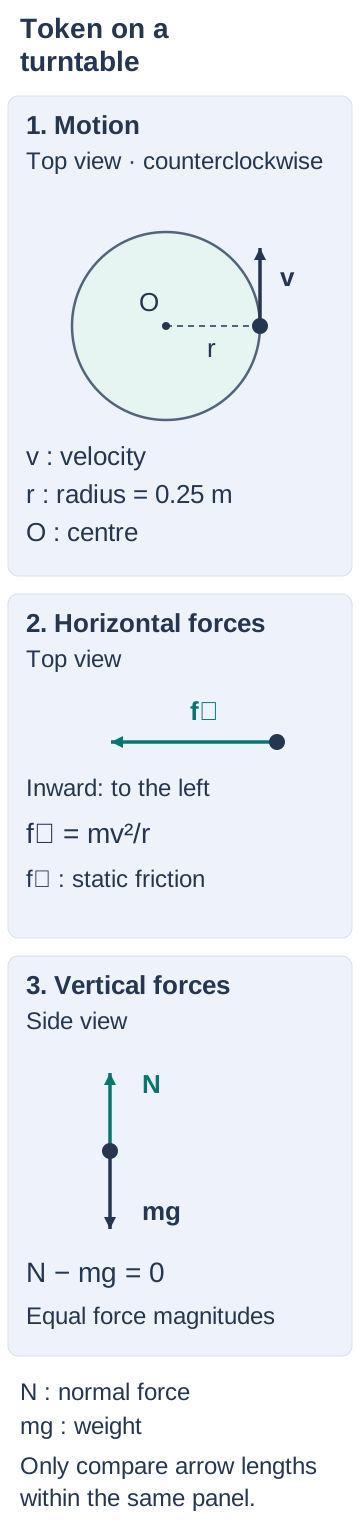
There is no vertical acceleration, so . The radial equation tells us the friction actually needed:
Compare this with the available maximum:
Because , no slipping is consistent with the model. The actual friction is , not its maximum. It acts perpendicular to the token's velocity, providing the turn without changing the speed.
At the limiting steady speed, the required friction reaches the maximum:
Mass cancels because both the required force and the friction limit grow in proportion to mass. Above this speed, the token cannot keep the stated circle without sliding. Do not continue using static friction or assume its path still has radius .
Optional extension: what changes when the turntable speeds up?
Keep the same token and surface: , , and . At an instant when its speed is , the turntable would make its speed increase at each second if it did not slip. Can friction supply that motion at this instant?
Call this rate of increase tangential acceleration, . It points along the motion. The inward acceleration changes velocity’s direction. These directions are perpendicular. The token stays at a fixed height, so the normal force remains .
Use Newton’s second law in both horizontal directions because friction must produce both accelerations. Let and be the inward and tangential components of the one static-friction force:
Picture one friction arrow pointing diagonally inward and forward. Its perpendicular components form a right triangle, so the required magnitude is
The available maximum is still . Because , no slipping is consistent at this instant. The actual friction is the required , not the maximum. As speed rises, the inward requirement rises too; this check does not guarantee later no-slip motion.
Try a faster speed increase: at the same instantaneous speed, change only to . Can the token stay without slipping at this instant? Explain which force must satisfy the limit.
Check your answer
Now , giving . Each component is below , but their combined magnitude exceeds it. The no-slip motion is impossible. The friction limit applies to the whole vector, not separately to each component. These required forces describe the failed no-slip assumption; they do not determine the actual motion after slipping.
5 Worked example 3 Contact at the top of a curved track
A small bead slides over the outside of a smooth, fixed circular hump of radius . At the top its instantaneous speed is . The track can push on the bead but cannot pull it or hold it down. Find the normal force there and check contact.
The centre of the circle is below the bead. Inward therefore means downward at the top. Weight contributes ; the upward normal force contributes . There is no friction:
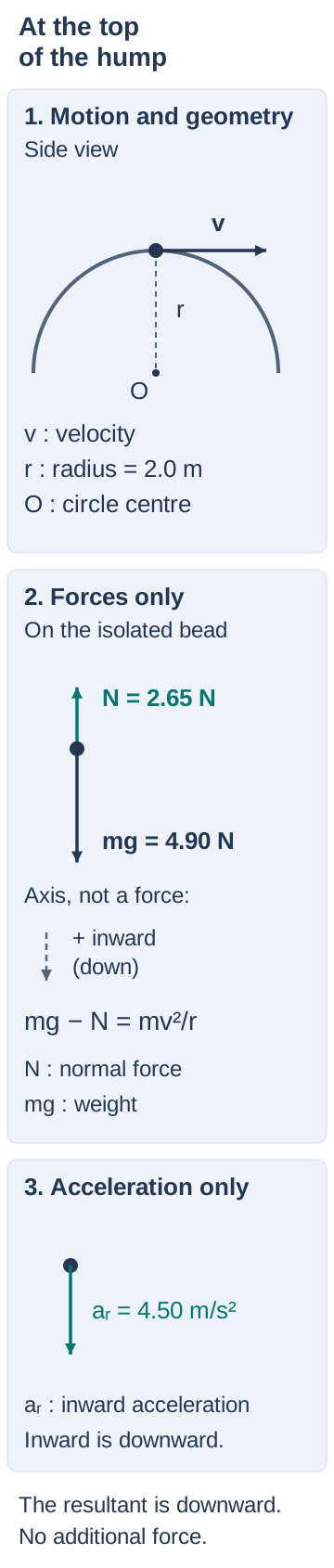
This is smaller than the weight. Their difference, downward, produces the inward acceleration . The bead is momentarily moving horizontally, but that does not make its vertical acceleration zero.
Contact requires . At the top, the limiting condition is
Equality gives zero normal force, the boundary of maintained contact in this ideal model. A negative computed would mean the assumed circular contact is impossible; it would require the track to pull downward. It is not a negative “push” that the track can actually provide.
The speed need not remain constant elsewhere on the hump. At the top, gravity and the normal force are both radial. Away from the top, gravity generally has a tangential component. This calculation checks the specified point; it does not determine the entire trip.
6 Four questions with less guidance
For each question, mark the centre and keep the force diagram separate from velocity and acceleration arrows. Try the question before opening the hint or solution.
1 Guided practice Draw the two directions
A puck moves counterclockwise at constant speed on a horizontal circle of radius . At the rightmost point, which way do its velocity and acceleration point? Find the acceleration's magnitude. If its horizontal force then disappears and no other horizontal force acts, what happens to its horizontal path?
Hint
Draw the tangent at the rightmost point. The centre lies to the left. After the force disappears, apply Newton's first law.
Explained solution
Viewed from above, velocity points upward along the page and acceleration points left, toward the centre. The magnitude is . After the horizontal force disappears, horizontal acceleration is zero. The puck follows the straight tangent in the horizontal plane with its existing velocity; it does not suddenly move radially outward.
2 Find the error Two names for one effect
A puck on a frictionless horizontal table is attached to a fixed point by a light, taut horizontal string. It moves at constant speed on a circle of radius . A student writes , with , and concludes . Explain the mistake and find .
Hint
Which interaction would exert in addition to the string? List the real forces before writing the radial equation.
Explained solution
The forces are weight, the table's normal force and string tension. The first two balance vertically. There is no fourth interaction producing an extra . Tension supplies the full inward force, so . The student's equation counts the inward net force twice. A zero tension would leave no horizontal force to maintain the circle.
3 Independent practice Test the friction limit
A token is from the centre of a horizontal turntable with . Consider two separate steady-speed trials, each assuming the token shares the turntable's motion without slipping: , then . Which assumption is possible? Give the actual friction when no slipping is possible and find the limiting steady speed.
Hint
Calculate the same normal force and friction maximum for both trials. Then compare each required with that maximum.
Explained solution
The normal force is , giving . At , the required friction is , greater than the maximum. The no-slip circle is impossible. At , the requirement is , so no slipping is possible and actual static friction is inward. The limiting speed is , consistent with both comparisons. The two trials do not describe an acceleration between speeds.
4 Transfer practice Change the direction of tension
A ball on a light string moves in a vertical circle of radius about a fixed point. At the top, the string is taut and the instantaneous speed is . Find the tension and the smallest top speed compatible with the taut-circle model. What would a negative calculated tension tell you?
Hint
At the top, both the string and gravity pull toward the centre. A string can pull but cannot push. This is different from the upward normal force in the hump example.
Explained solution
Choose downward, toward the centre, as positive. Both forces contribute positively: . Hence . This positive result is compatible with a taut string. Requiring gives at the top. Equality is the limiting case. A negative tension would require the string to push outward, so the taut circular-path assumption would fail. This is a local condition at the top, not proof that a particular starting state completes a whole loop. The speed is not assumed constant around the vertical circle.
7 Check your model
- Can you mark the centre and distinguish the tangent from the inward direction?
- Can you name the interaction behind every force arrow?
- Have you added signed radial components instead of adding a separate centripetal force?
- Are you finding total acceleration at constant speed, or only the inward component when speed changes?
- Does the result satisfy the friction, contact or tension condition?
If a step is unclear, a mechanics tutor can help you identify the forces, choose the inward direction and write the radial equation, whether you are starting or checking your work. For problems that first require finding a speed from a height or a force acting over a distance, continue with work, energy and momentum.
8 Useful for these courses
Useful for
Work on the step you’re missing.
Tell us the subject and your preferred time. Nablio confirms the details by text or email.
Request a lesson