Electric Field vs Electric Potential: Signs, Units and Worked Examples
Distinguish field, potential, force and energy. Compare two midpoint cancellations, read a potential graph and work through five explained practice questions.
Get one-to-one online help with electric fields, circuits and geometrical optics in PHYS 102. Your tutor can help you trace circuit connections before choosing equations, or build a ray diagram and explain the image. Start with a question or a concept you want to understand.
McGill PHYS 102 introduces electricity and magnetism, circuits, electromagnetic waves, and geometrical optics. Diagrams and consistent sign conventions are central to the problem-solving approach.
Review mechanics-style reasoning, scientific notation and rearranging formulas. Attach a physical meaning and unit to every symbol.
The guidance above is study preparation, not an eligibility decision. Confirm current prerequisites, restrictions and availability with McGill University.
Check the official course catalogueA constant current of 0.5 amperes flows for 8 seconds. How much electric charge flows during those 8 seconds?
Let be current, elapsed time and transferred charge. Current is charge per unit time, so for constant current . The units agree because one ampere is one coulomb per second.
Original practice for DC-circuit reasoning. Use your current PHYS 102 outline to choose the topics relevant to your assessment.
An ideal 12 V source feeds a 2 Ω resistor . After , the wire splits into two branches: one contains a 6 Ω resistor , the other a 3 Ω resistor . The branches rejoin and return to the source. Wires have zero resistance; the resistors obey Ohm’s law and the currents are steady. Find the source current, the voltage across the parallel pair and the current in each branch.
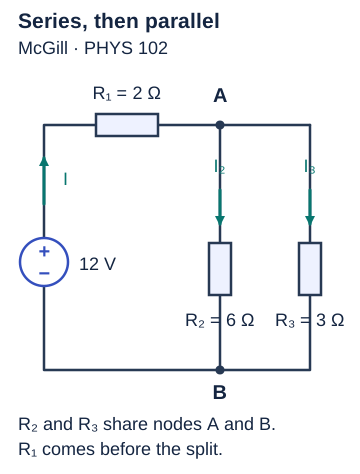
Predict first: and connect between the same two nodes. What must be equal across them? Which should carry more current?
A node is a connected region of ideal wire at one potential. Trace the two endpoints of each resistor before choosing a series or parallel rule. The branch currents add where the branches rejoin.
Read the connections. and share both endpoints, so they have the same voltage and are in parallel. carries all the source current before it splits. and do not carry the same current simply because they appear beside one another in a drawing.
Replace the parallel pair temporarily. Its resistance satisfies in , so . The total resistance is . Therefore through the source and .
Recover the actual branch voltage. The drop across is , leaving across each parallel resistor. The 12 V source is not connected directly across either branch resistor.
Find and check the currents. and . The junction check gives . Around either loop, the 6 V drop across and the 6 V branch drop add to the source’s 12 V rise.
Check energy per second. The source supplies . The resistors dissipate , and . Their sum is 36 W. This second check can catch a branch current that passed an isolated arithmetic check.
Common mistake: assigning 12 V to every resistor produces branch currents for a different circuit. Identify the nodes before inserting a voltage into .
Draw above instead of below it, keeping both endpoints connected to the same nodes. What changes in the results?
Nothing changes electrically. still carries 3 A, the parallel voltage is 6 V, and the branch currents remain 1 A and 2 A. Page position does not determine connectivity.
Disconnect the 3 Ω branch completely, leaving an open circuit there. The source remains 12 V. Before calculating, predict whether the source current falls and whether the current in the remaining 6 Ω resistor also falls.
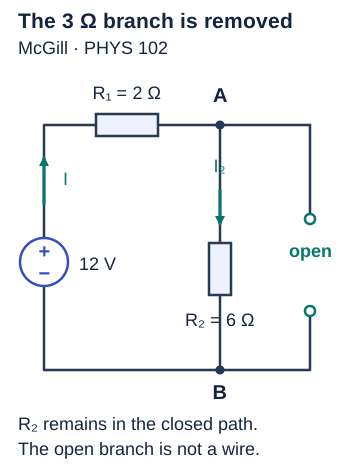
The remaining path contains 2 Ω and 6 Ω in series, so . The voltage across the 6 Ω resistor is 9 V. The source current falls from 3 A to 1.5 A, but the 6 Ω branch current rises from 1 A to 1.5 A: the smaller drop across leaves more voltage for it. The disconnected branch carries zero current. An open circuit is not a zero-resistance wire.
Return to the original circuit. How much charge passes through the 3 Ω resistor in 5 s? How much energy is transferred to that resistor during this time?
Its voltage is 6 V, so the transferred energy is . Equivalently, its 12 W power over 5 s gives 60 J. Charge is measured in coulombs; energy is measured in joules.
Choose the viewing direction before saying clockwise or counterclockwise. The full lesson connects diagrams, Lenz’s law and the slope of flux, with six questions, hints and targeted retries. The calculus extension is labelled separately; follow your section’s methods.
You can start with a circuit or optics question, even if you have not drawn a diagram or written an equation. For a circuit, your tutor can help you trace the connections, identify which voltage belongs to each resistor and check currents at a junction and voltage changes around a loop. For optics, you can draw the rays and choose a sign convention together, then explain the image distance and magnification. After working through an example, you can change one part and discuss what should happen before calculating.
For the circuit topics on your review list, solve one question without looking at the example, then redraw or disconnect a branch and predict what changes. Check both charge conservation at a junction and potential changes around a loop. Add a field-versus-potential question and the optics problems assigned in your section. State the sign convention and describe the image, rather than stopping at a signed distance. These are selected original exercises, not an official exam or a forecast of its coverage.
Use your section’s outline to choose the chapters to review. We work through permitted practice and comparable problems, without completing graded assignments or exams on your behalf.
Distinguish field, potential, force and energy. Compare two midpoint cancellations, read a potential graph and work through five explained practice questions.
Find induced current direction from changing flux. Four direction cases, angle diagrams, flux-time graphs and six explained questions, with an optional calculus extension.
Send your topic and preferred times. We’ll confirm whether we can help and, if so, agree on a time by text or email before payment.
Request PHYS 102 tutoringNablio is an independent service and is not affiliated with this institution.