Electric Field vs Electric Potential: Signs, Units and Worked Examples
Distinguish field, potential, force and energy. Compare two midpoint cancellations, read a potential graph and work through five explained practice questions.
Work through electromagnetism and optics questions in PHYS 142 with an online tutor. For electrostatics, your tutor can help you describe the charge distribution, draw field directions and decide which method fits before calculating. You can start with a question or a concept.
McGill PHYS 142 covers basic electricity and magnetism together with geometrical optics. It forms part of McGill’s calculus-based introductory physics sequence.
Combine vectors, mechanics, trigonometry and elementary calculus. Review how a field differs from the force on a particular charge.
The guidance above is study preparation, not an eligibility decision. Confirm current prerequisites, restrictions and availability with McGill University.
Check the official course catalogueTwo identical positive point charges lie equally far left and right of their midpoint. What is their net electric field at that midpoint?
Each positive charge produces a field directed away from itself. At the midpoint the left charge’s field points right and the right charge’s field points left. Equal charge and equal distance give equal magnitudes, so the vector sum is zero. Their scalar potentials, referenced to zero at infinity, are both positive and add rather than cancel.
Use this example when Gauss’s law is in your current PHYS 142 outline. This is original topic practice, not an official assessment question.
An isolated, nonconducting solid sphere of radius carries total charge spread uniformly throughout its volume. The charge stays fixed. Neglect polarization, use vacuum permittivity throughout, and take Find the electric field at distances and from the centre. State both magnitude and direction.
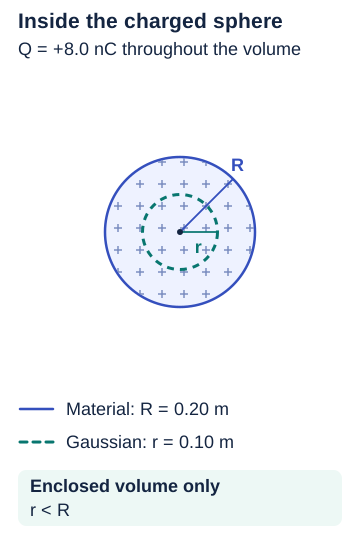
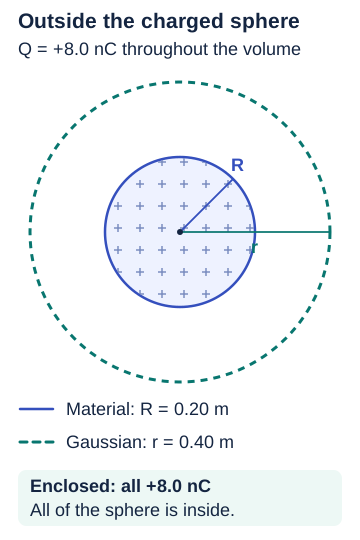
Predict first: The nearer point is inside the charged material. Does a sphere of radius 0.10 m enclose all the charge? Should the field become infinite at the centre?
The physical sphere has fixed radius R. Your Gaussian surface has variable radius r. Uniform volume charge makes the enclosed fraction equal to the enclosed volume fraction.
Establish the symmetry. The charge density depends only on distance from the centre; there is no external field. Rotations leave the distribution unchanged. The electric field must therefore be radial and have the same magnitude everywhere on a concentric sphere. For this positive charge it points outward. This is the justification for simplifying the flux integral, not a consequence of drawing a spherical surface by itself.
Write Gauss’s law with the correct enclosed charge. The outward flux through a concentric sphere is . For , uniform density gives . For , .
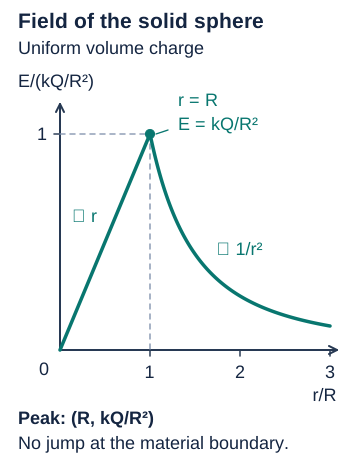
Solve in the two regions. Inside, ; outside, . At the centre by symmetry and by the limit of the inside formula. At , both expressions give , so the field is continuous for this volume-charge model.
Evaluate the interior point. At , the Gaussian sphere encloses of the charge: . Thus radially outward. Using all 8.0 nC here would overestimate the field by a factor of eight.
Evaluate the exterior point. At , all the charge is enclosed. radially outward. To two significant figures the results are and .
Common mistake: implies zero total flux. It does not, by itself, imply zero electric field at every point on the surface. You also need the symmetry argument. For example, a uniform nonzero external field has zero net flux through a closed sphere because as much field enters as leaves.
Find the field at and compare the interior and exterior results before substituting values.
Both give about outward. The field rises linearly from the centre to the surface, then falls as . This comparison tests whether the two formulas describe the same distribution.
Keep and , but put the charge uniformly on an ideal infinitesimally thin spherical shell. Find the fields at and . Do not evaluate exactly on the charged surface.
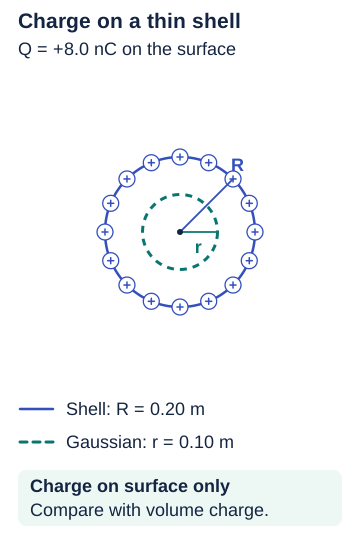
At the interior point, a concentric Gaussian sphere encloses no charge. Spherical symmetry still makes E constant in magnitude and radial, so Gauss’s law gives . Outside, the field remains 449.5 N/C outward because the total enclosed charge is unchanged. The interior field differs because the distribution differs. A uniformly volume-charged insulator is not interchangeable with a shell or a conducting sphere in electrostatic equilibrium.
Return to the original solid sphere. Put a test charge at . Neglect any disturbance of the source charge. Find the radial component of its force, taking outward as positive.
, with . Thus about −1.8 μN. The negative sign means inward. The electric field remains outward; changing the test charge changes the force on that charge, not the source field.
You can start with the electrostatics question, even if you have not chosen a surface or written an equation. Your tutor can help you describe the charge distribution, draw the field directions and check whether symmetry makes Gauss’s law a useful method. You can then choose a surface, find the enclosed charge and check the result together. If you need an earlier starting point, your tutor can explain the difference between electric field, potential and force using the midpoint example.
Start each electrostatics question by naming the required quantity and the charge distribution. For a Gauss’s-law question on your review list, justify the symmetry before replacing a flux integral by a product, and check the enclosed charge separately in each region. Retry the shell and test-charge questions without the solutions. Use your section’s assigned material to add circuit, magnetic and geometrical-optics questions; these exercises cover only selected electrostatics skills.
Use your section’s outline to choose the chapters to review. We work through permitted practice and comparable problems, without completing graded assignments or exams on your behalf.
Distinguish field, potential, force and energy. Compare two midpoint cancellations, read a potential graph and work through five explained practice questions.
Send your topic and preferred times. We’ll confirm whether we can help and, if so, agree on a time by text or email before payment.
Request PHYS 142 tutoringNablio is an independent service and is not affiliated with this institution.