Work through motion and force questions in Vanier 203-SN1-RE. Your tutor can help you distinguish velocity from acceleration, choose the forces on one object and check the signs in your equation. Start with the elevator example, then choose the braking or beam problem to review.
Vanier lists 203-SN1-RE as Mechanics in Pure and Applied Science. Its Physics Wiki brings together material on motion, forces and conservation laws. The example below connects a change in velocity to the force a scale measures.
Topics to review
Units, measurement and vectors
Motion in one and two dimensions; rotational kinematics
You will use signed numbers, the slope of a straight velocity–time graph and a one-step force equation. Acceleration describes how velocity changes; its direction can differ from the direction of travel.
What to watch for
Inferring acceleration from a change in velocity
Distinguishing weight from the scale’s normal force
Mechanics: stopping distance and torque balance
Find a stopping time and distance, then balance a beam. Choose positive directions before writing the force and torque equations.
Before you start: Allow 20–25 minutes to try both questions, then 15 minutes to check and retry any missed steps.
1. A force gives a stopping distance
A 2.0kg cart moves right at 4.0m/s. A constant net horizontal force of 4.0N acts left until it stops. Find the stopping time and distance.
Show the explained solution
With right positive, a=Fnet/m=−2.0m/s2.
From 0=4.0−2.0t, the stopping time is t=2.0s.
Using 02=4.02+2(−2.0)Δx gives Δx=4.0m. Check with work: the initial 16J is removed by (−4.0)(4.0)=−16J.
A massless horizontal beam is hinged at its left end. A 60N downward load acts 0.80m from the hinge. An upward vertical cable force acts 1.20m from the hinge. Find the cable tension and the vertical hinge force in static equilibrium.
Show the explained solution
Let T be the upward cable tension and Hy the hinge-force component, positive upward. Take torques about the hinge, so its force contributes no torque. With counterclockwise positive, 1.20T−0.80(60)=0.
Thus T=40N. Next impose vertical force balance: Hy+40−60=0.
The hinge force is Hy=20N upward. Zero net torque alone does not establish zero net force; both conditions are needed.
Use one sign convention from the force equation through the motion calculation. Check the distance against the loss of kinetic energy.
Equilibrium problems
Choose the torque pivot deliberately, then write both rotational and translational equilibrium equations.
When requesting mechanics support, include your free-body diagram, axis choice and your section’s permitted review questions. That makes it easier to target the setup you need.
A passenger of mass m=60kg stands on a force scale in an elevator. The elevator is rising, but its upward velocity decreases uniformly from 3.0m/s to 1.0m/s over 2.0s. The passenger stays at rest relative to the elevator. Use g=9.8m/s2. Model the passenger as a single point, ignoring body size. Neglect air resistance. Find the scale reading in newtons during this interval. First predict: is it greater than, equal to or less than the passenger’s weight?
Show a hint
Take upward as positive. Find acceleration from the change in velocity before writing the force equation. The scale reads the normal force it exerts on the passenger.
Show the reasoning
1. Separate motion from change in motion
Both velocities are positive because the elevator is moving upward. However, velocity is decreasing, so acceleration points downward. A positive velocity does not require a positive acceleration.
2. Find the acceleration
Let vi and vf be the initial and final vertical velocities, Δt the elapsed time, and a the vertical acceleration. Because the velocity changes uniformly, a is constant.
a=Δtvf−vi
a=2.0s(1.0−3.0)m/s
a=−1.0m/s2
3. Draw forces on the passenger
There are two vertical forces: the normal force N from the scale upward, and the gravitational force mg downward. Here m is mass in kilograms and g is gravitational acceleration in m/s2.
The magnitude of the weight is:
mg=(60)(9.8)N
mg=588N
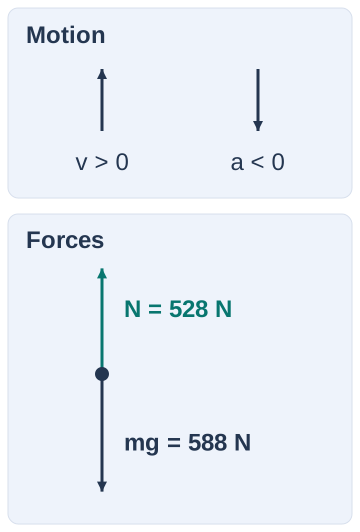
Draw one dot for the passenger, an upward arrow labelled N and a downward arrow labelled mg. The elevator’s upward velocity is not an extra force.
4. Use the net force
With upward positive, Newton’s second law is:
N−mg=ma
Rearranging gives:
N=m(g+a)
Substitute the values in SI units:
N=60(9.8−1.0)N
N=528N
The scale reads 528N, less than the 588N weight.
5. Check the result
N−mg=(528−588)N
N−mg=−60N
This agrees with:
ma=(60)(−1.0)N
ma=−60N
Also, kg⋅m/s2 is a newton. The passenger is still moving upward while the net force slows that upward motion. The mass and the gravitational force have not changed.
Upward is positive. The motion arrows indicate only the directions of velocity v and acceleration a. The two force arrows start at the point representing the passenger; their lengths are proportional to 528 N and 588 N.
Try the opposite direction
The same passenger now travels downward. With upward still positive, the elevator’s velocity changes uniformly from −3.0m/s to −1.0m/s in 2.0s. Predict whether the scale reading is above or below 588N, then calculate it.
Check your answer
Find the sign from the velocity change
a=2.0s[−1.0−(−3.0)]m/s
a=+1.0m/s2
The elevator is moving downward and slowing down, so acceleration points upward.
Reuse the force equation
N=m(g+a)
N=60(9.8+1.0)N
N=648N
The reading is above 588N. The sign of acceleration controls this comparison. At constant vertical velocity, a=0 and the scale would read 588N in either direction.
If the acceleration sign was the difficult part, review motion graphs. If the force equation was the difficult part, review free-body diagrams.
How a tutor can help
A tutor can ask you to predict the scale reading before calculating, check your chosen positive direction and help you separate a velocity arrow from a force arrow. You can then fix the first incorrect equation and try the downward-motion check without copying the worked answer.
Prepare for an assessment
Bring the topics announced for your assessment and a practice problem. Include any work you have started, or ask your tutor to help you begin. Practise explaining a sign or force choice before doing the calculation, then redo a missed question with the direction of motion changed.
Optional extension when assigned: rolling bodies, the static-friction threshold and translational plus rotational energy. Legacy enrichment coverage does not establish current assessment scope.
Angular momentum: choose the system and axis
For a rotation problem, extend your force diagram by naming the system and axis. The six questions ask when angular momentum is conserved, how a changed inertia affects rotation and what happens when an object sticks to a disk. Use them when this topic is in your current chapter.
Bring a question to a tutor. You can build the diagram and first angular-momentum equation together, or review what you have started. You can check the external-torque assumption, the signs and the energy comparison before retrying a missed question.
Send the topic you want help with and your preferred times. Start with a problem you’re stuck on or a concept you’d like to understand better. Your tutor can help you build confidence from the basics. You can include a practice question or any work you have started. We’ll confirm whether we can help and agree on a time before payment.
Does this guide match my section?
Use your current course outline and your instructor’s announced topics to decide which parts of this guide to practise. Follow your section’s assessment instructions.
Need help with 203-SN1-RE?
Choose a topic or send the step where you get stuck.
When rigid-body equilibrium is in your assigned material, practise force diagrams, torques and the friction limit in one model. This supplement is not a complete course review or an exam prediction.