Vanier 203-SN2-RE Electricity and Magnetism tutoring
Electricity and Magnetism: one-to-one online tutoring and exam preparation.
Course overview
Vanier 203-SN2-RE connects electric charges, fields and potential with capacitors, circuits, magnetic fields and induction. Start with the topic in your current chapter, then practise choosing the physical quantity, drawing directions and checking units.
203-SN2-RE topics to review
Common difficulties
- Keeping field, force, potential and energy distinct
- Finding a magnetic-force direction before calculating its magnitude
- Choosing consistent current directions and voltage signs
Choose the step you need to practise
- Field, force, potential or energy?
Separate the four quantities and their units before choosing a formula.
- What stays fixed in a capacitor problem?
Check whether the capacitor is connected to a voltage source or isolated.
- Which circuit terms are positive or negative?
Choose a loop direction and read each voltage rise or drop.
A magnetic-force example: direction, then magnitude
Use this short example to practise the magnetic-fields part of the course. Consider a small charged particle in a uniform, steady magnetic field. We calculate only the magnetic force at the instant shown.
Here q is the signed charge in coulombs (C); v is the speed in metres per second (m/s); B is the magnetic-field magnitude in teslas (T); θ is the angle between velocity and field; and F_B is the force magnitude in newtons (N). The cross product sets the direction; the magnitude uses |q|.
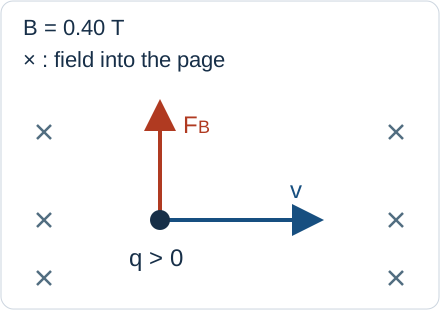
A particle with q = +2.0 nC moves right at 3.0 × 10⁴ m/s. A 0.40 T magnetic field points into the page. Find the magnetic-force magnitude and direction.
1. Draw the directions
Rightward velocity and an into-the-page field are perpendicular, so θ = 90°. Curl the fingers of your right hand from velocity toward field; your thumb points up. The charge is positive, so the magnetic force points up.
2. Convert and calculate
Convert 2.0 nC to 2.0 × 10⁻⁹ C. Then use the positive charge magnitude.
3. Check the result
The force is 2.4 × 10⁻⁵ N upward. It is perpendicular to both velocity and field. The units agree: C × (m/s) × T = N. A magnetic force is perpendicular to the instantaneous velocity, so it does no work on the particle. With magnetic force alone, the direction of motion can change while the speed stays constant.
Try two checks
1. Change only the charge sign
At the same instant, replace q with −2.0 nC. Keep the velocity and magnetic field unchanged. What are the magnetic-force magnitude and direction?
Show a hint
Use |q| for the magnitude. Reverse the right-hand-rule direction for a negative charge.
Show the explained answer
The magnitude remains 2.4 × 10⁻⁵ N; the direction is downward. Changing the charge sign reverses the force, not the given velocity or field.
2. Combine a speed change with an angle change
Use q = +2.0 nC and B = 0.40 T again, but now v = 6.0 × 10⁴ m/s and the angle between velocity and field is 30°. Find the magnetic-force magnitude. What would it be if the velocity were parallel to the field?
Show a hint
Compare v sin θ with the original example. An angle measured from the page is not automatically the angle between velocity and field.
Show the explained answer
F_B = (2.0 × 10⁻⁹)(6.0 × 10⁴)(0.40) sin 30° = 2.4 × 10⁻⁵ N. Doubling the speed is offset by sin 30° = 1/2. When velocity and field point in the same direction, θ = 0° and the magnetic force is zero. It is also zero for opposite directions, θ = 180°.
How tutoring can help
Bring your diagram, attempted equation and the step where you got stuck. A tutor can help you separate the given field from the force on a particular charge, check your right-hand rule, or connect a circuit equation to its labelled diagram.
Exam preparation for 203-SN2-RE
Choose a topic from your section’s outline and try a comparable problem without looking at the solution. State the model, draw the relevant directions, keep units through the calculation and explain a sign or limiting-case check. Include experimental reasoning when it appears in your course materials.
We work through permitted practice and comparable problems, without completing graded assignments or exams on your behalf.
Need help with 203-SN2-RE?
Send the topic, your attempted setup and your preferred times. We’ll confirm whether we can help and agree on a time by text or email before payment.
Request 203-SN2-RE tutoringNablio is an independent service and is not affiliated with this institution.