Stuck on a step? Text us Email us Request a lesson
A body that rolls can translate and rotate at the same time. The useful question is not simply “which rolling formula applies?” It is “can the contact force maintain rolling without slipping?” This lesson connects that contact condition to Newton’s laws and to the division of kinetic energy between translation and rotation.
This is original supplemental mechanics practice. Use it when rolling motion is assigned in your current course; it is not an official exam or a statement of the current 203-SN1-RE assessment requirements.
1. State the model before choosing an equation
We model a rigid circular body on a stationary, straight surface. Its centre of mass is at its geometric centre; its radius R and mass distribution are constant. The rotation axis passes through the centre and is perpendicular to the plane of motion. Neglect deformation, air drag and rolling resistance. The normal force acts through the centre, so it produces no torque about that centre.
Write the central moment of inertia as . The dimensionless shape factor k is 1/2 for a uniform solid cylinder or disk about its symmetry axis, 2/5 for a uniform solid sphere, and 1 for a thin hoop. These values are not interchangeable: a hollow cylinder with thick walls needs its own inertia.
You need a free-body diagram, force components, , , and kinetic energy. Review torque and lever arms or rotational inertia and pulley tensions first if needed. Pulley no-slip relates a rope to a rotating rim; rolling no-slip relates the body’s contact point to the ground.
In each calculation, positive translation is down the slope or to the right. Positive rotation is the corresponding rolling direction, clockwise for rightward rolling or a surface descending to the right. Thus the signed rolling relation is . If counterclockwise were chosen positive instead, a right-moving wheel would have . Choose one convention and retain it.
2. A moving centre can have an instantaneously stationary contact point
The contact point’s velocity along the surface is the sum of translation and rotation:
Rolling without slipping on this stationary surface means . Therefore, while the constraint holds,
The acceleration here is the centre’s acceleration along the straight surface, not the total acceleration of the material point at contact. That material point can have a nonzero acceleration even when its instantaneous velocity is zero.
Static friction is a response, not a preset value. First solve for the force needed by no-slip motion. Then test . Equality describes the limiting case, not every rolling body. If the calculated requirement exceeds the limit, discard the no-slip solution. Use a slipping model with kinetic friction and calculate v and ω independently.
Friction opposes relative sliding, or its tendency, at the contact. It need not oppose the centre’s velocity. A freely rolling ideal wheel on a level surface at constant speed needs no friction at all. A wheel driven by an axle torque can need forward static friction. The direction follows from the applied forces and torques, not the word “rolling.”
Where the energy goes
For no slip, substitution gives
The translation fraction is ; the rotation fraction is . Both energies belong to the same body. Do not add a separate to this expression: the parallel-axis form would already include translation.
In our ideal no-slip model on stationary ground, static friction supplies zero net instantaneous power to the rigid body because its point of application has zero velocity. It can nevertheless change the translation–rotation split: its contribution to the centre-of-mass kinetic-energy equation is balanced by its rotational contribution. This is not a claim that static friction never does work in other settings, such as a moving belt.
3. Derive the incline result and check its permission to apply
Release a body from rest on a slope of angle θ measured from the horizontal, with . Gravity acts at the centre; its component along the slope is . With no friction, gravity would accelerate the centre but would provide no torque about it: the contact would tend to slide downhill. Static friction therefore acts uphill and supplies the torque that increases the downhill rolling rotation.
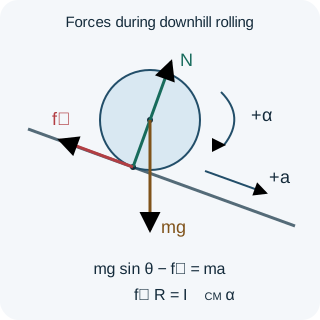
Let f be the nonnegative uphill friction magnitude. With positive translation downhill and positive rotation in the downhill rolling direction,
Apply and . The torque equation becomes . Substitution into translation yields
The no-slip solution exists in the static-friction model only if
Mass cancels from this threshold, but shape and slope do not. A larger available coefficient does not increase a once there is enough grip; it increases the margin before slipping.
For a vertical descent h from rest, ideal mechanical-energy conservation gives
This is a faster route to speed, not to the required friction. It is valid only after the rolling condition is justified, with no dissipative losses or additional energy input. The distance along the slope is , not h. Checking reproduces the energy result.
Worked example 1: a solid cylinder descends
A uniform solid cylinder has , and . It starts from rest on a 20.0° slope with . Its centre descends vertically by . Find the acceleration, friction and final speed. Use .
Step 1: solve the force and torque equations
The acceleration is downhill; friction is uphill. The angular acceleration is in the downhill rolling direction. The friction torque about the centre increases the spin even though the friction force reduces the centre’s acceleration relative to a frictionless sliding object.
Step 2: verify static friction can provide that force
Since 3.355 N is less than 5.531 N, no-slip rolling is feasible. Equivalently, . The actual friction is 3.355 N, not 5.531 N.
Step 3: use both kinetic-energy terms
The lost potential energy is 23.544 J. Translation receives 15.696 J, rotation receives 7.848 J, and their sum is 23.544 J. A calculation using alone would predict too large a speed.
Step 4: check with the distance along the slope
Here . The force result gives , agreeing with energy. Radius affects ω and α, but cancels from this model’s a and v when k is fixed.
Worked example 2: a horizontal pull through the centre
A uniform solid cylinder of mass 4.00 kg and radius 0.250 m starts at rest on level ground. A constant horizontal force of 12.0 N acts through its centre to the right, without applying a couple. Take . Find its motion and its speed after the centre travels 2.00 m.
The central pull has zero torque about the centre. Without friction it would translate the cylinder without spinning it, making the bottom tend to slide right. Friction must act left to produce clockwise rotation. Let f denote its leftward magnitude.
Thus , giving
Now check: , so . The required 4.00 N is available. The minimum coefficient is .
The applied force does work . Static friction has zero net work in this ideal model. Starting from rest,
The translation energy is 16.0 J and rotation energy is 8.0 J. The check agrees.
Why “friction always points backward” is not a rule
Replace the central pull by a clockwise driving couple of magnitude τ, with no horizontal applied force. The only horizontal force is static friction. In this different model, it points right: and . With no slip, . Friction gives forward translation and opposes part of the driving torque. Its required magnitude still must satisfy . Direction depends on how the wheel is driven.
Four graduated problems
Attempt each setup before opening its solution. Use and the ideal rigid-body assumptions above.
1. Separate translation and rotation
A thin hoop of mass 2.00 kg and radius 0.300 m rolls right at a constant centre speed of 1.80 m/s on level ground with no applied horizontal force or torque. Find ω, each kinetic-energy term and the friction force.
Hint
For a hoop k=1. Constant velocity and no other horizontal force determine friction without using μ.
Explained solution
No slip gives , clockwise. The central inertia is . Translation gives ; rotation gives . Total kinetic energy is 6.48 J. Since a=0 and there is no other horizontal force, f=0; then α=0 also. Static friction can be zero even while contact exists. Do not invent a force μₛN merely because the surface is rough.
2. Test a proposed rolling solution
A uniform solid sphere of mass 1.00 kg and radius 0.100 m is released from rest on a 30.0° incline with . Is rolling without slipping possible? Find a, α and the required friction, including directions.
Hint
Use k=2/5. Compute the required friction before comparing it with the maximum.
Explained solution
With downhill and downhill rolling positive, , , and . Therefore downhill, in the downhill rolling direction, and uphill. The normal force is 8.496 N and its static limit is 1.529 N. Since 1.401<1.529, the solution is feasible. Equivalently . The remaining margin is small but positive; μₛ does not set the actual friction equal to the limit.
3. Recognize when the rolling equations must be abandoned
A uniform solid cylinder of mass 2.00 kg and radius 0.200 m starts from rest on a 30.0° incline. The coefficients are and . Test no slip. If it fails, find the centre speed and angular speed after 1.00 s, assuming the same surface continues and the cylinder stays in contact.
Hint
First compare μₛ with the cylinder’s rolling threshold. During sliding, use , but do not impose .
Explained solution
A no-slip cylinder requires . Available μₛ=0.100 is insufficient. The contact tends to slip downhill, so kinetic friction acts uphill. With , translation gives . Rotation gives in the downhill rolling direction. From rest, at 1.00 s the results are and . Their difference at contact is , downhill: the assumed sliding direction is self-consistent. In fact , so slipping grows from release in this ideal constant-slope model; it does not automatically turn into pure rolling. Mechanical energy is dissipated by kinetic friction, so the no-slip energy formula is not valid.
4. Compare shapes without confusing mass and inertia
A uniform solid sphere and a thin hoop start from rest side by side on the same 20.0° straight incline. Both have mass 1.50 kg and outer radius 0.150 m. The static coefficient is 0.250 for each. Their centres each descend vertically by 1.20 m. Verify rolling for both, find their final speeds and arrival times, and explain which arrives first.
Hint
The bodies share h and slope length, but not k. Check friction before comparing energy.
Explained solution
The sphere has k=0.4 and needs . The hoop has k=1 and needs . Both satisfy the available 0.250, with uphill friction and downhill acceleration. Their accelerations are and . Using , the final speeds are 4.101 m/s for the sphere and 3.431 m/s for the hoop. The slope length is ; gives 1.711 s for the sphere and 2.045 s for the hoop. The sphere arrives first. Each loses the same 17.658 J of potential energy, but the sphere puts 5/7 of its kinetic energy into translation while the hoop puts only 1/2 into translation. Equal masses and radii do not imply equal central inertia. In this model, changing mass alone would not change either arrival time.
A final decision checklist
- State the inertia about the centre, the contact model and the positive directions.
- Use translation and torque to find the friction required by no slip.
- Check the static bound before accepting the no-slip result or using its energy formula.
- Use both kinetic-energy terms; distinguish vertical height from slope distance.
- If slipping occurs, determine its direction and solve translation and rotation separately.
Scope and references
This original lesson supplements the rotational-inertia lesson and work and energy. For another treatment of the physical model, see OpenStax University Physics, Rolling Motion. Course topic coverage and assessment requirements must be checked against the student’s current section outline; a legacy mechanics guide is not evidence of a current-term requirement.
Vanier’s legacy NYA rotation study guide includes rolling as enrichment. That supports offering supplemental practice, not declaring it a current SN1 requirement. Use this topic only when it matches your current section.
Useful for
Supplemental practice connecting translation, rotation and energy. Vanier’s legacy NYA rotation guide labels rolling as enrichment; this is not evidence of a current SN1 requirement. Use this topic only when assigned in your current section.
Work on the step you’re missing.
Tell us the subject and your preferred time. Nablio confirms the details by text or email.
Request a lesson