Stuck on a step? Text us Email us Request a lesson
A collision can reduce kinetic energy while leaving angular momentum unchanged. A rotating system can also speed up without receiving an external torque. To explain either result, start with the system, the axis and the time interval, then check what the external forces can change.
This lesson works with motion in a horizontal plane and a fixed vertical rotation axis in an inertial laboratory frame. Counterclockwise as viewed from above is positive. You will calculate the angular-momentum component along that axis, decide when it is conserved and check energy separately.
Use this topic when angular momentum is in your current mechanics chapter. It is original practice, not an official exam or a complete course review. For course-specific help, return to Ahuntsic 203-SN1-RE tutoring or Vanier 203-SN1-RE tutoring.
What to know first
You need signed numbers, basic vector components and the perpendicular lever arm of a force. If the lever arm is unclear, review torque and static equilibrium. If moment of inertia or rotational kinetic energy is unfamiliar, use the definitions in the rotating-pulley lesson. Here we use those ideas to study changes between two states, without rebuilding the pulley calculation.
The main quantities are:
- Angular momentum about the stated axis: , in .
- Net external torque about the same axis: , in .
- Moment of inertia about that axis: , in .
- Signed angular velocity: , in .
A torque changes angular momentum. They are different quantities and have different units.
1. Name the system and draw the axis
Suppose a small lump of clay hits a disk and sticks. For the collision, choose disk plus clay as the system, from just before contact to just after both rotate together. The contact forces between the clay and disk are then internal. They redistribute angular momentum within the system.
Choose the fixed vertical axle through the disk centre as the -axis. Mark counterclockwise as positive. Every angular momentum and torque in the calculation must refer to this same axis.
An ideal axle can exert an external force while contributing no torque about its own axis. Gravity and vertical support forces also have zero torque component about the vertical axis in this model. The bearing must exert negligible frictional torque for the conservation approximation to work.
This does not establish conservation of total linear momentum: the axle can supply an external force impulse. It also does not establish kinetic-energy conservation: sticking can convert kinetic energy into deformation, heating and sound.
Pause: if you choose only the disk, is the clay’s contact force internal? No. It comes from outside that smaller system and changes the disk’s angular momentum.
2. Start from angular impulse
For the chosen system about the fixed axis,
Over the interval from to ,
Here is the external angular impulse. If the net external torque is constant, the integral is simply
If the external angular impulse is zero, the initial and final angular momenta are equal. If the net external torque is zero throughout the interval, angular momentum stays constant throughout. Opposite torque pulses can give equal initial and final values even though angular momentum changes in between.
For an approximation, check that the external angular impulse is small on the angular-momentum scale relevant to the problem. A short collision alone is insufficient: a clamp or motor could exert a large torque during that short time.
We only need the -component here. Zero external torque about conserves ; it does not automatically conserve every component of the full angular-momentum vector.
Worked example: a wheel slows under a torque
A wheel has constant and initially spins at . A constant net external torque of acts for . Find the final angular velocity.
First calculate the initial angular momentum and the angular impulse:
Since , these quantities can be added:
The wheel is still turning counterclockwise, more slowly. The negative torque reduced a positive angular momentum; it did not immediately reverse the rotation. As a check, , so .
3. Find angular momentum before choosing a formula
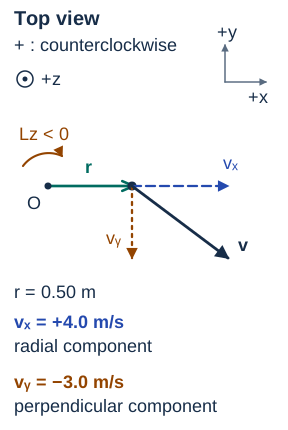
For a point particle, measured from a fixed origin on the chosen axis,
In the horizontal -plane, the signed component is
Its magnitude is , where is the angle between and . Equivalently, it is , where is the perpendicular distance from the axis to the straight line along the particle’s velocity. Choose the sign from the direction of .
The familiar is a special case: the velocity is tangent to the circle of radius , so it is perpendicular to . A radial velocity contributes no angular momentum about that axis. A particle can have angular momentum even while travelling in a straight line.
For a rigid object rotating about the fixed -axis,
This is the component along the rotation axis. We are not assuming that the full vectors and are parallel for every possible three-dimensional body.
Quick check: a particle passes directly through the axis along a straight line. What is its angular momentum about that axis? Zero: the perpendicular offset is zero.
4. When the mass distribution changes
If the total external angular impulse is negligible and the initial and final states each rotate together about the same axis, then
The moment of inertia describes where the mass is relative to the axis. For point masses, each contribution is . Moving mass inward reduces its contribution; the total mass can stay unchanged.
Worked example: pulling inward
A rotating apparatus, including its internal mechanism, has and . The mechanism pulls mass inward so that . Neglect external torque about the fixed axis. At both endpoints the parts rotate together and have no radial velocity.
Check the product: . The apparatus spins faster because the same angular momentum is carried with less moment of inertia.
Now check the endpoint kinetic energies:
The rotational kinetic energy increases by . The internal mechanism supplies energy while rearranging the mass. In a lossless mechanism with no other endpoint energy changes, its stored energy falls by ; losses would require more input. Zero external torque does not require constant kinetic energy.
For common-axis rotation with no other motion at the endpoints, substituting gives
At fixed nonzero , a smaller means a larger rotational kinetic energy. This endpoint formula does not include radial kinetic energy during the inward motion.
5. A lump sticks to a disk
A horizontal disk is initially at rest. Its moment of inertia about a fixed vertical axle is . A small lump of clay of mass moves horizontally at , strikes tangentially at and sticks at that radius.
Model the clay as a point mass. Choose the incoming direction to give positive angular momentum. Neglect external angular impulse about the axle during the collision. Find the common angular velocity and compare the initial and final kinetic energies.
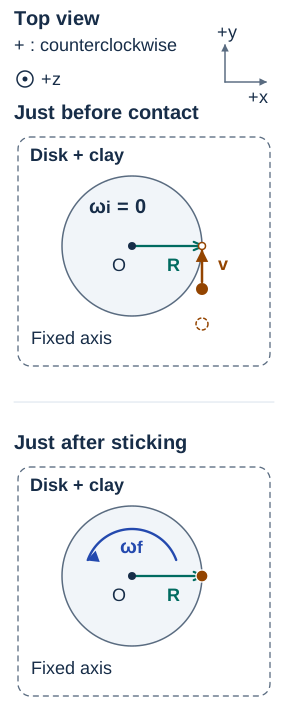
Step 1: keep the same system throughout
The system is disk plus clay, including the clay before it touches the disk. The interval runs from just before contact to just after they rotate together. The contact interaction is internal. The axle holds the centre fixed but contributes no torque about its own ideal frictionless axis.
Step 2: calculate the initial angular momentum
The disk contributes zero because it starts at rest. The incoming velocity is tangential, so
Step 3: include the clay in the final inertia
The radius is squared only in the point-mass inertia term. The incoming angular momentum contains one power of the perpendicular offset.
Step 4: use the angular-momentum balance
Checking gives . The positive sign matches the incoming angular momentum.
Step 5: calculate energy separately
Before contact, only the clay has kinetic energy:
After contact, both rotate together:
The system’s kinetic energy decreases by . Sticking is an inelastic collision: energy is transferred into internal deformation, heating and sound. Total energy is still accounted for, but kinetic energy alone is not conserved.
For this stationary-disk, tangential-hit model,
Here the ratio is , agreeing with . This ratio belongs to the stated model; an initially spinning disk or a non-tangential hit requires a fresh balance.
What if the disk already spins?
Include its signed initial angular momentum:
Clockwise contributions are negative with our convention. A sufficiently large clockwise initial contribution can make the final rotation clockwise even when the clay arrives with positive angular momentum. If external angular impulse is nonzero, include it rather than declaring conservation.
6. Use a different balance for each interval
A collision with negligible bearing torque and later braking are different intervals. You may conserve during the collision and then use during braking. Carry the collision’s final angular velocity into the braking interval as its initial value.
Before calculating, write these four lines:
- System: which objects are included before and after?
- Axis and sign: which fixed axis, and which rotation is positive?
- Interval and external angular impulse: what acts during this particular change?
- Separate checks: do the units, sign and energy comparison make sense?
If the geometry is unclear, return to the lever-arm lesson. If you are choosing among force, energy and linear-momentum methods, use work, energy or momentum.
Try it without the worked answer
The six angular-momentum questions move from the system choice to a non-tangential particle, angular impulse, changing inertia, a sticking collision and a signed collision with external torque. Each has a hint, an explained solution and a link back to the step worth revisiting.
Bring your diagram and the first balance you tried to Ahuntsic mechanics tutoring or Vanier mechanics tutoring. A tutor can check the system, axis and conservation condition with you before checking the arithmetic.
Course and physics references
Ahuntsic’s 203-SN1-RE course description names angular-momentum conservation. Vanier’s program course list identifies Mechanics as 203SN1RE, and the department Physics Wiki includes angular-momentum topics. These references establish topic relevance, not the material on a particular assessment.
For another presentation of the physics, see OpenStax angular momentum and conservation of angular momentum. The examples and questions here were written for this learning path.
Useful for
Angular-momentum conservation is explicit in Ahuntsic’s 203-SN1-RE description. Vanier’s program list confirms its mechanics code and its department Physics Wiki supports the angular-momentum topic. These references do not establish current-term offerings or assessment scope. Check your current section outline.
Work on the step you’re missing.
Tell us the subject and your preferred time. Nablio confirms the details by text or email.
Request a lesson