Choose the system, axis and interval before writing a conservation equation. These questions progress from identifying the right balance to combining signed angular momenta with an external angular impulse. Try each question before reading its hint or solution.
Use the fixed vertical -axis and a horizontal -plane throughout. Counterclockwise viewed from above is positive; points right and points up in a top view. Treat the laboratory frame as inertial. All given inertias refer to the stated axis.
This is original topic practice, not an official exam or a timed mock. Check your current course outline for assessment coverage. For a complete explanation, use the angular-momentum lesson. Course help: Ahuntsic 203-SN1-RE and Vanier 203-SN1-RE.
1. Choose a system that includes the collision
A small lump sticks to a horizontal disk on a fixed, ideal frictionless vertical axle. Consider the short contact interval. Gravity and vertical supports exert no -component of torque.
A student says: “The axle exerts no force, the disk’s angular momentum is conserved and the collision conserves kinetic energy.” Explain what must change in this reasoning. Which system makes the contact interaction internal?
Show hint
the axle can hold the centre in place by exerting a force. Ask whether that force has a moment about the axle’s own axis.
Show explained solution
Choose disk plus lump, including both objects before and after contact. Their mutual contact interaction is internal. The disk alone receives an external contact torque from the lump, so the disk’s individual angular momentum generally changes.
The axle can exert a force while contributing zero torque about its own axis. With negligible external angular impulse about , the combined system’s total is conserved. Total linear momentum need not be conserved because the axle can exert a force impulse. Kinetic energy generally decreases when the lump sticks.
Check: a correct claim names the combined system, the -axis and the contact interval. It does not claim that all forces vanish.
Review system and axis.
2. A particle is not moving tangentially
At an instant before contact, a point particle of mass 0.20 kg is at . Its velocity components are and . Find its signed angular momentum about . Explain why using its speed in would give the wrong magnitude.
Show hint
use . The horizontal component is radial at this position.
Show explained solution
The sign is negative, corresponding to clockwise angular momentum. The magnitude is 0.30 kg·m²/s. Although the speed is 5.0 m/s, only its perpendicular component contributes here. Using would incorrectly treat the whole velocity as tangential.
Check: changing while keeping this position and fixed leaves unchanged. The radial component contributes zero.
Review particle angular momentum.
3. Include an external torque
A wheel has constant and initially spins at +3.0 rad/s. A constant net external torque of −0.10 N·m acts for 2.0 s. Find the final angular momentum and angular velocity. Has the wheel reversed direction?
Show hint
calculate the initial angular momentum, then add the angular impulse with its sign.
Show explained solution
The wheel still rotates counterclockwise. Its angular momentum is not conserved over this interval. The negative torque reduces the positive angular momentum.
Check: giving Under that same constant torque it would first reach zero after 6.0 s, longer than the stated interval.
Review angular impulse.
4. Move two masses inward
A rotating platform and its internal actuator have a constant combined inertia of 0.50 kg·m². Two small masses, each 0.25 kg, initially rotate with the platform at radius 1.0 m. The actuator moves both to radius 0.50 m. Treat them as point masses and neglect the inertia of the connecting parts. The initial angular velocity is +3.0 rad/s.
Choose the entire apparatus as the system. Neglect external torque about . At both endpoints all parts rotate together, with no radial motion. Find , and . Compare the endpoint kinetic energies and explain their difference.
Show hint
add two terms to the platform-and-actuator inertia. Conserve before evaluating energy.
Show explained solution
The kinetic energy increases by 2.70 J. The internal actuator supplies energy as it pulls the masses inward. With a lossless mechanism and no other endpoint energy changes, its stored energy decreases by that amount. Conservation of angular momentum did not require conservation of kinetic energy.
Check: . Also . The total mass did not change; its distance from the axis did.
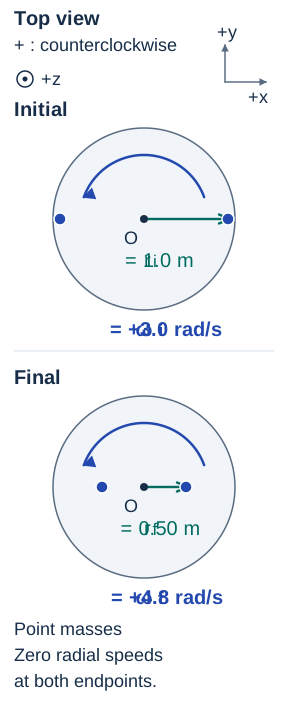
Review changing moment of inertia.
5. A lump sticks to a stationary disk
A disk initially at rest has . A 0.40 kg lump moves tangentially at 2.0 m/s and sticks at radius 0.50 m, delivering positive angular momentum. The disk has a fixed ideal frictionless vertical axle. Treat the lump as a point mass. Neglect external angular impulse during the collision.
Find the common final angular velocity. Calculate the initial and final kinetic energies and the decrease in kinetic energy.
Show hint
include the lump’s in the final inertia. Use angular momentum to find ; do not start by setting .
Show explained solution
For disk plus lump about ,
Kinetic energy decreases by 0.60 J in the inelastic collision. This does not conflict with angular-momentum conservation about .
Check: . The final clay speed is . Adding the disk energy 0.15 J and the clay energy 0.05 J reproduces the total 0.20 J.
Review the sticking collision and its energy check.
6. A short collision with nonzero angular impulse
A disk with initially rotates clockwise at 0.50 rad/s. A 0.20 kg point-like lump arrives tangentially at 3.0 m/s and sticks at radius 0.50 m, with positive incoming angular momentum. During the contact interval an external motor delivers an angular impulse about the fixed vertical axis. Other external angular impulses are negligible.
Find the signed common final angular velocity. Compare it with the result obtained by incorrectly ignoring the motor. Is “the collision is brief” enough to justify conservation?
Show hint
sum the two initial angular momenta with their signs, add the given angular impulse and divide by the final combined inertia.
Show explained solution
The disk starts with negative angular velocity, so
The final rotation is counterclockwise. Ignoring the motor would give , about +0.22 rad/s. The supplied external angular impulse changes the answer substantially. Its nonzero value prevents setting , regardless of the collision’s duration.
Check: exactly the given angular impulse. An angular impulse gives an angular-momentum change; its units are not joules, so it is not by itself a value for the motor’s work.
Review the signed collision balance.
What to revisit
- Q1: name the combined system and distinguish axle force from axle torque.
- Q2: use the perpendicular velocity component or the signed cross product.
- Q3: add the external angular impulse before deciding the final direction.
- Q4: include every mass in the inertia about the same axis; check energy separately.
- Q5: conserve angular momentum across sticking, then calculate the energy change.
- Q6: keep clockwise terms negative and include the external angular impulse.
At Ahuntsic mechanics tutoring or Vanier mechanics tutoring, we can choose the system and axis, identify external torques and write the angular-momentum equation together, or review a question you have already tried.
Useful for
Angular-momentum conservation is explicit in Ahuntsic’s 203-SN1-RE description. Vanier’s program list confirms its mechanics code and its department Physics Wiki supports the angular-momentum topic. These references do not establish current-term offerings or assessment scope. Check your current section outline.
Work on the step you’re missing.
Tell us the subject and your preferred time. Nablio confirms the details by text or email.
Request a lesson