Stuck on a step? Text us Email us Request a lesson
Who this is for
Use this lesson when your course is studying quadratic relations and their graphs. You should already be able to expand brackets, substitute into a formula and solve a simple linear equation. The graph-and-form work supports selected quadratic-relations expectations from Ontario Grade 10 Academic MPM2D. Completing the square with other leading coefficients extends that work toward selected Grade 11 MCR3U and MCF3M expectations. In Quebec, the quadratic forms and methods required depend on the secondary year and mathematics option. Check your course outline; this is a topic lesson, not a complete provincial course or exam guide.
Already comfortable with roots and graphs? Continue to the optional quadratic inequalities extension and its practice questions.
Working with two graphs? Try the optional arch and straight-segment system, then three new segments.
1. One curve, three useful forms
A quadratic function has the form . Here is the input, is the output, and , and are fixed real coefficients, with . Its graph is a parabola. For this lesson, can be any real number unless a problem gives a narrower domain.
Consider these three expressions:
They give the same for every . Expanding the product gives . Expanding the square gives .
To find the factored form of this example, look for two numbers whose sum is and whose product is 5: and . This works because expands to , where and are those two numbers. Always expand your factors to check. This shortcut applies directly when the coefficient of is 1.
Each form makes a different feature easier to read:
Expanded form shows the -intercept: when , , so the point is .
Factored form shows the roots: at and , so the -intercepts are and .
Vertex form shows the turning point: . The smallest possible value of is zero, so the minimum -value is .
The axis of symmetry is . Inputs equally far from 3 have equal outputs. For example, and both give .
Check: Do the roots tell you where the curve crosses the -axis?
Show answer and reasoning
No. Roots are -values that make . The -intercept comes from setting .
2. Build a sketch that agrees with the equation
For , plot , , , , , and . Draw a smooth curve through them. It opens upward because the coefficient of is positive. Label the axes and the vertex. Its domain (the allowed inputs) is all real numbers and its range (the possible outputs) is .
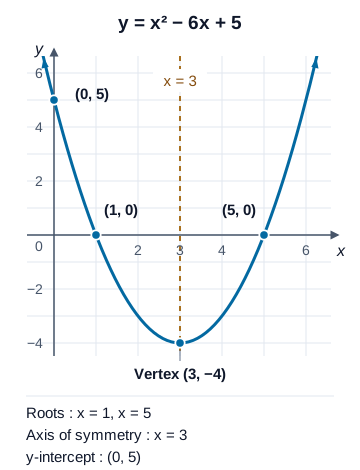
Do not connect the points with straight segments and call that the parabola. The points guide the curve. A graphing tool can check your sketch after you have predicted its key features.
The general vertex form has fixed real parameters , and , with . Here is the vertex’s -coordinate and is its -coordinate, so the vertex is . A positive gives a minimum; a negative gives a maximum. The sign inside the brackets needs care: means , so the vertex's -coordinate is .
3. Solve the question that was actually asked
For :
To find the roots, set : , so or . Therefore or 1.
To find where , solve . Then , so or 0.
If a product is zero, at least one factor must be zero. Thus means or ; the factors need not both be zero. This zero-product rule applies only when the product is zero. If , you cannot set either factor equal to 5 and expect all solutions.
Some parabolas have no real roots. For example, is always at least 2, so its graph never reaches the -axis. It still has a vertex and a -intercept.
4. Complete the square to find the vertex and solve equations
Rewrite by completing a square:
Why add 9? Half of is , and . Why subtract 9 too? To preserve the original value. This worked example has leading coefficient 1; when it is different, account for that coefficient before completing the square.
Try: Write in vertex form.
Show answer and reasoning
. The vertex is .
Complete the square when the coefficient is different from 1
The same idea works when the coefficient of is different from 1. First factor that coefficient out of the terms containing . Leave the constant outside the brackets for now. Then complete the square inside the brackets.
The detail to watch is the multiplier outside: adding a number inside the brackets changes the whole expression by that number times the multiplier.
Example with a positive coefficient
Write in vertex form.
Factor 2 out of the first two terms:
Inside the brackets, half of is , and . Add and subtract 9 inside the same brackets:
Why does become ? The 2 multiplies every term inside the brackets, including .
You can also keep the compensation outside from the start:
Adding 9 inside adds to the whole expression, so subtract 18 outside. Both approaches preserve the original expression.
The vertex is . Since , the minimum value of is , reached when .
Check by expanding:
Example with a negative coefficient
Write in vertex form.
Factor out of the first two terms. Notice that , so the term inside is :
Half of 4 is 2, and . Add and subtract 4 inside:
Here, the compensation is positive outside because .
The other way to write the same step is
Adding 4 inside changes the whole expression by . Add 12 outside to balance that change.
The vertex is . Since , the maximum value is 3, reached when .
Check by expanding:
A quick check for the compensation
If the brackets have a multiplier , adding inside changes the whole expression by . Subtract outside to preserve its value. When is negative, subtracting may mean adding a positive number.
You can instead add and subtract inside the same brackets. When you later distribute , multiply both terms by .
See where the quadratic formula comes from
You can use the formula below without reproducing its derivation. Follow these optional steps to see why it works; check your course outline to see whether you need to reproduce them.
Now use letters in place of the numbers. In
is the unknown, and , and are fixed real numbers. The number is the coefficient of , is the coefficient of , and is the constant term. Their signs are part of their values. We require ; otherwise the equation is not quadratic.
First complete the square in the expression. Here the compensation is written outside the brackets:
Inside the brackets, half of is . The compensating term outside is , using exactly the same multiplier rule as the examples.
Define . This number is called the discriminant. The completed-square form is
This also gives the vertex: .
To find the roots, set and isolate the square:
The second line multiplies both sides by . This is valid for positive or negative , because .
If , a number whose square is can equal or , so
Subtract , then divide by :
That is the quadratic formula. The symbol tells you to consider both the plus and the minus choice. The denominator divides the whole numerator. When the square root is zero, the two choices give the same solution.
Tell how many real solutions there are
Look at . A square of a real number cannot be negative.
If , there are two distinct real solutions. The graph of crosses the -axis at two points.
If , there is one distinct real solution, . It is called a double root. The graph touches the -axis at its vertex.
If , there are no real solutions and no -intercepts. This does not mean the quadratic has no graph; its graph simply does not meet the -axis.
These statements apply whether the parabola opens upward or downward. This part of the lesson works with real-number solutions.
Before using the discriminant or the formula, rearrange your equation so one side is zero and identify , and , including their signs.
Practise in three steps
Use the hints or open a worked answer whenever it helps.
Practice 1: Find the compensation
Write in vertex form. State the vertex and minimum value.
Hint: start with . What do you need to add and subtract inside the brackets?
Show answer and reasoning
Half of 4 is 2, and :
Adding 4 inside adds 12 to the whole expression. The compensation is outside. The vertex is ; the minimum is , reached at . Expanding gives
This gives the original expression.
Practice 2: Handle a negative coefficient and solve
Complete the square for . State the vertex and maximum value, then solve .
Hint: factor out before taking half of the coefficient of inside the brackets.
Show answer and reasoning
The inside becomes outside, because . The vertex is ; the maximum is 2, reached at .
For the roots, set :
So or . Check: , and
Practice 3: Use the discriminant and formula
For each equation, identify , and , calculate , state the number of distinct real solutions, and find any real solutions.
Show answer and reasoning
, , . Then
So there are two distinct real solutions:
The square form confirms this: , so .
, , . Then
So there is one distinct real solution:
It is a double root. The square form is , which gives the same result.
, , . Then
There are no real solutions. In square form, the equation is , so , which is impossible for real .
5. Use a quadratic model and respect its domain
A rectangular garden has 20 m of fencing around all four sides. Let its width be metres and its length be metres. Ignoring fence thickness, , so .
Let be the numerical value of the area in square metres. Then .
A real garden needs and , so . The graph opens downward and its maximum occurs at . The length is also 5 m, and the maximum area is . Check: the perimeter is m.
The algebraic roots and describe zero-area boundary cases. They are not admissible widths for this garden. The model's physical domain matters even though the polynomial can be evaluated outside it. No differentiation is needed: the squared term establishes the maximum.
When a line meets a parabola: solve the system, then check the segment
This optional 10–15 minute route connects linear systems by substitution to quadratic graphs. You will build two rules from a diagram, find their shared points and decide which points belong to the stated objects. Review vertex form and quadratic equations above if needed. If this is not your current topic, continue to the independent quadratic practice.
Use the method your course asks for. Quebec’s progression places first-/second-degree systems in Secondary IV Science (SN), with reinvestment in V, and graphical solutions in Secondary V TS. Ontario MCR3U includes graphical and algebraic linear–quadratic intersections. The exact algebra below is an optional explanation when your course asks for graphical estimates; it is not a requirement for every secondary option. See the curriculum references.
1. Turn the geometric information into two rules
An arch is modelled by a parabola with endpoints and , with highest point . A straight segment joins to . Where do their centreline models meet? Ignore thickness and structural forces: this is a geometric model.
Let be horizontal position from the arch’s left endpoint and height above the ground, both expressed as numerical values in metres. Write for the arch’s height and for the segment’s height at position . Here names a height function, not the garden’s area from the previous example.
The vertex gives , where is a fixed nonzero real coefficient. Use at the left endpoint to determine it:
The arch’s domain is . The segment’s slope is . Its height at is 2, so
These domains include the endpoints. The same algebraic rules can be extended to every real , but those full graphs are not the bounded objects in the question.
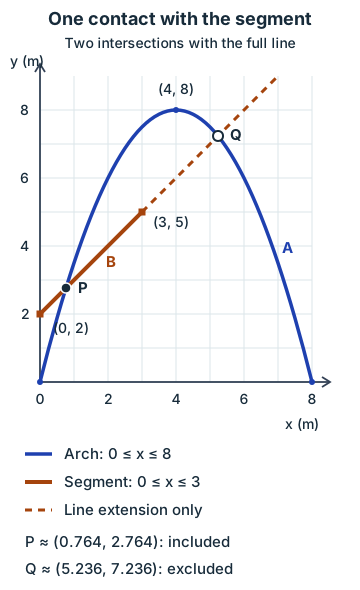
Graphical route: plot the endpoints and vertex, draw the smooth arch and the straight segment, then read the coordinates of each shared point. A graphing tool can refine the estimate near . Show the segment’s endpoint or restrict its domain; otherwise the tool may also report a point on the line’s extension.
2. Shared points have equal heights at the same position
At an intersection, the same pair satisfies both rules. Set , rather than setting either height to zero:
In the third line, both sides were multiplied by ; in the fourth, completing the square gives . The two roots locate intersections with the full line. They still need a height and a domain check.
3. Recover both coordinates, then filter the candidates
Use to recover each height. Call the point with the smaller -coordinate , and the other point :
Substitute each exact input into both original rules, using the same sign throughout. Both heights agree:
Both candidates have , so both are on the arch. Only also has . Thus the given segment and arch meet once, at , about 0.764 m to the right of the left endpoint and 2.764 m above the ground. is a valid intersection of the full graphs, but lies beyond the segment. Rounding comes after the exact calculation.
Two common errors: finds the arch’s ground contacts, not its intersections with the segment. And reporting only the two roots leaves out the heights and the physical-domain decision.
4. Why there can be two, one or no intersections
Subtracting a nonvertical line’s rule from a quadratic rule leaves a quadratic expression. Set that difference equal to zero and use its discriminant : positive gives two distinct full-graph intersections; zero gives one, with a repeated root; negative gives none over the real numbers. Use the coefficients of this difference equation, not the arch’s equation alone. Restricting the domains can remove candidates, but cannot add new intersections.
For the original difference equation above, the coefficients are 1, −6 and 4, giving . There are two full-graph intersections, but only one contact with the given segment.
Try three new segments
Keep the same arch and its domain. Each question replaces the original segment with a new one on , with both endpoints included. First predict the number of contacts from a sketch or graphing tool. Then check algebraically, give every full coordinate pair and apply both domains. For a graphical course route, give coordinate estimates and the domain decision; use the exact working to check your interpretation.
1. Guided: include an endpoint
The new segment follows . Set the heights equal. Multiplying the resulting equation by gives . Factor, recover the heights and decide whether a point at counts.
Show answer and reasoning for question 1
The sketch suggests two contacts. Algebra gives , so or . The full pairs are and . Check the heights: , and . Both inputs lie in both domains. The endpoint is included, so there are two contacts.
2. Less guided: a repeated root
The new segment follows . Find all contacts. Explain why a repeated root describes one point rather than two different points. You can complete the square in the difference of the heights.
Show answer and reasoning for question 2
The sketch suggests one contact. Subtract the line’s height:
This equals zero only at . Both heights are 6: . The point lies in both domains. The equation has a repeated root, but only one distinct input and one contact. Everywhere else the difference is negative, so the arch stays below the line. The graphs touch without crossing; no calculus is needed.
3. Independent: justify no contact
The new segment follows . Decide whether it meets the arch and justify your answer. Explain what the graph suggests and what an exact calculation adds.
Show answer and reasoning for question 3
The graph suggests no contact. The exact difference is
A real square is nonnegative, so the arch’s height is always at least 1 m below the line’s height where both objects exist. No real input makes the heights equal: there is no coordinate pair to report and no contact on the segment. The inequality establishes this exactly; a small or poorly scaled graph might hide a contact or a gap.
For these three changed segments, the physical contact counts are two, one and zero. For the original segment, two full-graph intersections led to only one physical contact. Keep the equations, coordinate pairs and allowed domains together in your final answer.
From roots to intervals: solve a quadratic inequality
An equation asks where two expressions are equal. An inequality asks for every input where one is greater or smaller. Finding the roots is often the first step, but those roots alone are usually not the answer.
This optional extension assumes you can find quadratic roots and read a parabola. Review linear inequalities and included endpoints if the symbols are unfamiliar. It supports selected Quebec secondary algebra expectations, with year and option depending on the course, and the quadratic part of Ontario MHF4U polynomial inequalities. It is not an additional MPM2D course requirement. If inequalities are not part of your current topic, continue to the original quadratic practice.
1. Use the same parabola to answer a different question
Earlier in this lesson, we used . Here is a real number and is its output; neither has a physical unit. Solve
The equation gives the boundary inputs 1 and 5. The inequality asks where the graph is on or below the horizontal axis. Check the three intervals separated by the roots:
- When , both and are negative. Their product is positive. For example, .
- When , is positive and is negative. Their product is negative. For example, .
- When , both factors are positive, so the product is positive. For example, .
At each root, the product is zero. Because allows equality, include both roots. The solution is every real input from 1 to 5:
On a number line, use filled dots at 1 and 5 and shade the segment between them. On the parabola, the corresponding part of the curve lies on or below the axis. The answer describes horizontal inputs, not a range of vertical outputs.
Why do intervals work? Each linear factor keeps its sign until its own zero is crossed. Thus the product has a fixed sign between consecutive distinct roots. A test input checks that sign; it is not the only input that works.
Change just one symbol: solve , then .
Check the strict inequalities
For , use , or : the roots give zero, so exclude them. For , use or , or . The union symbol joins alternatives. Infinity is not an endpoint that can be included, so use a parenthesis there.
2. A method you can reuse
- Bring the comparison to zero. Subtract the same expression from both sides. If asked to solve , study .
- Find the real zeros of that difference. Use factoring, a completed square or the quadratic formula from the earlier section. Keep exact values when possible.
- Determine signs between the zeros. Use the factors or the position of the parabola relative to the axis. Keep the leading coefficient: a negative multiplier reverses the sign of the product.
- Select the intervals and handle the roots. Include a zero for or , exclude it for or . For a quadratic, the sign does not change at a repeated root.
- Apply the stated domain and check the original comparison. Test an allowed input and an excluded input when such inputs exist, and check any finite boundary. In a context, some algebraic solutions may not describe a possible situation.
Do not divide an inequality by an expression containing unless you first account for where that expression is positive, negative or zero. You could reverse the comparison incorrectly or discard solutions. Factoring and checking signs avoids that problem.
3. Keep a negative leading coefficient
Worked example: solve for real .
The roots are 1 and 3. Outside these roots, the two linear factors have the same sign, so their product is positive; multiplying by makes the whole expression negative. Between the roots, the factors have opposite signs, so their product is negative; multiplying by makes the whole expression positive.
We want a positive or zero value, giving . The downward-opening parabola is on or above the axis over this interval. Check the original expression: at , ; at , the value is , which fails; at 1 and 3, the value is zero, so both boundaries work.
An equivalent route divides both sides by and reverses the sign:
Dividing by the known negative constant is safe when you reverse the comparison. Do not replace the inequality with an equation and stop at the two roots: is also a solution.
4. A repeated root, or no roots, changes the decision
A square is never negative. Use this fact rather than assuming that the sign alternates at every root.
For , the only root is 2. The output is positive on both sides of 2, and zero at 2. Therefore:
- has the single solution .
- has no real solution.
- holds for every real .
- holds for every real except 2.
Now consider . It has no real roots because . Nevertheless, holds for every real input, while has no solution. “No roots” answers the equation question; the requested inequality still decides whether all or none of the inputs work.
5. Return to the garden: meet a target area
The garden above has 20 m of fencing around all four sides. Its width is metres, its length is metres, and its area has numerical value in square metres. The physical domain is . What widths give an area of at least 21 m²?
The boundary widths are 3 m and 7 m. The expression is nonnegative between them, including both boundaries, so . Every width in that interval is already in the physical domain. At or 7, the area is exactly 21 m²; at , it is 25 m²; at , it is only 16 m². These checks confirm the endpoints, an interior value and a rejected value.
The question asks for all widths that meet a target. The maximum-area width of 5 m is one valid choice, but it is not the whole answer.
Practise from a sign choice to a new model
Work over the real numbers unless a question gives a narrower domain. For each interval answer, explain a sign and check whether its finite endpoints belong. Try the question before opening its hint or answer.
1. Start with the factors
Solve .
Hint
Mark −2 and 4. A positive product can come from two negative factors as well as two positive factors.
Answer and reasoning
Both factors are negative for and positive for . Between −2 and 4, their signs differ. Thus or , or . Exclude the roots because zero is not strictly positive. At , the product is 7; at , it is −8; at , it is 7.
2. Change the leading sign
Solve .
Hint
Factor as . Reuse the previous signs, but account for the minus sign outside.
Answer and reasoning
The minus sign makes the expression positive between −2 and 4, and negative outside. Include the zeros: . At , the original value is 8; at , it is −7. Both endpoints give zero.
3. Move the comparison before finding boundaries
Solve .
Hint
The needed boundaries occur where the expression equals 5, not where it equals zero before rearrangement.
Answer and reasoning
Subtract 5: . The product is nonpositive for . In the original comparison, and both give . At , ; at , is false.
4. Do not force a sign change
Solve . How do the answers change if is replaced by or ?
Answer and reasoning
The expression is nonnegative and equals zero only at 3. For , the solution is . For , there is no solution. For , every real input except 3 works: or . At 2 and 4, the output is 2 on both sides of the repeated root.
5. No real roots does not settle an inequality
Solve , then solve .
Answer and reasoning
Since , the whole expression is at most −2. The first inequality has no solution. The second holds for all real . At the maximum, , the value is already −2; elsewhere it is smaller.
6. Keep exact boundaries when factoring is awkward
Solve . Use the earlier quadratic-formula work.
Hint
The roots are and . Does the parabola open upward or downward?
Answer and reasoning
The leading coefficient is positive, so the parabola is on or above the axis outside its two roots. Thus or . In completed-square form, gives , confirming the same two regions. At , the value −1 fails; at 0 and 2, the value 1 works. Keep the radical boundaries rather than replacing an exact solution with rounded cutoffs.
7. Transfer to a different rectangle
A rectangle has perimeter 24 cm. Which widths give an area greater than 32 cm²? State the physical domain and explain whether the boundary widths belong.
Hint
If the width is cm, the length is cm. Write the area comparison before factoring.
Answer and reasoning
The physical domain is . Solve , or . The answer is , with widths measured in centimetres. The boundaries 4 and 8 give exactly 32 cm², so they are excluded. At , the area is 36 cm²; at , it is 27 cm². The whole solution interval lies in the physical domain.
8. Diagnose an unsafe division
A student solves by dividing both sides by , then writing . What is missing? Give the complete solution.
Answer and reasoning
The sign of was not known. For , both factors are negative, so their product is positive too. The complete solution is or . For example, gives 4, but the student's answer excludes it. The boundary inputs 0 and 3 give zero and fail the strict inequality. Dividing by an unknown-sign expression without cases loses the negative-input branch.
Check your method: Can you explain why a whole interval works, why each endpoint is included or excluded, and how the domain changes the answer? If finding the boundaries was difficult, return to completing the square and the quadratic formula. If the boundary values were correct but the interval was wrong, repeat question 1 and change only the inequality symbol.
6. Independent practice
Try each question before opening its solution.
Question 1
For , find the vertex, axis of symmetry and real roots.
Show answer and reasoning
Vertex ; axis . Set : , so and or 7.
Question 2
For , find the vertex, maximum value and -intercept.
Show answer and reasoning
Vertex . Since , the maximum value is 8. At , , so the -intercept is .
Question 3
Rewrite in factored form and vertex form. State its roots and minimum.
Show answer and reasoning
. The roots are 2 and 6. The minimum -value is , reached at .
Question 4
Solve . Explain why the solutions are not the roots of .
Show answer and reasoning
gives or 5. These inputs give . The roots instead satisfy and are and 3.
Question 5
A rectangle has perimeter 28 cm. Use a quadratic model to find its greatest possible area and dimensions.
Show answer and reasoning
Let width be cm; length is cm, with . Let be the numerical value of the area in square centimetres. . The maximum area is , with dimensions 7 cm by 7 cm. Their perimeter is 28 cm.
Question 6
A student claims has roots and 2. Explain the error and state the actual number of real roots.
Show answer and reasoning
The numbers were read from vertex form as though they were zeros of factors. The vertex is , and is always at least 2. There are no real roots.
Choose your next step
If expansion was difficult, revisit brackets and factoring. If your algebra worked but the graph did not, practise labelling the vertex and both kinds of intercept before sketching. If the garden model was difficult, name the two dimensions and write the perimeter equation before the area formula.
Review basic algebra and equations
Tutoring next step
Ask a tutor to work through the bracket and sign steps with you, connect the completed square to the graph, and guide you through a similar question. Tell us your level or course code and the topic you’d like help with. We can confirm topic fit and availability before booking. Tutoring sessions are currently in English.
Curriculum references and scope
This lesson covers selected quadratic-relations expectations, not an entire course. Quebec year and option requirements vary.
Useful for
Work on the step you’re missing.
Tell us the subject and your preferred time. Nablio confirms the details by text or email.
Request a lesson