A Wave in Space and Time
Read a wave snapshot and a particle’s time trace to connect amplitude, wavelength, period, frequency and propagation speed.
Waves and Modern Physics: one-to-one online tutoring and exam preparation.
Dawson 203-SN3-RE extends the physics sequence from oscillations and waves to introductory quantum and nuclear ideas.
Review sinusoidal graphs, radians, scientific notation and energy conservation. Distinguish period from frequency, and angular frequency from ordinary frequency. Translate between a wave’s spatial pattern and its time variation. For introductory modern physics, practise converting wavelength to frequency and keeping joules distinct from electronvolts.
The guidance above is study preparation, not an eligibility decision. Confirm current prerequisites, restrictions and availability with Dawson College.
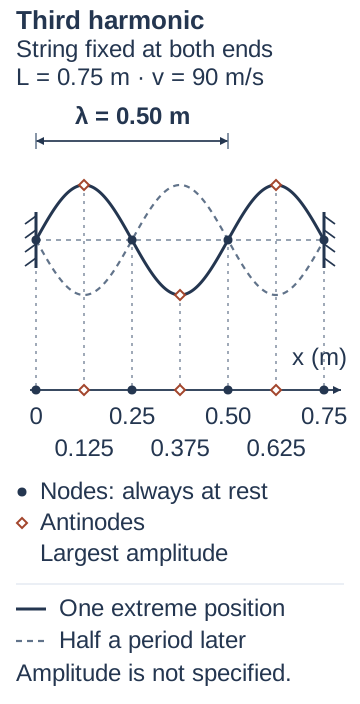
Check the official course catalogueAn ideal uniform string of length is fixed at both ends and carries transverse waves at speed . Find the wavelength, frequency, node positions and antinode positions for its third harmonic. Measure position along the string from one fixed end. If the tension is quadrupled while length and mass per unit length remain constant, how does this same harmonic change?
1. Interpret the mode. A node is a point whose transverse displacement stays zero; an antinode is a point of maximum oscillation amplitude. Each fixed end must be a node. Let denote the positive-integer harmonic number and the wavelength. A string fixed at both ends contains half-wavelengths, so . For the third harmonic, , giving . 2. Find frequency. Let denote the number of oscillations per second. The wave relation gives . Three half-wavelengths, rather than three full wavelengths, fit between the fixed ends. 3. Locate nodes and antinodes. Adjacent nodes are separated by , so the node positions are , , , and . Each antinode lies halfway between adjacent nodes: , , and . These positions give three vibrating segments and include both endpoints among the nodes, as required. 4. Change the tension. Let denote the string tension in newtons and its linear mass density, meaning mass per unit length in . For this ideal string, . Replacing by with fixed multiplies speed by , giving . Keeping and fixed preserves , so the node and antinode positions stay unchanged. Frequency doubles to because . This changes the resonant frequency; it does not determine the vibration amplitude.
If you’re reviewing simple harmonic motion for Dawson’s 203-SN3-RE, try this optional worked lesson on a spring oscillator with a given initial position and velocity.
Your tutor can compare your mode sketch with the boundary conditions to explain why a frequency is allowed. You can also unpack a Doppler or photon-energy attempt together, identifying which motion or measured quantity belongs in the model before practising a similar question.
Use your section’s outline to choose questions on oscillations, superposition, Doppler and any quantum or nuclear topics assigned for the next exam. Check which references are permitted. For each topic, practise a sketch, a calculation and an explanation. Change one given parameter and predict how the sketch or result changes before recalculating.
We work through permitted practice and comparable problems, without completing graded assignments or exams on your behalf.
Read a wave snapshot and a particle’s time trace to connect amplitude, wavelength, period, frequency and propagation speed.
Send your topic and preferred times. We’ll confirm whether we can help and, if so, agree on a time by text or email before payment.
Request 203-SN3-RE tutoringNablio is an independent service and is not affiliated with this institution.