Return to Durham MECH 2103 course guide. Tutoring coverage for this course must be confirmed before booking and payment.
Read the triangle first
A right triangle contains a angle. The two sides meeting at that angle are its legs. The side opposite the right angle is the hypotenuse, and it is the longest side. Rotating a drawing does not change which side is the hypotenuse.
You will use multiplication, square roots and simple equations. A calculator is useful for the angle and word-problem examples. All angles in this lesson are in degrees; use degree mode. These are original practice questions, not a complete secondary-school or college course.
1 Separate distance around from area inside
A triangle’s perimeter is the sum of its three side lengths. Its area is half a base times the perpendicular height. The height must meet the chosen base, or its extension, at a right angle. For a right triangle, its two legs can serve as base and height.
Worked example: a right triangle has legs 3 cm and 4 cm, and hypotenuse 5 cm.
Here is perimeter and is area. A centimetre measures length; a square centimetre measures area. For this area calculation, the hypotenuse is not the height corresponding to the 4 cm base.
Try it: a right triangle has legs 9 cm and 12 cm, and hypotenuse 15 cm. Find its perimeter and area.
Check your answer
Answer: cm and cm². Write both units.
2 Use Pythagoras when two side lengths are known
For a right triangle with leg lengths and and hypotenuse length ,
Use the same length unit for all three sides. The letter labels the hypotenuse here; a different question may use a different letter.
Worked example: the legs are 6 cm and 8 cm. Find the hypotenuse .
The hypotenuse is 10 cm. We take the positive square root because is a length. It is longer than either leg, as expected.
Try it: find the hypotenuse of a right triangle with legs 5 m and 12 m.
Check your answer
Answer: , so m. The numerical lengths were all expressed in metres.
3 Subtract when the missing side is a leg
Worked example: a right triangle has hypotenuse 13 cm and one leg 5 cm. Let be the other leg’s length in centimetres.
The missing leg is 12 cm. Check: . Adding would treat the hypotenuse as a leg and solve a different problem.
Try it: a right triangle’s hypotenuse is 10 m and one leg is 8 m. Find the other leg.
Check your answer
Answer: , so the other leg is 6 m.
4 Choose a ratio from the marked angle
Choose an acute angle , which is greater than and less than . Relative to that angle:
- The opposite side lies across from .
- The adjacent leg touches and is not the hypotenuse.
- The hypotenuse is still opposite the right angle.
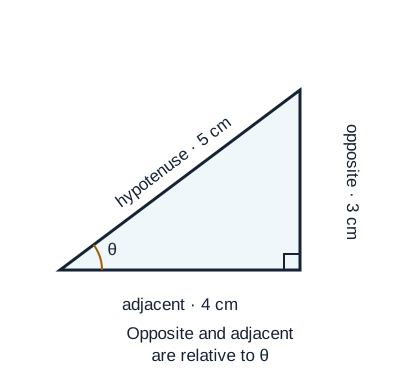
The three ratios are
For the pictured triangle, , and . Matching length units cancel, so the ratios have no unit.
Worked example: a different right triangle has hypotenuse 12 cm and an acute angle of . Find the opposite side, whose length in centimetres is .
We know the hypotenuse and want the opposite side, so use sine:
The opposite side is 6 cm. For this angle, exactly. Keep the ratio attached to the marked angle; changing to the other acute angle swaps opposite and adjacent.
Try it: a right triangle has hypotenuse 10 m and an acute angle of . Find the adjacent leg. Use .
Check your answer
Answer: m, where denotes the adjacent leg’s length in metres.
5 Find an angle from two legs
Worked example: relative to an unknown acute angle , a right triangle’s opposite leg is 3 cm and its adjacent leg is 4 cm. Then
Use inverse tangent to find the angle with this ratio:
The expression with is exact; is rounded to the nearest tenth of a degree. On many calculators, the inverse-tangent key is labelled . Here it means an inverse function, not .
The three angles in a triangle sum to . The other acute angle is therefore , approximately . Keep the unrounded calculator value until the final rounding.
Try it: a right triangle has opposite leg 1 m and adjacent leg 1 m relative to an acute angle . Find .
Check your answer
Answer: , so . The other acute angle is also .
6 Turn a height problem into a right triangle
Worked example: you stand on level ground 24 m horizontally from the base of a vertical building. Your eyes are 1.6 m above the ground. Looking at the top, you measure an angle of elevation of . Find the building’s height to the nearest tenth of a metre.
Translate the words into a sketch
An angle of elevation is measured upward from a horizontal line to the line of sight. Mark your eye position and the top . From , draw a horizontal line to a point on the building at eye level; then join to . The horizontal line and the vertical wall meet at a right angle at . The sloping line of sight is the hypotenuse.
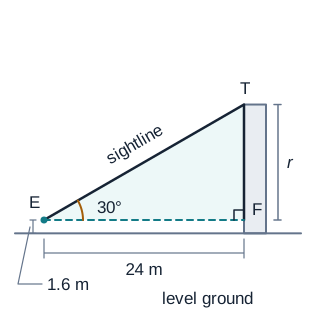
Level ground puts the base of the building at the same height as the ground beneath you, so m. This model assumes a vertical wall and an unobstructed straight line of sight. On sloping ground, the eye-level offset would need to be worked out differently.
Choose the ratio before entering numbers
Relative to the angle, the known horizontal distance is the adjacent leg, and the rise is the opposite leg. Tangent relates those two legs; we do not know the sloping distance. Let and be numerical lengths in metres.
Find the rise, then add the eye height
Use degree mode. Rearrange before calculating:
The building is approximately 15.5 m high. The rise alone is about 13.9 m. Adding 1.6 m answers the question about the whole building. Keep the unrounded rise until the final answer; has no unit, so multiplying by a distance in metres gives a distance in metres.
Check what the answer means
Since , the rise must be smaller than the 24 m horizontal distance. Our answer gives a positive rise below 24 m, and a total height above 1.6 m. Using in the tangent ratio would incorrectly put the whole building inside the eye-level triangle.
7 Build the triangle from a new situation
For each question, sketch the scene, mark the right angle and label the known measurements before choosing an equation. The optional sketches and explained answers are available whenever you need them.
Find the horizontal space for a ramp
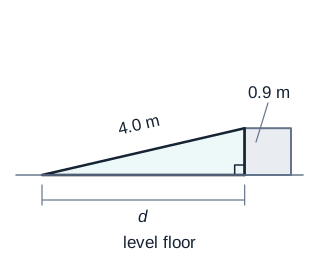
A straight 4.0 m ramp runs from a level floor to a platform 0.9 m above that floor. How far horizontally is the foot of the ramp from the point directly below its top? Give the distance to the nearest tenth of a metre. Identify which measurement lies along the hypotenuse.
Show a sketch and a starting hint
The 4.0 m measurement follows the sloping ramp. Draw the vertical drop from its top to the level floor; it meets the floor at a right angle. The wanted horizontal distance is a leg.
Check the ramp model and answer
Let be the horizontal distance in metres. The ramp is opposite the right angle, so its 4.0 m length is the hypotenuse:
The horizontal distance is approximately 3.9 m. It is positive and slightly shorter than the 4.0 m ramp, which fits this small rise. Check the unrounded value: . Adding the two given squares would produce a length longer than the ramp and misidentify the hypotenuse.
Distinguish the string length from the ground distance
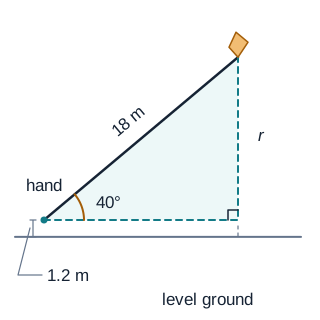
A kite is held by a taut, straight 18 m string. The string makes a angle with the horizontal at the holder’s hand, 1.2 m above level ground. How high is the kite above the ground, to the nearest tenth of a metre? Choose your own triangle and explain which ratio fits. Assume the ground below the kite is at the same level as the ground below the holder.
Show a sketch and a starting hint
Draw a horizontal line from the hand to the point directly below the kite at hand level. The string is the hypotenuse, not the horizontal leg. Find the rise above the hand first.
Check the kite model and answer
The string is opposite the right angle. The wanted rise is opposite , so use sine, which relates opposite and hypotenuse. Let be the rise above the hand and the height above ground, both in metres.
The kite is approximately 12.8 m above the ground. The rise is about 11.6 m, less than the 18 m string, as any leg must be shorter than the hypotenuse. The full height must lie between 1.2 m and 19.2 m. Using would treat the string as a horizontal distance. If the string sags, its full length is no longer the straight side of this triangle.
8 Solve a 3D problem using two right triangles
A sloping line across a room can be longer than either a floor edge or a floor diagonal. Before calculating, separate the scene into two flat triangles: one on the floor and one standing vertically above a line on that floor.
All angles below are in degrees. Use degree mode and keep unrounded values until the final answer. Unless stated otherwise, round lengths to the nearest tenth of a metre and angles to the nearest tenth of a degree. The stated measurements are treated as exact values in these practice models.
Find the horizontal projection
Suppose A is a point on a horizontal floor, T is above the floor, and C is the point directly below T. The segment TC is vertical. The segment AC is the horizontal projection of the sloping segment AT: it joins A to the point directly below T. Viewed from directly above, T and C appear at the same position.
For the sloping cases here, A and C are different points, so AC > 0. A vertical segment would instead make a 90° angle with the plane and would not form this non-degenerate triangle.
The angle that AT makes with the horizontal plane is the acute angle between AT and AC, at A. It is not generally the angle between AT and a floor edge. The triangle ACT has a right angle at C because TC is vertical and AC is horizontal.
If AC is not given, first find it in a triangle lying on the floor. You can then use AC as a leg of the vertical triangle ACT. The same segment can be the hypotenuse of one triangle and a leg of the next.
Worked example 1: a diagonal across a rectangular room
A rectangular room has a level floor 6 m long and 8 m wide, with a ceiling 5 m above the floor. Find the straight distance from one floor corner A to the opposite ceiling corner T, and the angle this line makes with the floor.
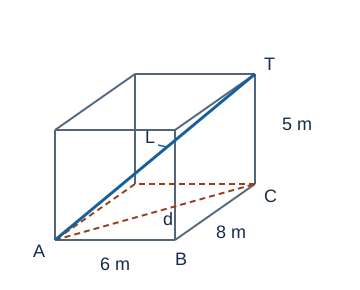
Let B be the next floor corner along the 6 m edge. Let C be the diagonally opposite floor corner, directly below T. Thus AB = 6 m, BC = 8 m and CT = 5 m. Adjacent floor edges meet at right angles; the height is perpendicular to the floor.
Step 1: use the floor triangle ABC. Its right angle is at B. Let d = AC, the floor diagonal. With lengths in metres,
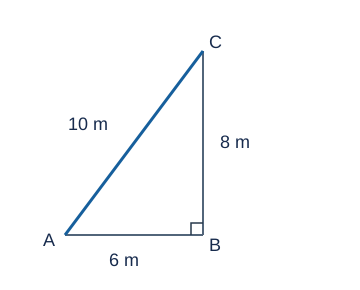
Step 2: use the vertical triangle ACT. Its right angle is at C. The floor diagonal d is now the horizontal leg; CT is the vertical leg. Let L = AT, the spatial diagonal:
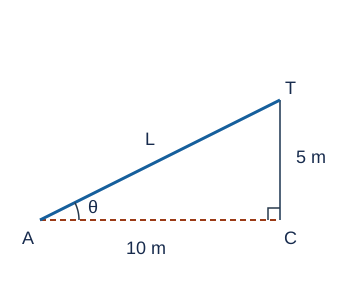
Step 3: mark the angle before choosing a ratio. Let θ = ∠CAT. Relative to θ, the opposite leg is CT = 5 m and the adjacent leg is AC = 10 m. Therefore
The distance is approximately 11.2 m, and the angle with the floor is approximately 26.6°. The spatial diagonal is longer than the 10 m floor diagonal, as it must be. Since the rise is smaller than the horizontal run, the angle is less than 45°.
Using tan θ = 5/6 would use an edge of the room instead of the line directly underneath AT. That edge and the 5 m height describe a different triangle.
Worked example 2: recover a missing ground offset
A straight, taut 13 m guy wire joins the top T of a vertical 5 m pole to an anchor A on level ground. The pole’s base is C. On a plan view, the displacement from C to A consists of two perpendicular ground offsets: 9.6 m east and an unknown distance y north. Find y and the angle the wire makes with the ground. Ignore sag and extra wire needed for fastening; the anchor and pole base are at the same ground level.
Start with the vertical triangle. Let d = AC be the direct horizontal distance from the base to the anchor. The wire is the hypotenuse, so
Return to the plan view. The east and north offsets are perpendicular legs, and AC = 12 m is their hypotenuse. With y in metres,
Use the vertical triangle for the elevation angle. At A, the wire and the horizontal segment AC form an angle θ. The rise is 5 m and the horizontal run is 12 m:
The missing northward offset is 7.2 m, and the wire makes an angle of approximately 22.6° with the ground. Check both triangles: 9.6² + 7.2² = 12² and 12² + 5² = 13². Adding the ground offsets, 9.6 + 7.2, would give a distance along a two-part route, not the straight horizontal distance AC.
Four gradual practice questions
Draw the two triangles separately if the spatial sketch feels confusing. Hints and solutions are available whenever you need them.
1. Find the floor diagonal first. A rectangular box has a horizontal base 3 m by 4 m and a vertical height of 12 m. Find its base diagonal, its spatial diagonal and the angle the spatial diagonal makes with the base.
Show a hint 1
Hint: the base diagonal becomes the horizontal leg of the second triangle.
Show the solution 1
Solution: the base diagonal is d = √(3² + 4²) = 5 m. The spatial diagonal is L = √(5² + 12²) = 13 m. Its angle to the base is θ = arctan(12/5) ≈ 67.4°. Here the vertical rise exceeds the horizontal run, so an angle above 45° is reasonable.
2. Work backwards from the sloping length. A straight line joins a ground point A to a point T above a horizontal plane. The line AT is 17 m long and its horizontal projection AC is 15 m. Find the vertical height CT and the angle between AT and the plane.
Show a hint 2
Hint: 17 m is the hypotenuse, so subtract squares to find the height.
Show the solution 2
Solution: CT = √(17² − 15²) = √64 = 8 m. The angle is θ = arctan(8/15) ≈ 28.1°. A second check is sin θ = 8/17. No further plan-view calculation is needed because the horizontal projection is already given.
3. Diagnose the wrong triangle. For the 6 m by 8 m by 5 m room in worked example 1, a student calculates arctan(5/6) ≈ 39.8° for the spatial diagonal’s angle with the floor. Which horizontal distance is needed, and what does the student’s calculation describe instead?
Show the solution 3
Solution: the required horizontal distance is the floor diagonal √(6² + 8²) = 10 m, giving arctan(5/10) ≈ 26.6°. The ratio 5/6 gives the elevation angle of a diagonal on a 6 m by 5 m vertical face. It leaves out the room’s 8 m width and does not describe AT.
4. Transfer the model to a wire. A pole stands vertically on level ground. An anchor is 9 m east and 12 m north of its base. A straight, taut wire joins the anchor to the pole’s top and makes a 40° angle with the horizontal ground. Find the pole’s height and the straight wire length. Assume the base and anchor are at the same ground level; ignore sag and fastening lengths.
Show a hint 4
Hint: the 9 m and 12 m offsets belong to the plan-view triangle. Find the direct ground distance before using the 40° angle.
Show the solution 4
Solution: the direct horizontal distance is d = √(9² + 12²) = 15 m. Let h be the pole height and L the wire length. In the vertical triangle, tan 40° = h/15, so h = 15 tan 40° ≈ 12.6 m. Also cos 40° = 15/L, so L = 15/cos 40° ≈ 19.6 m. Using unrounded values, L² = 15² + h². The wire is longer than either leg, and h < 15 m because 40° < 45°.
A quick setup check
Before calculating, ask: where is each right angle, which line is the horizontal projection, and which triangle contains the marked angle? A perspective sketch can make perpendicular lines look slanted. Use the given geometry and labels, not the apparent angle on the page. If the two ground offsets are not perpendicular, do not apply Pythagoras to them; a different triangle method is needed.
Choose a method before calculating
- Two side lengths are known and a third is missing: use Pythagoras.
- One acute angle and one side length are known: choose sine, cosine or tangent using the known side and the wanted side.
- Two side lengths are known and an acute angle is missing: use the matching inverse trigonometric function.
These methods here require a right triangle. A drawing that merely looks square does not establish a right angle; look for a right-angle mark or a statement in the question.
If no right angle is given, continue with choosing the sine or cosine law for a non-right triangle.
Try again without the worked examples
A right triangle has legs 8 cm and 15 cm. Find its hypotenuse, perimeter and area.
Check your answer 1
Hypotenuse cm; perimeter cm; area cm².
A right triangle has hypotenuse 20 cm and an acute angle of . Find the opposite side.
Check your answer 2
Opposite side cm.
Relative to an acute angle , a right triangle has opposite leg 5 cm and adjacent leg 12 cm. Find to the nearest tenth of a degree.
Check your answer 3
. Use degree mode and round only at the end.
Before moving on, mark the right angle and the hypotenuse on a fresh sketch. Explain why your chosen equation uses the known measurements. If rearranging the equation is the difficult step, review rearranging a formula.
For angle relationships, similar triangles and scaling, continue with Angles, similarity, area and volume.
To use Pythagoras on a coordinate grid, try distance between two points. Start with horizontal and vertical changes, then use distance, midpoints and slopes to find perpendicular bisectors.
Need help turning the words into a sketch or choosing the sides? In algebra and precalculus tutoring, your tutor can build the diagram with you, explain why a ratio fits and help you check a new problem. You can start with a question or a confusing idea. Tutoring sessions are currently offered in English.
Useful for
Work on the step you’re missing.
Tell us the subject and your preferred time. Nablio confirms the details by text or email.
Request a lesson