Return to Centennial PHYS-100 course guide. Tutoring coverage for this course must be confirmed before booking and payment.
Stuck on a step? Text us Email us Request a lesson
A glider speeds up, hits another glider, then compresses a spring. It is one story, but the most useful equation changes during the story. This lesson teaches you to choose a system and an interval before choosing between work–energy and impulse–momentum.
Before you start: know how to rearrange an equation, square a number, take a square root and use signed velocities along a line. The main lesson needs no calculus. We model objects as particles with constant mass, neglect rotation, and work in an inertial reference frame, where a particle with no net force stays at rest or moves in a straight line at constant speed. Values are idealized; numerical answers are rounded only at the end.
By the end: you should be able to explain when momentum or mechanical energy is conserved, distinguish work from impulse, and solve a collision followed by spring compression without carrying a conservation assumption into the wrong interval.
This is original topic practice connected to Concordia PHYS 204 and the mechanics content of McGill PHYS 101 and PHYS 131. Official descriptions and the limits of these connections appear at the end. Use your own course outline to check the depth you need.
1. Choose the system and the interval
A system is the object or group of objects you include. A force from something outside that boundary is external. The contact forces between two gliders are external to either glider alone, but internal to the two-glider system. Changing the system changes which forces can change its total momentum.
An interval has a definite start and finish: before the push to after the push, just before impact to just after impact, or first spring contact to maximum compression. Mark those states on a sketch. Do not write “before” and “after” without saying before and after what.
Use the information in the question to choose a useful first equation:
- Force acting through a displacement, or a speed linked to a height or spring compression: start with work–energy or an energy balance.
- Force acting over a time, or a force–time graph: start with impulse–momentum.
- A collision with negligible external impulse: use conservation of total momentum for the colliding objects. Check the collision type separately before making a kinetic-energy claim.
- Acceleration, tension, or a contact force at an instant: Newton’s second law may be the best start. Energy and momentum are not the only tools.
These are clues to efficiency, not exclusive rules. Both work–energy and impulse–momentum remain valid in their proper form. A conservation shortcut needs its own justification.
Notation: is mass in kilograms, is time in seconds, and is signed velocity along the chosen -axis in m/s. Speed in one dimension is nonnegative. Subscripts and mean the start and finish of the stated interval, and means final minus initial.
2. Connect work with a change in speed
A particle’s kinetic energy is , measured in joules, J. It depends on speed squared, so motion to the left and motion to the right at the same speed have the same kinetic energy.
For a constant force vector acting through displacement , the work is
Here is the force magnitude in newtons, is the displacement magnitude in metres, and is the angle between them. Thus . A force does positive work when its component along the displacement is positive, negative work when that component is negative, and zero work when it is perpendicular. For a changing force in one dimension, use the signed area under a force-component-versus-position graph, following the direction of travel on each segment.
Add the work of all forces on the particle. The work–energy theorem gives
This equation does not assume kinetic energy is conserved. A positive net work increases speed; a negative net work decreases it. If your calculation gives , the proposed final state cannot be reached under the stated model.
Worked example 1: a push over a known distance
A 0.75 kg glider is moving right at 2.0 m/s on a level air track. A constant horizontal force of 3.0 N pushes it right through 2.0 m. Other horizontal forces are negligible. Find its speed at the end of the push.
System and interval: the glider, from the start to the end of that 2.0 m displacement. Its weight and the track’s support force do zero work because the displacement is horizontal. The push is parallel to the displacement.
Check: the push supplies positive work, so the final speed exceeds 2.0 m/s. In this setup the velocity stays rightward. The square root alone supplies a speed; the direction comes from the motion and forces.
Impulse–momentum would also work, but the duration is not given. The displacement makes work–energy the shorter route. Momentum is not conserved for the glider because the push provides an external impulse.
3. Decide whether mechanical energy is conserved
A conservative interaction, such as ideal gravity or an ideal spring, can be described by potential energy . Its work is . Potential energy belongs to an interaction: gravitational energy involves the object and Earth; spring energy involves the spring and its deformation.
- Near Earth: , with upward height measured from any fixed chosen zero and in this lesson. A fall decreases .
- Ideal spring: , where is stiffness in N/m and is signed extension or compression from the unstretched position. The energy is positive for either sign of . We set it to zero at .
For our particle model, put the chosen conservative interactions into . Let be the work of the remaining forces. The work–energy theorem becomes
The mechanical energy is conserved over the interval when . State why: for example, negligible air resistance and a stationary support that does no work. A spring must also behave elastically without appreciable damping. Do not include the same spring or gravitational interaction both as work and as potential-energy change.
A sticking collision requires a fuller energy account because deformation and other internal changes can absorb kinetic energy. Total energy is still accounted for when all forms and transfers are included. The shortcut , or with those internal changes omitted, is generally invalid across that collision.
Quick prediction: if a particle falls from rest through a height with no air resistance, , so . This gives a speed. It does not say the particle’s momentum is constant: gravity changes that momentum.
4. Connect impulse with a change in velocity
Linear momentum is the vector , measured in kg·m/s. Along one axis, , so its sign follows the velocity. Total momentum of a fixed group of objects is the vector sum of their individual momenta.
Impulse measures a force accumulated over time. For a constant force, ; for a changing force, use its time-average value or the signed area under its force–time graph. Its unit is N·s, equal to kg·m/s. The impulse–momentum theorem for a fixed-mass system is
Here is the total impulse of external forces over the stated interval. Internal forces between objects occur in equal-and-opposite pairs and cancel in the system’s momentum balance. They do not cancel the changes in each object’s individual momentum.
Total momentum has the same initial and final value if the net external impulse is zero, or approximately the same value if that impulse is negligible at the precision needed. For momentum to stay constant throughout an interval, the net external force must vanish throughout. A short collision alone is not enough: an external impact from a wall can still give a large impulse. A single component can be conserved even when another is not.
Worked example 2: a positive impulse that reverses the motion
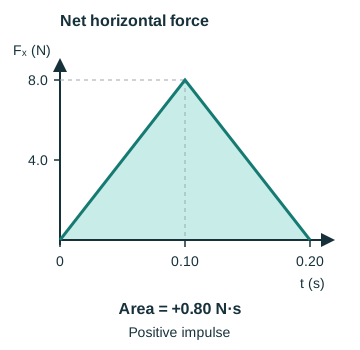
A 0.20 kg particle initially has . Take right as positive. Its net horizontal force forms the triangular pulse below: zero at , +8.0 N at 0.10 s, then zero at 0.20 s, with straight-line segments between. Find its final velocity.
View the force–time diagram full size
Use the signed area: the triangle is above the time axis.
The impulse first removes the leftward momentum and then creates rightward momentum. The particle ends moving right at a smaller speed than it began.
Energy check: and , so the net work is . A positive impulse did not require positive work. Impulse depends on force and time; work depends on force and displacement. While the particle is moving left, the rightward force does negative work.
Optional calculus connection: in one dimension, , whereas when force is described as a function of position along the motion. More generally , which also handles a reversal. The extra factor explains the sign difference here.
Optional: momentum without a collision
A 10–15 minute extension: use a fixed centre of mass to separate displacement relative to a boat from displacement relative to shore. The worked example and first two questions need only algebra. The last question is an optional calculus connection. You can continue the main lesson with the collision and spring at any time.
Start with a weighted position
For a person of mass and a boat of mass , let and locate their individual centres of mass along the same shore-based horizontal axis. The system’s centre of mass is their mass-weighted average position:
Choose person + boat as the system. If its total horizontal momentum starts at zero and the net external horizontal force remains negligible throughout, its centre of mass stays fixed horizontally. Internal contact forces can still move each part. With constant masses, subtracting the initial weighted-position equation from the final one gives
This is a balance of mass times displacement, not a momentum equation with displacements substituted for velocities. It follows from the fixed centre of mass. Zero net external impulse over the whole trip would establish equal endpoint momenta only; it would not by itself fix the centre of mass throughout the trip.
A person walks along a boat: which displacement is 3 metres?
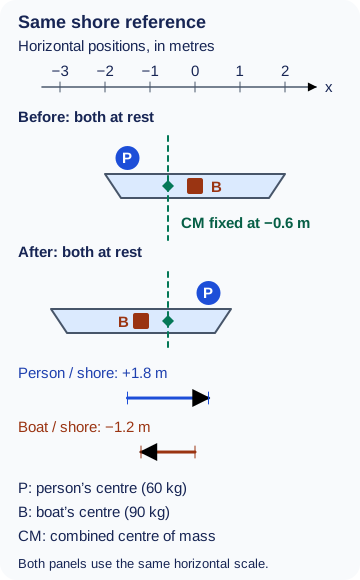
A 60 kg person and a 90 kg boat are initially at rest relative to shore. The person moves 3.0 m to the right relative to the boat, then stops relative to it. Find each displacement relative to shore.
Model: take right as positive and shore as an approximately inertial reference. Neglect external horizontal forces throughout and neglect rotation. Masses stay constant; the boat translates without changing its internal mass distribution. Track the person by their centre of mass and assume enough deck space.
Two conditions, two equations. Both unknown displacements below are measured from shore. The second equation states how far the person’s position changes relative to the boat:
Thus the person’s shore displacement is the boat’s shore displacement plus 3.0 m. Substitute into the weighted balance:
Check both conditions: the mass-weighted displacements cancel, and their difference is the specified relative displacement.
The first check uses kg·m; the second uses metres. The boat moves left, so the person advances less than 3.0 m relative to shore.
View the shore-reference diagram full size
At the end: stopping relative to each other means a common velocity. Total momentum is still zero, so that common shore velocity is zero. Their displacements are not zero. Do not conserve the two bodies’ mechanical kinetic energy throughout the walk: internal energy powers motion, and stopping can dissipate energy. The displacement result needs neither a walking time nor a detailed force history.
New try: change the masses
Keep the same assumptions, but use a 90 kg person, a 30 kg boat and a relative displacement of +2.0 m. Predict which object travels farther relative to shore, then find both signed displacements and check both conditions.
Show a hint
The lighter boat must have the larger displacement magnitude to balance mass times displacement. Use the new masses in the weighted balance and +2.0 m in the relative-displacement equation.
Show the explained answer
Write and , with masses in kilograms and displacements in metres. Substitute to get . The boat moves and the person moves . Check: and . The lighter boat travels three times as far as the person, in the opposite direction.
Diagnose the model: the boat is held at shore
Return to the original 60 kg person, 90 kg boat and +3.0 m relative walk. Two opposing taut mooring lines now hold the boat fixed at shore throughout the motion. Does the boat still move −1.2 m? Explain which condition fails and find both shore displacements.
Show a hint
Draw the boundary around person + boat. Do the mooring lines cross it? Which of the two equations follows from geometry alone?
Show the explained answer
The shore and mooring lines provide an external horizontal interaction, so the fixed-centre-of-mass argument no longer applies. A boat held fixed has ; the relative-displacement equation then gives . The system’s centre of mass shifts +1.2 m. Both bodies start and finish at rest, so the net external impulse over the complete trip is zero, but that does not make the external force zero throughout. Its time history cannot be recovered from the endpoint displacements.
Optional calculus retry: differentiate, then integrate
Use the original masses and the free-boat assumptions. A supplied model gives the person’s displacement relative to the boat from the initial configuration:
where L = 3.0 m, T = 4.0 s and . Find both shore-displacement functions, differentiate to find their velocities, locate the maximum relative speed, then integrate the boat’s velocity to recover its displacement. This is a mathematical motion model, not a model of actual footsteps or constant acceleration.
Show a hint
Replace 3.0 m by in the two equations. For differentiation, set and include the chain-rule factor . Complete the square in to find its maximum.
Show the explained answer
Solving the same mass-weighted and relative balances at each time gives
The chain rule gives
This is nonnegative on the stated interval and zero at both endpoints, so both shore velocities also vanish at the endpoints. Since , the maximum relative speed is at .
This recovers the algebraic result. The endpoint accelerations do not vanish: . If the system is at rest outside this interval, its acceleration must be described piecewise, with different one-sided limits at the joins. The acceleration is not defined exactly at those joins.
Takeaway: identify the reference frame for every displacement, test the external-force assumption, then use a mass-weighted balance and a relative-position balance. For the weighted-position definition, see OpenStax University Physics, section 9.6: centre of mass.
5. Split a collision and a spring compression
A collision is elastic when the total kinetic energy of the colliding objects is the same before and after. A collision in which the objects stick together is perfectly inelastic. For ordinary sticking collisions with relative motion before impact and negligible external work, kinetic energy decreases. Momentum conservation depends on the net external impulse, regardless of whether the collision is elastic.
Worked example 3: stick together, then compress a spring
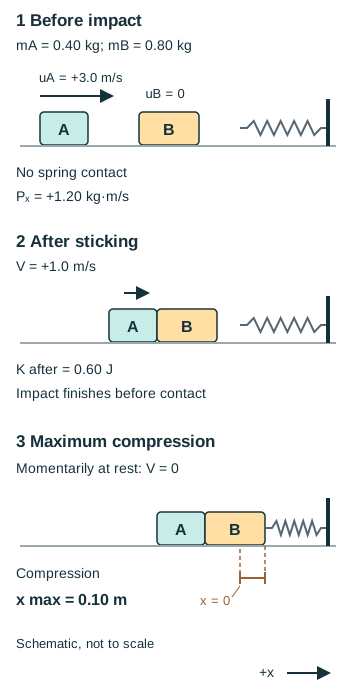
On a level air track, glider A has mass and velocity . Glider B has mass and is at rest, so . They collide and stick. After crossing a short clear gap, the pair contacts an initially unstretched, ideal massless spring of stiffness , fixed to a wall. Find the maximum compression.
Assume negligible horizontal resistance and negligible rotational energy. The collision finishes before spring contact. The spring is not attached to the gliders beforehand. These details let us separate the two intervals.
View the collision and spring diagram full size
Interval A: just before to just after collision
Choose both gliders as the system. Their collision forces are internal. The external horizontal impulse is negligible, so their total horizontal momentum is conserved. Because they stick, they share one velocity afterward:
Now calculate the kinetic energy before and after the collision instead of assuming it is conserved:
The gliders have 1.20 J less kinetic energy after sticking. That amount goes into other forms or transfers, such as deformation, internal energy and sound. It is not energy that the ideal spring will subsequently receive.
Interval B: first spring contact to maximum compression
The pair crosses the gap at the unchanged speed . For the compression interval, include the ideal spring in the energy account. The fixed support does no work, height is unchanged, and losses are neglected. Initially ; at maximum compression , the pair is momentarily at rest.
Why switch methods? During compression, the spring gives the gliders an external leftward impulse, so the gliders’ momentum is not conserved. Mechanical energy of the glider–spring model is conserved under the stated assumptions. Zero velocity at maximum compression does not mean zero force: the spring force is leftward with magnitude .
Catch a plausible wrong answer: sending the original 1.80 J directly into the spring gives . This overestimates compression because it skips the sticking collision’s kinetic-energy decrease.
Reusable structure: mark three states, apply momentum across impact, carry the resulting speed to spring contact, then apply energy during compression. Recheck these assumptions whenever a spring or wall acts during the collision itself.
6. Try six questions with hints and answers
For each question, write the system, interval, chosen positive direction and first equation before calculating. Use when needed. Try the hint before opening the answer.
Question 1: use negative work
A 0.50 kg particle has initial speed 4.0 m/s. The net work on it over an interval is −3.0 J. Find its final speed. Does the energy equation alone determine the sign of its final velocity?
Show a hint
Find , add the signed work, then solve for speed. Ask what information disappears when velocity is squared.
Show the answer and reasoning
, so . Thus . The energy equation alone permits or −2.0 m/s; additional motion information determines direction. Work of −5.0 J would instead demand negative kinetic energy, so that proposed interval could not occur as described.
Question 2: a height without a time
A 0.30 kg object is released from rest and falls vertically through 0.80 m, with negligible air resistance. Find its speed before it has any contact with the floor. Is the momentum of the object alone conserved during this fall?
Show a hint
Choose the final height as the zero of gravitational potential energy. Compare the object–Earth energy account with the momentum account for the object alone.
Show the answer and reasoning
The object–Earth energy balance is , giving , downward. The mass cancels. Momentum of the object alone is not conserved because gravity provides an external impulse. Mechanical energy can be conserved while the object’s momentum changes.
Question 3: same speed, different momentum
A 0.30 kg particle initially moves at . A constant net force acts for 0.80 s. Find final velocity, impulse and net work. How can the last two have different signs or one be zero?
Show a hint
Use . Then compare the initial and final kinetic energies, rather than multiplying force by time to find work.
Show the answer and reasoning
The impulse is . Initial momentum is +0.60 kg·m/s, so final momentum is −0.60 kg·m/s and . Both kinetic energies are 0.60 J; net work is zero. The force first slows the particle, then speeds it up in the opposite direction. Equal endpoint speeds do not imply equal velocities or momenta.
Question 4: diagnose an energy shortcut in a collision
Two 0.50 kg gliders move toward one another at and . They stick on a level air track with negligible external horizontal impulse. A student conserves kinetic energy and predicts a shared speed . Find the actual shared velocity and explain the error.
Show a hint
Add signed momenta before dividing by the total mass. Then calculate the kinetic-energy decrease as a check.
Show the answer and reasoning
The total mass is 1.0 kg, so . Initially ; afterward . The 4.50 J decrease is compatible with sticking. A shared speed would give momentum of magnitude , contradicting the required +1.0 kg·m/s. The student assumed a conservation law that the collision does not satisfy.
Question 5: solve a new two-interval problem
A 0.20 kg glider moving right at 5.0 m/s sticks to a stationary 0.30 kg glider. After the collision is complete, the pair reaches an initially unstretched spring with . Use the same idealizations as worked example 3. Find their shared speed, the kinetic-energy decrease in the collision, and maximum compression. How does compression change if only doubles?
Show a hint
Keep the speed after impact as the starting speed for compression. At that fixed speed and mass, is proportional to .
Show the answer and reasoning
Momentum gives . Kinetic energy falls from 2.50 J to 1.00 J, a decrease of 1.50 J. Then , so . Doubling only the stiffness gives . The collision speed stays the same because the spring is not acting during impact.
Question 6: keep an external impulse in the equation
Return to the 0.40 kg and 0.80 kg gliders in worked example 3, with the same initial velocities. This time an external device supplies a known horizontal impulse of −0.24 N·s during their sticking collision. Find the shared velocity immediately afterward. Can you label the entire kinetic-energy decrease as internal conversion within the gliders from these data alone?
Show a hint
Use , not . An impulse does not by itself specify the work of the device.
Show the answer and reasoning
Initial momentum is +1.20 kg·m/s, so final momentum is . Therefore . Kinetic energy changes from 1.80 J to , a decrease of 1.416 J. You cannot assign all of it to internal conversion: the external device may do work, and its impulse alone does not determine that work. More information about its force and the motion is needed for that split.
Transfer practice: change the situation, keep the reasoning
Apply the method to three new situations: sliding with friction, crossing a hilltop and a collision in two dimensions. Each worked example is followed by a similar question with different values. You can pause to choose a system, an interval and a first equation, or open the explanation straight away. Hints are optional. Use throughout this section.
Worked example 4: a rough incline changes mechanical energy
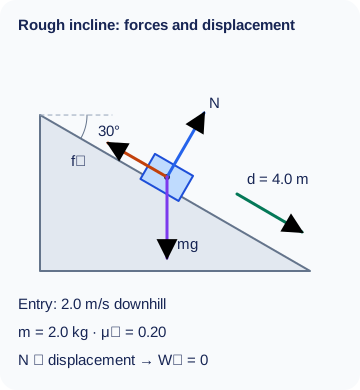
A block of mass already sliding downhill enters a straight, stationary 30° incline at 2.0 m/s. It travels a distance along the slope. The coefficient of kinetic friction is ; air resistance is negligible. Find its speed after those 4.0 m. Write for the normal-force magnitude and for the kinetic-friction magnitude. Before calculating, which force removes mechanical energy, and why does the normal force do no work?
Show a hint
The perpendicular acceleration is zero on a straight slope. Find , then . The vertical drop is , not .
Show the worked explanation
System: the block. Interval: entry to the point 4.0 m down the slope. First equation: . Here , and are the work done by gravity, friction and the normal force. Gravity does positive work; sliding friction does negative work. The fixed slope keeps the normal perpendicular to the instantaneous displacement, so . This is a work statement, not a claim that the normal force is zero.
Why not conserve mechanical energy? Equivalently, the block–Earth mechanical-energy balance is when the surface interaction is represented by frictional work. It decreases by 13.58 J. Including the surface and thermal energy in a larger system restores total-energy accounting; it does not restore conservation of mechanical energy. The frictionless answer would be larger. Here gravity’s downhill component exceeds friction, so the block keeps sliding downhill throughout the interval; the kinetic-friction model remains consistent.
Question 7: retry on a different rough slope
A 1.5 kg block slides downhill at 1.0 m/s onto a straight 30° slope. Over the next 2.0 m, ; the slope is fixed and air resistance is negligible. Find its final speed and the mechanical-energy decrease. Name the system, interval and first equation.
Show a hint
Use . Separately calculate the positive energy decrease .
Show the answer and reasoning
System: block; interval: the stated 2.0 m descent; first equation: , because the normal does zero work. Here , , and . Thus and . Mechanical energy decreases by 2.55 J, even though kinetic energy increases: gravity supplies more work than friction removes. Downhill acceleration is positive, consistent with continued sliding.
Worked example 5: energy gives speed; Newton’s law tests contact
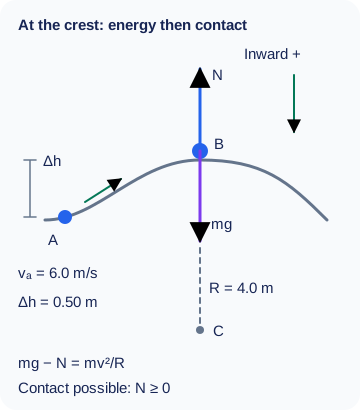
A 2.0 kg cart, modelled as a particle with no rotational energy, has speed 6.0 m/s at A on a smooth, fixed track. Crest B is 0.50 m higher, with local radius of curvature 4.0 m. The cart rides on top of the track, which can push but cannot pull it. Neglect drag. Assuming contact until B, find the speed there, then test whether contact is locally possible. Does conserving energy alone tell you the normal force?
Show a hint
First use . Then draw the cart’s forces at B and use inward-positive .
Show the worked explanation
Energy system: cart and Earth; interval: A to B along the proposed contact path. First equation: . The stationary, smooth track’s normal force does zero work while contact holds, and there is no dissipative work.
Force system: cart alone; instant: at B. First radial equation: . Weight is inward; the normal is outward. “Centripetal force” names the net inward force, not a third interaction.
Contact check: is compatible with contact at B. The local limit is , or ; a negative required normal would mean the track must pull the cart and the assumed contact path is impossible. A positive result at B alone does not prove contact everywhere earlier; that depends on the rest of the track. Energy supplied the missing speed, and Newton’s law tested the constraint. For further force-diagram practice with speed supplied, continue to Circular motion and force diagrams.
Question 8: retry and reject an impossible contact assumption
A 1.0 kg particle-cart enters a smooth fixed track at 9.0 m/s. A convex crest is 1.0 m higher and has local radius 5.0 m. The cart is on top of the track, which cannot pull it; neglect drag and rotation. Assuming contact up to the crest, calculate the candidate speed and required normal. Is that path physically possible?
Show a hint
Find the candidate . Do not discard the sign when substituting into .
Show the answer and reasoning
Energy system: cart and Earth; interval: entry to the proposed crest state; first equation: . It gives , or candidate speed 7.84 m/s. For the cart alone at the crest, the first radial equation is . It demands . This is not a physical downward normal: it rejects continued contact along the assumed path. The cart must lose contact before that constrained crest state. After separation, and the trajectory is free flight under gravity; the full track shape is needed to locate departure. Do not report 7.84 m/s as a verified speed at the actual crest point.
Worked example 6: conserve momentum component by component
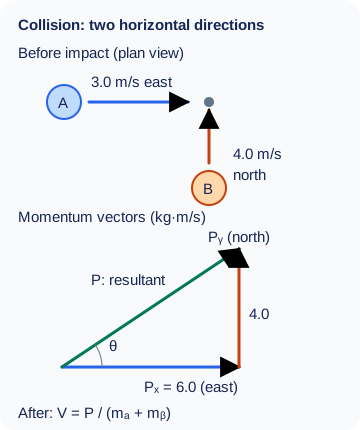
On a level air table, puck A (2.0 kg) moves east at 3.0 m/s and puck B (1.0 kg) moves north at 4.0 m/s. They collide and stick. Model the pucks as particles, neglect rotation, and assume negligible net external impulse in both horizontal directions during impact. Find their shared velocity, speed and direction, then the kinetic-energy decrease. Why can you not add the two initial momentum magnitudes as scalars?
Show a hint
Choose east as +x and north as +y. Write one momentum equation for each component, then divide both totals by the combined mass.
Show the worked explanation
System: both pucks; interval: immediately before to immediately after sticking. First equation: . The net external horizontal impulse is negligible separately in x and y, so each horizontal momentum component is conserved. A short collision alone does not guarantee this condition. Weight and support balance vertically in this ideal level-table model; they are not horizontal impulses. The internal contact impulses cancel in the two-puck sum.
The signs place the vector in the northeast quadrant; the angle is measured from east. The initial momentum magnitude is , not , because the contributions are perpendicular.
Check: final momentum is (6.0, 4.0) kg·m/s, matching the initial vector. Kinetic energy is not generally conserved in a collision; this sticking event converts some into internal energy. Total momentum conservation does not imply kinetic-energy conservation.
Question 9: retry with a negative component
On a level air table, a 1.0 kg puck moving east at 4.0 m/s sticks to a 3.0 kg puck moving south at 2.0 m/s. Treat them as particles with no rotation. Net external horizontal impulse during impact is negligible in both directions. Find the shared velocity components, speed, direction and kinetic-energy decrease. Use east as +x and north as +y.
Show a hint
The southward velocity has a negative y-component. Total initial momentum is ; divide each component by 4.0 kg.
Show the answer and reasoning
System: the two pucks; interval: immediately before to immediately after sticking; first equation: , justified by negligible net external impulse in each horizontal direction. Thus , speed , and direction south of east. The negative y-component decides the quadrant. Initially ; afterward . The decrease is 7.50 J. Check momentum with both components, not only the speed.
Elastic collisions in one dimension: find both final velocities
When two carts separate after impact, there are two final velocities to find. Momentum conservation supplies one equation. A perfectly elastic collision supplies a second: total kinetic energy is also unchanged. Learn to justify both equations, keep the velocity signs and reject a solution that still describes the incoming motion.
This optional extension uses algebra, with no calculus. Use this section when your course covers elastic collisions. Review the worked example, then try questions 10–13. Open a hint whenever it helps.
Set up the collision model
Consider two carts on a straight, level air track. Cart A is to the left of cart B. Treat both as particles with positive, constant masses; neglect rotation. Take right as positive in the track’s inertial reference frame. The interval runs from immediately before contact to immediately after the collision has ended and the carts are separating. Net external horizontal impulse is negligible. A short duration alone does not establish that assumption.
Write for the masses in kilograms; for the signed velocities before impact; and for the signed velocities afterward, all in m/s. A negative velocity means motion to the left. Speed is the nonnegative magnitude of velocity. Initially the carts approach, so . The total horizontal momentum is , in kg·m/s; the total kinetic energy is , in joules. Subscripts and mean before and after.
For the system containing both carts, negligible external impulse gives
If the collision is also perfectly elastic,
The first equation depends on the system and its external impulse. The second depends on the collision type. Neither the word “collision” nor the fact that the carts separate is enough to justify kinetic-energy conservation.
Derive a simpler second equation
Rearrange momentum conservation:
Call their common value , in kg·m/s. It is the rightward impulse received by B in this ideal model. Rearrange the kinetic-energy equation, cancel the common factor one half, then factor the differences of squares:
Hence . If , positive masses force and : both velocities are unchanged. This branch satisfies both conservation equations, but does not describe the completed impact of these approaching, nonpassing carts. They would still be approaching at contact.
For the actual collision with nonzero impulse, divide by :
The speed at which the carts separate equals the speed at which they approached. This is a consequence of both conservation equations for a one-dimensional perfectly elastic collision. It is not an extra rule for every collision. Here , so it also ensures , as required after impact.
Worked example 7: a lighter cart reverses direction
Cart A has mass and velocity . Cart B has mass and is initially at rest, . They undergo a perfectly elastic collision under the model above. Find both final velocities. Does each cart keep its own kinetic energy?
Show a hint
Use total momentum conservation together with . Do not assign one shared final velocity: the carts separate.
Show the worked explanation
Choose the system and interval. Include A and B, immediately before to immediately after the completed impact. Their contact impulses are internal and cancel in the total momentum balance. Negligible external horizontal impulse conserves total horizontal momentum; the stated elastic model conserves total kinetic energy.
Write two independent equations.
The second equation gives . Substitute into the first:
A reverses and moves left at a speed of 2.0 m/s. B moves right at 2.0 m/s. Equal speeds here do not mean equal velocities.
Check both original conservation equations.
A’s kinetic energy decreases from 8.0 J to 2.0 J; B’s increases from 0 to 6.0 J. The total is conserved, not each cart’s energy separately. Likewise, their individual momentum changes are −6.0 and +6.0 kg·m/s.
Check the physical branch. The separation speed is , matching the approach speed. The unchanged pair also passes the two conservation checks, but A would still be catching B at contact. It is not the required state after this impact.
Four questions with less guidance
Questions 10–12 use the same one-dimensional, perfectly elastic model, with A initially to the left of B and negligible net external horizontal impulse. Use right as positive. In question 13, the collision type is deliberately left unspecified.
Question 10: equal masses, opposite incoming directions
Both masses are 0.50 kg. Initially and . Find both final velocities and check total momentum and kinetic energy.
Show a hint
Cancel the equal masses in the momentum equation. It gives ; the relative-speed equation gives . Add, then subtract.
Show the answer and reasoning
Adding gives , so and . The carts exchange their signed velocities. Initial and final total momentum are both . Initial and final total kinetic energy are both . Exchanging velocities is a result for equal masses in this one-dimensional elastic model; do not apply it blindly to unequal masses.
Question 11: a momentum check can pass the wrong model
Return to the 1.0 kg and 3.0 kg carts in worked example 7. A student calculates and assigns this same velocity to both carts. They say the answer must be correct because total momentum is unchanged. Test the answer and identify the assumption they introduced.
Show a hint
The student replaced two final velocities by one. Check total kinetic energy as well as momentum.
Show the answer and reasoning
The proposed total momentum is , which is correct. But the proposed kinetic energy is only , compared with 8.0 J initially. A 6.0 J decrease contradicts the perfectly elastic condition. The shared-velocity assumption is the perfectly inelastic immediate outcome used for a sticking collision, not the separating elastic outcome requested here. Momentum conservation alone cannot choose between those models.
Question 12: both carts move before impact
Cart A has mass 2.0 kg and incoming velocity +2.0 m/s. Cart B has mass 1.0 kg and incoming velocity −1.0 m/s. Find both final velocities. Verify momentum, kinetic energy and separation after impact.
Show a hint
Initial momentum is +3.0 kg·m/s. The approach speed is . Set up your two equations before substituting.
Show the answer and reasoning
Momentum gives . Elasticity gives . Substituting leaves , so and . Final momentum is 3.0 kg·m/s. Initial kinetic energy is , matching afterward. B moves away from stationary A at 3.0 m/s. One cart stopping is compatible with an elastic collision.
Question 13: separating does not establish elasticity
Use the initial masses, positions and velocities from worked example 7, but remove the statement that the collision is elastic. You only know that net external horizontal impulse is negligible and the carts separate afterward. Are their final velocities uniquely determined? Test the pairs and , listed in the order A, B.
Show a hint
Check momentum and separation for each pair, then compare their kinetic energies. Which additional condition selected the answer in worked example 7?
Show the answer and reasoning
No. Both pairs give total momentum 4.0 kg·m/s and satisfy , so the carts separate. The first pair has 8.0 J of kinetic energy and is the elastic result. For the second pair,
This is less than the initial 8.0 J. It is a possible inelastic, separating outcome under a model that converts some kinetic energy into internal energy. It shows why “the carts do not stick” is insufficient. You need another independent condition, such as an explicitly elastic collision, a specified kinetic-energy change, or a measured final velocity. Do not silently supply the missing information.
Final self-check: name the two-cart system and interval; justify momentum conservation; justify the collision model separately; keep signed velocities; check momentum conservation and, when the collision is specified as elastic, kinetic-energy conservation; then check that the carts separate. If you want more practice, try the matching question again, using its hint or explanation whenever helpful.
Force–position graphs: work, speed and reachable positions
A force can change as an object moves. A force–position graph lets you find the work without pretending that the acceleration is constant. Check which force is plotted, which direction the object travels, and whether it can reach the requested position.
Use triangles and trapezoids; calculus is optional. First review the work–energy theorem.
Read the axes and define the quantities
Take right as positive. Position is measured in metres; signed horizontal velocity in m/s; speed ; mass in kilograms; and kinetic energy in joules. The graph's vertical coordinate , in newtons, is a signed horizontal force component. Check whether it is the net force, the sum of all horizontal force components, or just one applied force.
For motion toward increasing , area above the horizontal axis gives positive work; area below it gives negative work. Split at every corner and zero crossing, then add the signed areas. A triangle contributes half its base times its height. A straight segment contributes its average endpoint force times its position change. Area units are .
For a fixed position-dependent force rule, traversing the same segment in the opposite direction reverses the work sign. A negative force acting during leftward travel does positive work. This does not let you reverse a kinetic-friction graph unchanged: friction changes direction when the sliding direction changes.
If the plotted force is net, its work gives
Here is the kinetic energy at the specified initial position, and is the net work accumulated from there to position along the proposed travel. If the graph shows only an applied force, add the other forces' work before using this equation. Do not count an interaction once as work and again as a potential-energy change.
The square root gives speed; the motion determines the velocity sign. Check that stays nonnegative all along the proposed path. If it reaches zero, stop the assumed one-way trip and inspect the force before deciding whether the object turns or remains at rest. A positive calculated energy at a distant endpoint cannot rescue a path that would require negative kinetic energy earlier.
Optional calculus notation: for the fixed net-force rule, , where is the position variable inside the integral. The order of the limits supplies the travel direction. In contrast, a force–time area has units N·s and gives impulse, not work.
Worked example 8: add work before finding speed
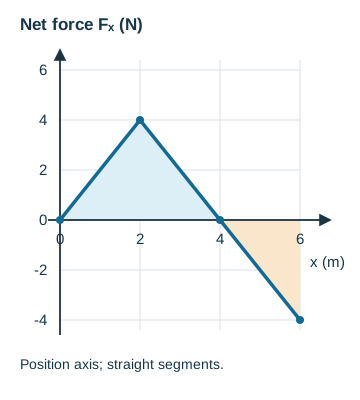
A glider starts at with on a straight, level air track. Treat it as a particle, neglect rotation and resistance, and use the track's inertial frame. A controlled actuator supplies the net horizontal force shown below. Weight and support balance vertically and do zero work. The force rule depends only on position and is unchanged if the glider reverses.
Find the speed at , and . Where is the greatest speed on this trip? Verify that the glider can reach all three positions.
Read the exact graph values
- At 0 m: 0 N.
- At 2.0 m: +4.0 N.
- At 4.0 m: 0 N.
- At 6.0 m: −4.0 N.
The force changes linearly between consecutive points.
Show a hint
Find three signed triangular areas, one for each 2.0 m interval. Add each to the kinetic energy carried from the previous interval. Zero force at one position does not imply zero speed.
Show the worked explanation
System and intervals: use the glider, from its initial position to each requested position. The first equation is , not conservation of the glider's kinetic energy. Initially,
For rightward travel, the first two triangles are positive and the last is negative:
Carry the energy forward, rather than treating each interval as a new start from rest:
Check the entire trip: kinetic energy rises continuously from 2.0 to 10.0 J over 0–4.0 m, then falls to 6.0 J over 4.0–6.0 m. It stays positive. The glider never stops, so all three velocities are rightward and the requested positions are reachable.
The greatest speed is 4.47 m/s at 4.0 m. Force changes there from positive to negative, so the glider changes from speeding up to slowing down. The zero force at that instant means zero instantaneous acceleration, not rest. The greatest force, at 2.0 m, is not where speed is greatest.
Check units and method: the total work to 6.0 m is +4.0 J, so the final kinetic energy exceeds its initial value. The graph area is not a velocity change or an impulse. Because changes with position, one constant-acceleration equation cannot describe the whole trip.
Four questions with less guidance
For every question, name the plotted force, travel direction and work–energy equation. Open a hint when needed; use the solution to check the reasoning as well as the number.
Question 14: change the mass and initial speed
Use the net-force graph in worked example 8, now with a 2.0 kg glider starting at with . Find its speed at 4.0 m. Can it reach that position? Does zero force there mean zero kinetic energy?
Show a hint
The work to 4.0 m remains +8.0 J. The initial kinetic energy changes, and the mass also appears when converting final energy to speed.
Show the answer and reasoning
For the glider from 0 to 4.0 m, . Initially . Thus , and , rightward. Force is nonnegative throughout this outward interval, so kinetic energy never falls below its positive initial value. The glider reaches 4.0 m. Zero force there means zero instantaneous acceleration; the kinetic energy is 9.0 J.
Question 15: the graph shows only the applied force
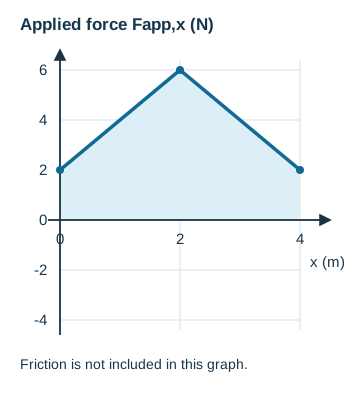
A 1.0 kg block already sliding right enters at 2.0 m/s on a fixed, level surface. Its horizontal applied force is piecewise linear, joining (0 m, +2.0 N), (2.0 m, +6.0 N) and (4.0 m, +2.0 N) with straight segments. Kinetic friction has constant magnitude 1.0 N and opposes sliding. Weight and normal do zero work; all other forces and rotation are neglected. A student adds the applied-force area to the initial kinetic energy and reports 18 J at 4.0 m. Correct the energy account and find the speed.
Show a hint
Each 2.0 m trapezoid has average applied force 4.0 N. Then calculate frictional work over the full 4.0 m rightward displacement.
Show the answer and reasoning
System: block; interval: 0 to 4.0 m. Use , where and denote applied-force and frictional work.
The student's 18 J omitted friction. Throughout the proposed rightward motion the net force is at least , so the block speeds up and continues sliding right. The assumed friction direction is consistent, and the final velocity is rightward.
Question 16: traverse a negative-force segment leftward
In a separate trial, use the fixed net-force rule from worked example 8. A 1.0 kg glider starts at 6.0 m with signed velocity −1.0 m/s. Find its velocity when it first reaches 4.0 m. Is the work negative because the graph is below the position axis?
Show a hint
Now displacement is leftward. Reverse the sign of the work for the original 4.0-to-6.0 m traversal, then recover the velocity's direction from the motion.
Show the answer and reasoning
The graph's force is negative over the interior of this segment, and so is each displacement. Work is positive: . For the glider over that leftward interval, . Thus speed is 3.0 m/s and signed velocity is . Kinetic energy increases continuously during this traversal, so it reaches 4.0 m without reversing. “Below the axis means negative work” requires increasing position; the travel direction matters.
Question 17: a positive endpoint answer can still be impossible
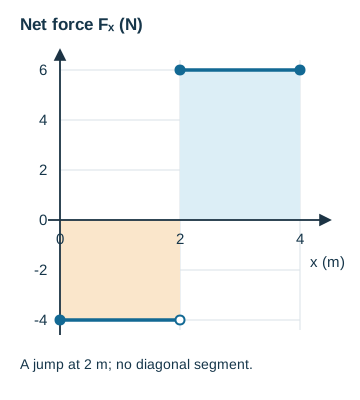
A 1.0 kg glider starts at with . A new fixed net-force rule is −4.0 N for , then +6.0 N for . The finite jump in force is idealized; there is no collision or impulsive kick. Use the same particle and air-track assumptions as in the worked example. A student calculates and concludes that the glider reaches 4.0 m. Find the first position where this proposed trip fails and explain the subsequent motion near that position.
Show a hint
Within the first interval, every metre of rightward travel removes 4.0 J. How far can the initial 2.0 J carry the glider? What force acts when it stops?
Show the answer and reasoning
System: glider; first inspect the outward trip within the negative-force region. Its kinetic energy would be
It first reaches zero at
Here denotes the turning position. The force there is still −4.0 N, so . The glider is momentarily at rest, then moves left. It cannot continue right into positions just beyond 0.50 m, which would require negative kinetic energy. On the return near the turning point, both force and displacement are leftward, so work is positive and the glider speeds up leftward.
The later positive-force region is not reached on the proposed rightward journey. Motion after leaving the supplied domain at is unspecified. The student's endpoint arithmetic is formally correct for an assumed traversal of the whole graph, but that traversal is impossible from the stated initial condition. The computed 6.0 J is not an attained endpoint energy. For a fixed one-dimensional force rule, allowed positions with can be separated by an inaccessible interval; do not jump across it.
Final self-check: identify net versus applied force; read metres versus seconds; retain signed work and initial kinetic energy; check other work; inspect the whole proposed path; and recover velocity direction separately from speed.
7. Check the method before the arithmetic
- Have I named the same system on both sides? If you use two gliders’ initial momentum, use both gliders’ final momentum.
- Have I justified conservation? Write “negligible external impulse” for momentum; identify the absent losses and zero-work external interactions for mechanical energy.
- Have I kept velocity signs? Momentum can cancel between opposite directions; kinetic energies add as nonnegative quantities.
- Have I checked the horizontal axis? Force times distance gives joules. Force times time gives newton-seconds.
- Have I split the event where the interactions change? A velocity found after impact becomes an initial condition for what happens next.
- Have I checked a limiting case? A stiffer spring should compress less at the same incoming energy. No initial relative motion means no kinetic-energy decrease from an ideal sticking event with no external work.
If choosing the system or identifying external forces is the obstacle, revisit Free-body diagrams and friction. Bring a problem or concept you would like to understand to a tutoring session; your tutor can start from the basics and work through it with you. Tutoring sessions are currently offered in English. A useful next step is to explain exactly why each conservation statement applies before repeating the calculation with different numbers.
8. References and course connections
Concordia PHYS 204 covers conservation of momentum and energy. McGill PHYS 101 covers introductory mechanics, including energy, without calculus; PHYS 131 covers Newtonian mechanics.
- Concordia official Physics course descriptions, PHYS 204
- McGill Department of Physics, 100-level course descriptions
- OpenStax University Physics Volume 1, section 7.3, work–energy theorem
- OpenStax, section 8.3, conservation of energy
- OpenStax, section 9.2, impulse and collisions
- OpenStax, section 9.3, conservation of linear momentum
- OpenStax, section 9.4, collision types
The explanations, problem settings, numerical values and figures in this lesson are original. The resource is independent of the universities named.
Useful for
Work on the step you’re missing.
Tell us the subject and your preferred time. Nablio confirms the details by text or email.
Request a lesson