Online CEGEP Electricity & Magnetism Tutoring
CEGEP physics tutoring in charge, fields, potential, circuits and induction, with practice in vector calculations and circuit equations.
Start with a concept you would like explained or a question you do not yet know how to begin. A course outline or an attempted solution can help if you have one. We confirm the level, topics and availability before booking. Tutoring sessions are currently offered in English. In-person options in Montréal
Choose the quantity or constraint first
These lessons cover selected electric-field, capacitor and circuit questions. Use your current course outline to choose the topics you need.
- Field, force, potential or energy? Separate what the source creates from what happens to a charge placed there.
- A capacitor changes: what stays fixed? Check the connection before choosing a formula.
- A circuit current has an unexpected sign? Choose directions and account for each potential rise or drop.
Courses by institution
Choose an institution to browse courses in this subject. You can also text or email us directly.
Browse courses in this subjectTopics covered
Common difficulties
- Adding potentials as scalars but fields as vectors
- Recognizing series and parallel connections after a circuit is redrawn
- Determining an induced-current direction from changing flux
How tutoring can help
Tell us which idea you’d like to understand, or bring a circuit, a field diagram or a question. We can start with the basic concepts. A tutor can help you identify what stays fixed, choose the relationship, check signs and units, then work through a similar problem with you. Share your topic and preferred times; we confirm the scope and availability before booking.
Ask about electricity and magnetism tutoringCurrent and former course codes
This table matches current and former codes by Science program subject. Your institution must confirm any transfer-credit equivalence. The prefix matters: 201-SN1 is probability and statistics, while 203-SN1 is mechanics. Course codes and topics can vary by institution. Check your current course outline.
| Subject | Current code | Former code |
|---|---|---|
| Electricity and magnetism | 203-SN2-RE | 203-NYB-05 |
Check current names and content in the official Dawson mathematics list and Dawson physics list.
Worked example
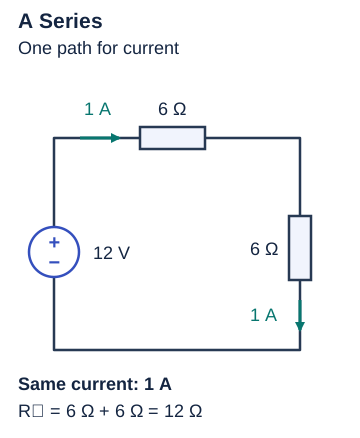
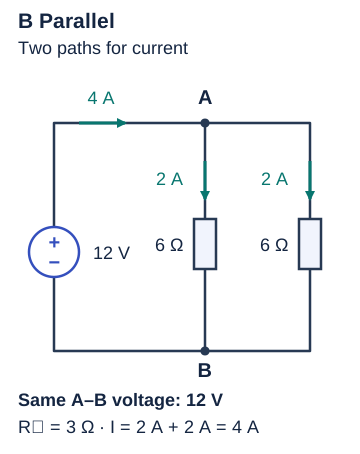
Use two resistors and an applied potential difference . Let and denote the equivalent series and parallel resistances, and the total current. In series, resistances add: . Ohm’s law gives , the current through each resistor. In parallel, add reciprocal resistances: , so . Each branch has the full , giving a branch current of . Adding the two branch currents gives , also found from . Connections, not the drawing’s shape, determine the model.
Check your understanding
What stays equal in parallel: current or potential difference? Potential difference. Equal branch currents here result from the equal resistances.
Same resistors, different connections
What to practise
Use mixed problems so you have to choose the physical law, then explain the direction and sign before calculating. Practise junction and loop equations together, and check that the currents obey charge conservation. Use your outline to choose the circuit and induction topics to review.
Need help in another CEGEP subject? Explore CEGEP math and physics tutoring.