The time estimate covers the core guide. Allow extra time for the optional practice.
Return to Dawson 201-015-RE course guide
Stuck on a step? Text us Email us Request a lesson
Calculus introduces change and accumulation, but many difficult-looking calculus problems depend on familiar algebra. A small error with fractions, signs or domains can hide an otherwise good solution.
Try each self-check before opening its answer. If you make a mistake, identify the exact step that caused it, then solve a similar question without looking back. The goal is reliable reasoning, not speed.
Negative numbers: a short repair before algebra
If negative signs interrupt your algebra, pause here. This optional section practises the numbers first, then returns to an expression with a letter. You can go straight to basic algebra if these steps are already comfortable.
In , the minus sign belongs to a negative number. In , it tells you to subtract. Parentheses help separate the two uses: means subtract the number . Zero is neither positive nor negative.
1 Add and subtract on a number line
Start at the first number. Adding a positive number moves right; adding a negative number moves left. Move by the added number’s distance from zero. To subtract a number, add its opposite instead: the opposite of is .
Worked example 1: the same start, different directions
Subtracting is adding . Start at and move 4 units left.
Subtracting undoes adding , so move 4 units right instead.
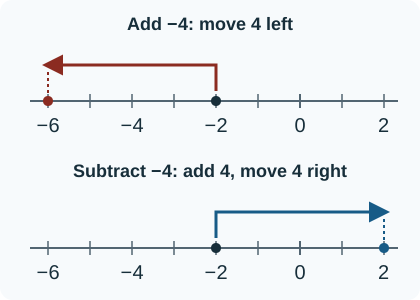
Watch the operation: two negative numbers do not always give a positive answer. For addition, ; do not use the multiplication rule here.
2 Multiply and divide: choose the sign separately
For two nonzero numbers, first multiply or divide their distances from zero. Then choose the sign: matching signs give a positive result; different signs give a negative result.
Why can two negative factors give a positive product? Multiplying by takes the opposite: the opposite of is . For example, is the opposite of , so it equals .
Worked example 2: use multiplication to check division
The product is positive because the factors have matching signs. The quotient is negative because its two numbers have different signs. Check division by multiplying: .
Zero times any number is zero. Zero divided by a nonzero number is zero. Division by zero is undefined.
3 Keep the substituted number inside parentheses
Calculate inside parentheses first, then powers, then multiplication and division from left to right, then addition and subtraction from left to right.
Worked example 3: substitute a negative value
Evaluate when :
The whole input is squared: .
The base matters: , but . Without parentheses, the square applies before the leading minus. Similarly, means ; squares the entire base .
Try four short questions
Choose a question, try it on paper, then open the hint or solution.
Calculate .
Show a hint
Start at . Adding moves 8 units right.
Show the solution
. Five units take you to zero; three more take you to .
Calculate .
Show a hint
Replace subtracting with adding its opposite.
Show the solution
. Start at and move 3 units right.
Calculate .
Show a hint
Multiplication and division have equal priority. Work from left to right.
Show the solution
, then . The answer is . Do not multiply by first: the expression has no parentheses grouping those factors.
When , evaluate and .
Show a hint
Rewrite the first as . In the second, the entire expression is the base.
Show the solution
. For the second, , so . The parentheses change what is squared.
Return to basic algebra and try a negative input again. If fractions are your next obstacle, use fractions, one step at a time.
Starting with basic algebra
If letters in an equation still feel unfamiliar, start here. You will read an expression, combine matching terms and solve an equation one step at a time. You need addition, subtraction, multiplication and division. A variable is a letter that represents a number. In these examples, the variables represent real numbers.
Use a pencil and try each question before opening its answer. Checking an answer is part of the solution.
Stuck on a negative sign? Review operations with negative numbers, then return to this step.
1 Read the expression before calculating
The expression means “multiply by 3, then add 2.” The writing means . An expression can be evaluated once a value of is given. An equation, such as , states that two expressions have the same value.
Worked example: evaluate when .
The parentheses show where the value of went. For a negative input, keep them: when , .
Try it: evaluate when .
Show the answer
. Multiply before subtracting.
Retry: evaluate when .
Show the retry answer
.
2 Combine terms that match
Like terms have the same variable part. Four lots of plus two lots of make six lots of . A constant is a number without a variable.
Worked example:
You can combine and , and you can combine 3 and . You cannot combine into : the two terms have different variable parts.
Try it: simplify .
Show the answer
. The variable terms give , and the constants give .
Retry: simplify .
Show the retry answer
.
3 Keep the two sides equal
An equation is like a balance. Adding the same number to both sides, subtracting the same number from both sides, or multiplying or dividing both sides by the same nonzero number keeps that balance.
Start with . Subtract 5 from both sides to get . Check: .
Worked example: solve .
We added 4 to undo subtracting 4, then divided both sides by 3 to undo multiplication by 3. Check in the original equation: .
Try it: solve and check your answer.
Show the answer
subtract 7 to get , then divide by 2: . Check: .
Retry: solve .
Show the retry answer
divide both sides by : . Check: .
4 Undo parentheses and division carefully
In , the whole expression is multiplied by 2. Dividing both sides by 2 first gives , so . Check: .
Worked example: solve .
Multiplying both sides by 3 undoes division by 3. Adding 1 then gives 13. Check: . The fraction bar divides the whole numerator .
Try it: solve .
Show the answer
multiply both sides by 4: . Subtract 2: . Check: .
Retry: solve .
Show the retry answer
subtract from both sides to get . Subtract 5: . Both sides of the original equation then equal 26.
One short application
A rectangle is 7 cm long and has perimeter 22 cm. Its width is cm. The perimeter is the total distance around the rectangle, so
Subtract 14 to get , then divide by 2: . The width is 4 cm. Check by adding all four sides: cm.
Build an equation from a word problem
Sometimes the hard part comes before solving: the equation is not given. Start by naming one unknown quantity, express the other quantities using it, then use a stated total or equality to connect them. The equation is a model of the situation. Solving it finds a candidate answer; checking the original story decides whether that answer fits.
- Name the unknown and its unit. State what the letter measures or counts. Decide whether it can be any positive real number, or must be a whole-number count.
- Translate the relationship. “4 cm longer than the width” means add 4 to the width measured in centimetres. “Twice the width, plus 1 cm” means multiply the width by 2, then add 1.
- Write what is equal. For a perimeter, add all four sides. For a total price, add the price of each group. Both sides must describe the same kind of quantity in the same units.
- Solve and check the story. Use balanced operations, recover every requested quantity, and check both the relationship and the total.
Worked example: neither side length is given
A rectangle has perimeter 32 cm. Its length is 4 cm greater than its width. Find both dimensions.
Let be the numerical value of the width in centimetres. Then the length, in centimetres, is . The allowed values have ; lengths need not be whole numbers. The number 4 represents a difference of 4 cm, not four copies of the width.
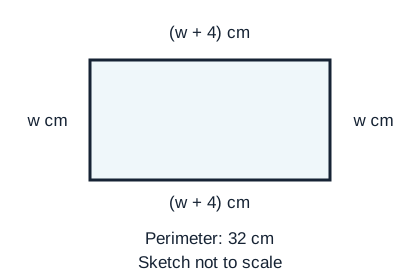
There are two lengths and two widths. Their numerical values in centimetres add to 32:
This is why the parentheses matter: each of the two lengths includes the extra 4 cm. Expand and solve:
The width is 6 cm and the length is cm. Both are positive. The difference is cm, and the perimeter is cm. Checking only the perimeter would not check the “4 cm greater” condition.
Common setup error: counts the extra 4 cm only once. Read the two lengths separately as before combining terms. The expression instead describes area in square centimetres; it cannot equal a perimeter in centimetres.
Guided retry: translate the new relationship
A second rectangle has perimeter 44 cm. Its length is 1 cm greater than twice its width. Let again be the numerical value of its width in centimetres, with . Write the length in terms of , build the perimeter equation, and find both dimensions.
Show a setup hint
“Twice the width” gives ; adding 1 cm gives . It does not give , which adds 1 before doubling. Now use two widths and two lengths.
Show the solution and checks
The width is 7 cm and the length is cm. The relationship holds: . The perimeter is cm, and both dimensions are positive.
Independent problem: a total in a different setting
A school event sells exactly 22 tickets. Each regular ticket costs $8 CAD and each reduced-price ticket costs $5 CAD. The ticket revenue is exactly $140 CAD. There are no other ticket categories, fees or discounts. How many of each ticket were sold? Define one unknown, express the other count using it, write an equation, and check both totals.
Show the solution and checks
Let be the number of regular tickets. The reduced-price count is : the two counts must add to 22. The domain is the integers from 0 to 22 inclusive, because tickets are counted individually and neither count can be negative.
Price per ticket multiplied by the number of tickets gives the revenue from that group. Expressing the revenue in CAD gives
There are 10 regular tickets and reduced-price tickets. Check the count: . Check the revenue: CAD. Both counts are nonnegative integers. Here would price another group of tickets, rather than the remaining tickets.
A non-integer count would not be fixed by rounding: it would mean that the exact ticket totals and prices do not fit the model. Recheck the setup and the stated data.
Before moving on: explain what each term counts or measures. A correct calculation cannot repair an equation that describes the wrong situation.
For a word problem you’re stuck on, algebra and precalculus tutoring can begin with choosing the unknown and building the equation together from an example like these. We can start with the basics and build your confidence step by step. Share your level and topic so we can confirm support and availability before booking. Sessions are currently in English.
Choose what to practise next
- If fractions interrupt your work, continue to Work confidently with fractions in this same guide.
- If signs change when you open parentheses, continue to Expand without losing signs.
- If equations are still uncertain, continue to Solve linear equations with balanced operations.
- If you can explain each step above, try the Points, slope and straight-line graphs lesson.
- For lengths and angles, continue to Right triangles: lengths and angles.
The later skills in this guide build towards precalculus. Work through them when they appear in your current course; you do not need logarithms or composition to practise the first equations above.
Linear inequalities: describe all the allowed values
An equation asks where two expressions are equal. An inequality compares them. Here is a real number: means less than 3, while means less than or equal to 3. Similarly, means greater than 3 and includes 3. A solution set contains every value that makes the original inequality true.
Use the equation-balancing skills above. Adding or subtracting the same number on both sides keeps the inequality direction. Multiplying or dividing both sides by a positive number also keeps it. Multiplying or dividing both sides by a negative number reverses it.
Worked example 1: an endpoint that is excluded
Solve . Subtract 2 from both sides:
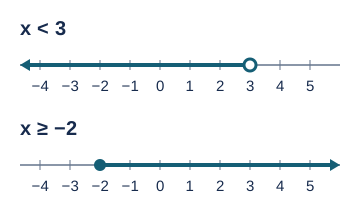
The answer is all real numbers less than 3, not just one number. An open circle at 3 excludes the endpoint; the ray points left toward smaller values. Check an inside value: gives , which is true. An outside value, , gives , which is false. At the endpoint, gives , also false. These checks illustrate the set; the reversible algebra establishes the full solution.
Why a negative multiplier reverses the comparison
Start with . Multiplying both numbers by gives : reflection across zero reverses their left-to-right order on the number line. More generally, if , then . For a negative number , the difference is negative, so . Here are real numbers and . Division by a negative number is multiplication by its reciprocal, which is negative, so the same reversal applies. Equality remains included when the symbol is or .
Worked example 2: reverse the sign and include the endpoint
Solve . Subtract 1, then divide both sides by :
The answer is all real numbers greater than or equal to . A filled circle includes , and the ray points right. Check inside the set: is true. Check outside it: is false. At , is true, so the endpoint belongs.
Practise one decision at a time
For questions 1–3, is real. Give the solution set, say whether the endpoint is included, and check one value inside and one outside. In question 4, use the stated counting domain.
1. Solve .
Show answer 1
Subtract 4: . Use a filled circle at 3 and a ray left. Inside: gives . Outside: gives , false. At 3, equality holds.
2. Solve .
Show answer 2
Multiply by positive 3, keeping the comparison: . Use an open circle at 6 and a ray right. Inside: gives . Outside: gives , false. At 6, is false.
3. Solve .
Show answer 3
Subtract 5 to get . Divide by and reverse the comparison: . Use an open circle at and a ray left. Inside: gives . Outside: gives , false. The endpoint gives , false.
4. A workshop charges a fixed fee of 5 CAD plus 3 CAD per kit. Your total budget is 20 CAD. Let be the number of kits, a nonnegative integer. Write the budget inequality and find every allowed value of .
Show answer 4
Expressing total cost in CAD, the budget condition is . Subtract 5 and divide by positive 3: . Combine this with the counting domain: . These are separate whole-number choices, not a continuous ray. Five kits cost CAD and fit; six cost CAD and exceed the budget. A negative number of kits is excluded by the context even if it satisfies the algebraic inequality.
Before moving on: explain why the comparison changes when dividing by a negative number, then connect the symbol to the endpoint and direction on the number line.
Optional extension: absolute value is a distance
Use this extension after the linear-inequality examples. Allow about 15 extra minutes. All variables below are real numbers unless a physical meaning adds a restriction.
The absolute value |u| is the distance from u to zero on a number line. A distance is never negative: |−3|=3, |3|=3 and |0|=0. The bars do not mean “remove every minus sign”: first evaluate the whole expression inside them. For example, at x=1, .
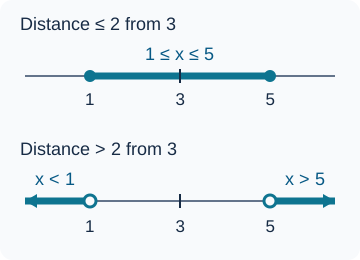
More generally, |x−a| is the distance between x and a. If that distance is at most a positive number r, then x must lie inside the interval from a−r to a+r, including both ends:
The two inequalities mean and: both must hold. By contrast, |x−a|>r means the distance is greater than r, so x<a−r or x>a+r. These are two outside regions, not the interval between them. Replace “at most” by “less than” to exclude inside endpoints; replace “greater than” by “at least” to include outside endpoints.
Worked example: the expression is twice the distance
Solve . Since and , the distance from x to 3 can be at most 2. We can also derive the endpoints without guessing:
Add 6 to all three parts, then divide every part by positive 2:
The solution interval is . Square brackets include the endpoints. Check them in the original statement: and . The inside value x=3 gives 0; the outside value x=6 gives 6 and fails. These checks support the algebra but do not replace the reasoning for every value.
Check the right-hand side before splitting into cases
A negative number cannot be a distance. Therefore |u|=−2 and |u| ≤ −2 have no solutions, while |u| ≥ −2 is true for every value for which u is defined. At zero, |u|=0 or |u| ≤ 0 requires u=0; |u|<0 is impossible; |u|>0 requires u ≠ 0; and |u| ≥ 0 is always true on the original domain. Keep any restrictions from the expression inside the bars.
Four steps of distance-and-inequality practice
1. Find the centre, then decide about endpoints
Solve . State the centre, both bounds and whether the endpoints belong.
Show a hint
Rewrite . Which point is at distance zero?
Show the explained solution
The centre is −2. Distance less than 3 gives , so . In interval notation this is ; round brackets exclude both endpoints. At either endpoint the distance is exactly 3, which is not less than 3.
2. Keep the two outside branches separate
Solve . Explain why “and” would give the wrong solution set.
Show a hint
Set . The condition is u ≤ −5 or u ≥ 5. Each branch needs its own inequality calculation.
Show the explained solution
The first branch is , hence and x ≥ 4. The second is , hence and x ≤ −1. Dividing by negative 2 reverses each inequality. The answer is x ≤ −1 or x ≥ 4, written . Infinity is not an endpoint value, so it never receives a closed bracket. At x=−1 and x=4, the absolute value is 5. At x=0, it is only 3. Requiring both x ≤ −1 and x ≥ 4 would wrongly give no solutions.
3. Diagnose an impossible distance
Without splitting into two algebraic branches, solve both and . Then solve .
Show a hint
What is the smallest possible value of ?
Show the explained solution
The expression inside the bars is defined for every real x, and its absolute value is nonnegative. Equality to −2 is impossible, so the first equation has no solution. Every nonnegative value is at least −2, so the inequality holds for every real number. A zero distance occurs only at x=4. Writing for the first equation would create false candidates: x=2 and x=6 both give an absolute value of 2, not −2.
4. Translate a tolerance into an interval
In this original model, a strip should be 18 cm long. It is accepted when its length differs from 18 cm by at most 0.4 cm, including the limit. Let L be its numerical length in centimetres, with L>0. Write an absolute-value condition and the accepted interval. Decide whether lengths 17.58 cm and 18.35 cm are accepted. Treat these stated lengths as exact for this exercise.
Show a hint
“Differs from” asks for a distance, whether the strip is too short or too long.
Show the explained solution
The condition is . It becomes , then . Every value in this interval is positive, so the physical restriction adds no further exclusion. For 17.58 cm, , so reject it. For 18.35 cm, , so accept it. Do not round 17.58 to 17.6 before checking: that would change the stated value and the decision. The endpoints 17.6 and 18.4 cm are accepted because the rule says “at most”.
Before moving on: say whether the allowed values are inside, outside, a single point, all of the original domain, or none. Then check the endpoints in the original condition.
Optional mixed review: choose the method
Choose a question that is useful for you. Hints and answers are there to guide you; this review helps you choose the next step to practise. You can also go straight to a lesson or ask about tutoring.
Question 1
Find the real number satisfying . Check the original equation.
Show a hint
Undo the addition before undoing multiplication by a fraction.
Show the explained answer
Subtract 2 from both sides: . Multiply both sides by : . Check: . Multiplying only one side would break the equality.
Review equations with fractionsQuestion 2
A craft session costs 4 CAD plus 2 CAD per item. You have 13 CAD. Let be the number of items, a nonnegative integer. Which values of fit your budget?
Show a hint
Write “total cost is at most the budget”, then use the counting domain.
Show the explained answer
Expressing costs in CAD gives , so . The allowed counts are . Four items cost 12 CAD; five cost 14 CAD. A fractional item is outside the stated domain, so rounding up would exceed the budget.
Review inequality solution setsQuestion 3
A straight line passes through and . Coordinates are dimensionless. Find an equation , where is slope and is the vertical intercept. Does lie on it?
Show a hint
Use the change in the second coordinate divided by the change in the first; then substitute one point.
Show the explained answer
. Using , , so and . The second given point checks: . At , , so belongs. Slope is a change ratio, not the ratio at one point.
Review points, slope and equationsQuestion 4
A right triangle has perpendicular sides of 5 cm and 12 cm. Let be the acute angle opposite the 5 cm side. Find the hypotenuse and in degrees. A similar triangle doubles every length: what is its area?
Show a hint
Use the two perpendicular sides for Pythagoras; choose a ratio relative to the labelled angle. Area scales with the square of the length factor.
Show the explained answer
The hypotenuse is cm. Since , . Use degree mode. Original area: cm². Doubling lengths multiplies area by , giving 120 cm²; directly, cm².
Review right-triangle methodsQuestion 5
For the dimensionless function , with real input , find the vertex and all roots. Explain why the vertex is a minimum.
Show a hint
A square is nonnegative. To find roots, set the output to zero and keep both square-root possibilities.
Show the explained answer
The square is smallest at , where ; the vertex is . Setting gives , so or : the roots are 5 and −1. Both give in the original expression. Since the square is always nonnegative, .
Review quadratic forms and rootsOptional transfer: ticket price and attendance
At a fictional school event, $8 CAD per ticket predicts 120 buyers. Each whole $0.50 increase predicts five fewer buyers. Each buyer purchases one ticket. These are model predictions, not guaranteed sales.
Let count the nonnegative whole-number increases: means adding $1, not charging $2 per ticket. Organizers require at least 95 predicted buyers. Revenue means ticket receipts before expenses. Try the questions before opening the hints or solution.
Build and compare the choices
- Write price (CAD/ticket) and predicted buyers in terms of . State the initial domain and explain why is not allowed.
- Write and solve the attendance inequality; list the allowed values. Explain the effect of dividing by a negative number.
- Form the revenue , measured in CAD, and expand it as a quadratic expression.
- Tabulate price, buyers and revenue for every allowed choice. Plot revenue against as separate points; label both axes and their units or counts.
- Which admissible choice gives the largest predicted revenue? State its ticket price, attendance and revenue. Explain why this revenue is not profit.
- Does a higher ticket price always produce more revenue in this model? Justify your answer using two allowed choices.
Hints: expressions, attendance and comparison
- Start each expression with its value at . Each increase adds to the price but subtracts from the number of buyers.
- A minimum attendance means . Multiplying or dividing both sides by a negative number reverses the inequality.
- Compare all allowed integers, not every real number between the endpoints. The largest ticket price need not give the largest product.
Solution: six choices, table and graph
The expressions are and . Initially, is a nonnegative integer. The value would mean two and a half increases, adding $1.25. That violates the whole-increment rule; rounding would change the choice.
Subtract 120, then divide by , reversing the inequality:
Together with the integer condition, this gives . For example, predicts only 90 buyers and is excluded.
Multiply price per ticket by the number of tickets, then combine the linear terms:
| Increases | Price (CAD/ticket) | Buyers | Revenue (CAD) |
|---|---|---|---|
| 0 | 8.00 | 120 | 960.00 |
| 1 | 8.50 | 115 | 977.50 |
| 2 | 9.00 | 110 | 990.00 |
| 3 | 9.50 | 105 | 997.50 |
| 4 | 10.00 | 100 | 1,000.00 |
| 5 | 10.50 | 95 | 997.50 |
The table checks every allowed choice, proving the maximum at : $10 CAD per ticket, 100 predicted buyers and $1,000 CAD revenue. Attendance satisfies . Both neighbours, and , give $997.50 CAD. Raising the price from $10 to $10.50 reduces revenue: fewer buyers outweigh the higher price. Profit would subtract expenses, which are unknown. This conclusion depends on the model and constraint.
Optional check: vertex form
The table is sufficient. This form also proves the bound: , so , with equality at the allowed value .
Retry: require at least 110 buyers
Require at least 110 predicted buyers with the same formulas. Did the formulas or allowed set change? Find the permitted choices, best price, attendance and revenue. Is the previous winner, , still admissible? Try before opening the answer.
Retry solution: the 110-buyer constraint
Now gives . Dividing by reverses the inequality: . The formulas for stay unchanged; only the allowed set shrinks to . The old choice predicts 100 buyers and is excluded. Comparing $960, $977.50 and $990 CAD gives : $9 CAD per ticket, 110 predicted buyers and $990 CAD revenue.
Work through the next step with a tutor
Bring a problem you’re stuck on or a concept you’d like to understand better. A tutor can explain the method choice, work through an example with you and guide you through a similar question. We can also start with the basics and build confidence step by step.
Share your level and topic so we can confirm support and availability before booking.
Ask about algebra tutoring1. Work confidently with fractions
Fractions represent division. When adding them, rewrite each fraction using a common denominator. When multiplying, multiply numerators and denominators. Keep intermediate fractions exact rather than rounding too early. The numerator is the number above the fraction bar; the denominator is the nonzero number below it. To divide by a nonzero fraction, multiply by its reciprocal, obtained by swapping its numerator and denominator.
Fractions, one step at a time
A fraction can describe equal parts of one whole. In , the denominator 5 says the whole is divided into five equal parts; the numerator 3 counts three of those parts. The fraction also represents . A denominator cannot be zero.
Keep the value when you change the pieces
Multiplying or dividing both the numerator and denominator by the same nonzero number keeps a fraction’s value. For example,
Each quarter has been split into two eighths: the amount has not changed. To simplify , divide the numerator and denominator by 6:
Try it: simplify , then write the result with denominator 12.
Show answer and reasoning
divide both numbers by 5 to get ; multiply both by 3 to get .
Use equal-sized pieces before adding
Worked example: add . Rewrite the half as two quarters:
The denominator stays 4 because we are still counting quarters. Use the same whole when interpreting fractions as parts of a whole.
Try it: calculate .
Show answer and reasoning
. Adding the denominators would change the size of the pieces.
Find a fraction of an amount
A ribbon is 20 cm long. You use of its length. Divide 20 into five equal parts, then take three:
You use 12 cm of ribbon. The same calculation is . The fraction is a share of the length; the answer keeps the length unit.
Try it: find of 28 m.
Show answer and reasoning
, then m.
One more step: of is a product of two fractions:
The factor 3 appears in the numerator and denominator of that product, so it can be cancelled. This does not permit cancelling terms across a plus sign.
Try it: calculate .
Show answer and reasoning
. Dividing both numerator and denominator by 15 checks the simplification.
Begin dividing fractions
Ready to continue? Try the existing subtraction and division examples below. For division, first ask “How many groups of this size fit?” For example, : three quarter-sized portions fit into three quarters. The next example shows how the reciprocal rule handles a different divisor.
Worked example
For division, The reciprocal belongs to the divisor, not to both fractions.
Common mistake. Adding denominators: is not . You need equal-sized pieces before adding their counts.
Try it yourself
Calculate .
Show answer and reasoning
Use twelfths:
Why fraction division works
The example above gives . What does that answer mean, and why do we turn the second fraction upside down? Start with the same whole for both fractions.
Count groups with equal pieces
For , express both amounts in twentieths:
You have 15 twentieths. One group uses 8 twentieths. That makes one complete group, with 7 twentieths left. Those 7 pieces make of another group because a whole group needs 8 pieces.
The quotient is 1 and groups. The describes a fraction of a group; the leftover amount is of the original whole. Keeping those two meanings separate helps with word problems.
See why the reciprocal works
The reciprocal of is . Their product is 1:
The answer to is the number that gives when multiplied by . Multiplying by produces that number, because multiplying the result by gives the original amount back:
Dividing by a nonzero fraction is therefore equivalent to multiplying by its reciprocal. Keep the first fraction and invert the divisor. Check the existing answer:
Zero has no reciprocal: zero multiplied by any number is zero, never 1. Division by zero is undefined. The positive fractions here let us picture the quotient as a number of groups.
Ratios, proportions and percentage change
Use this lesson when a word problem asks you to compare quantities, scale an amount or explain a percentage change. Start from equivalent fractions, then work toward prices and everyday comparisons. You need multiplication, division and decimal notation. Choose the examples that help you; open a worked solution whenever useful.
1. Say what you are comparing
A ratio compares two quantities in a stated order. If a paint mixture contains 2 cups of blue paint and 3 cups of white paint, blue:white is . There are 5 cups altogether, so the blue share is , not . A part-to-part ratio and a part-to-whole fraction answer different questions. Here both colours use the same volume unit; convert units before comparing.
A rate compares quantities with different units. If 6 m of cord costs $15, the unit rate is $15 ÷ 6 m = $2.50 per metre. “Per metre” tells you what one unit means. A unit rate compares an amount with one unit of the other quantity.
2. Scale only when the relationship permits it
A proportion states that two ratios are equal. Suppose cord costs the same amount per metre, with no fixed charge or quantity discount. Then 6 m for $15 and 10 m for c dollars give , keeping dollars over metres on both sides. Return to one metre first: ; then . The cost is $25. Alternatively, multiply both quantities by . Check: dollars per metre.
Let x be the numerical length in metres and y the numerical cost in dollars. The rule has a constant for x > 0 and passes through . This is direct proportion. If there is an extra $4 cutting charge per order, instead. Doubling length does not double the full bill. A straight line alone does not prove direct proportion. Check the context before setting equal ratios.
3. Choose the reference whole for a percentage
Percent means “per hundred”: . To find 18% of $50, multiply 0.18 × $50 = $9. The percentage has no currency unit; the answer keeps the unit of the amount.
For an original positive amount O and a new amount N measured in the same units, signed percentage change is . Divide by the original amount because it is the comparison base. From $50 to $59, the change is $9 and , an increase. From $59 back to $50, the decrease is . Reversing the journey changes the base. Percentage change from an original value of zero is undefined by this formula.
Here, r is the percentage number: for 15%, r = 15. An increase of r% multiplies the original amount by . A decrease of r% multiplies it by . Use each new amount as the base for the next change. Two successive percentage changes do not generally cancel.
Three gradual practice questions
Choose a question and open a hint or solution whenever useful.
Question 1
A mixture uses 3 cups of blue paint for every 5 cups of white paint. Find the blue share as a fraction and percentage. How much white paint is needed with 9 cups of blue paint to keep the same mixture?
Show a hint 1
First count all the parts. To scale the mixture, apply the same factor to both colours.
Show the worked solution 1
The whole contains parts. Blue is of the mixture. Blue increases by a factor of , so white must be cups. Check: . The ratio compares blue with white, not with all the paint.
Question 2
Printing costs $0.40 per page plus a fixed $3 setup fee per order. An order of 5 pages costs $5. Does an order of 10 pages cost $10? Find its actual cost and explain.
Show a hint 2
Separate the cost of the pages from the one-time setup fee. Compare the total cost per page.
Show the worked solution 2
No. The rule is , where n is the page count and C is the numerical dollar cost. For 10 pages, , so the bill is $7. The page count doubles but the single setup fee does not. The unit bill is $1 per page at 5 pages and $0.70 per page at 10 pages, so the total cost is not directly proportional to page count.
Question 3
A backpack's listed price is $80. A shop reduces it by 15%, then raises the reduced price by 15%. Ignore taxes and fees. Find the final price and the overall percentage change from $80.
Show a hint 3
Find 85% of the original price, then 115% of that result. Compare the final amount with $80.
Show the worked solution 3
The reduction is = $12, leaving $68. The later increase is = $10.20, making $78.20. Relative to $80, the change is , a 2.25% decrease. Check with factors: , so . Each 15% used a different base.
Choose your next step
- Review equations
- Connect the rules to straight-line graphs
- Apply a scale factor to similar triangles
- Return to the eight-stage foundations path
Is a concept still unclear? A tutor can help you label the quantities, choose a reference whole, work through an example and try a related question. You can start with a concept or a problem; no materials or attempted solution are required. Share your level and topic so support and availability can be confirmed before booking.
2. Expand without losing signs
The distributive property applies to every term inside parentheses. A negative sign outside parentheses means multiplication by , so it changes every sign inside.
Worked example
Writing the middle line exposes a missed negative sign.
Common mistake. Distributing only to the first term, or turning into .
Try it yourself
Simplify .
Show answer and reasoning
3. Recognize useful factorizations
Factoring rewrites a sum as a product. Check for a common factor first, then patterns such as a difference of squares or a quadratic trinomial. Expand your answer to verify it.
Worked example
and multiply to 6 and add to . Also,
Common mistake. The product equals , not .
Try it yourself
Factor .
Show answer and reasoning
Take out the common factor : .
4. Solve linear equations with balanced operations
Adding or subtracting the same expression, defined for all allowed values, preserves the solution set. So does multiplying or dividing both sides by the same nonzero constant. Other operations may lose solutions or introduce extra ones, so check their restrictions and verify answers in the original equation. For a linear equation, clear parentheses, collect terms, then divide by the nonzero coefficient of the unknown.
Worked example
becomes . Subtract from both sides to obtain , then add 4 to both sides: . Substituting into the original equation gives .
Common mistake. Moving a term across the equals sign without understanding the addition or subtraction being performed.
Try it yourself
Solve .
Show answer and reasoning
. Subtract and then 6 to get .
Solve an equation with fractions
Here is an unknown real number. The idea is to keep both sides equal while removing the fractions. Multiply every term on both sides by a common multiple of the denominators. Choosing the least common multiple keeps the numbers small. Because that multiplier is nonzero, you can undo the step by dividing by it.
If you would like to review equivalent fractions and common denominators first, try fractions, one step at a time.
In these examples, the denominators are fixed, nonzero numbers. They exclude no values of .
Worked example
Solve . The least common multiple of 3 and 2 is 6. Multiply both terms on the left and the term on the right by 6:
Since and , this becomes
The whole numerator is multiplied by 2. Expand, combine like terms, then use balanced operations:
Check in the original equation: . So works. Multiplying by 6 changes every term, including the right-hand side; it does not change the solution.
Guided retry
Solve . First choose a common multiple of 4 and 6. Keep parentheses around when you multiply its fraction.
Show a hint
The least common multiple is 12. The equation becomes . Expand the parentheses, then collect the terms in .
Show the solution and check
Expand: . Combine like terms to get , then subtract 6 from both sides: . In the original equation, . The answer satisfies the equation.
Independent challenge
Solve . Show how you clear the fractions and check your answer in the original equation. A correct answer can be a fraction.
Show the solution and check
Multiply every term by 12:
The minus sign applies to the whole second product: . Expand and collect:
Check each fraction separately:
Their difference is , as required. All steps were reversible because we multiplied or divided by nonzero constants, so this is the unique solution.
Before moving on, explain why the right-hand side must also be multiplied, and why the numerator needs parentheses. These questions use constant denominators. If a denominator contains the unknown, first determine which values make that denominator zero before using the method.
Rearrange a formula before inserting the numbers
A formula relates quantities. To make one variable the subject, leave that variable alone on one side of the equals sign. Undo the operations around it, applying the same operation to both sides. Other letters can stay in the answer. Check that any quantity you divide by is nonzero.
Find a rectangle’s width from its perimeter
For a rectangle, let be the perimeter, the length and the width, all in centimetres. Its perimeter formula is
To make the subject, first subtract from both sides, then divide both sides by 2:
Now use cm and cm:
Check in the original formula: cm. A rectangle needs positive side lengths; these values meet that condition.
Common error: divides only by 2. Keep the whole numerator together. The correct result can also be written .
Try it: use the rearranged formula when cm and cm.
Show answer and reasoning
cm. Check: cm.
Find a triangle’s perpendicular height
Let be a triangle’s area in cm², its base length in cm and the perpendicular height to that base in cm. Here . Starting from , multiply both sides by 2, then divide by :
For cm² and cm, cm. The units also work: cm² divided by cm gives cm. Check: cm².
Common error: dividing by 2 again gives . In the original formula, multiplication by 2 is what undoes division by 2.
Try it: rearrange to make the subject. Here is a rectangular box’s volume in cm³, and are its positive dimensions in cm. Then use cm³, cm and cm.
Show answer and reasoning
divide both sides by , which is positive: cm. Check: cm³. The denominator contains the whole product .
Before moving on, explain the inverse operation in each step, then check your numerical answer in the original formula.
Continue: repeated variables, parameters, restrictions and units, with six explained questions
5. Keep every valid quadratic solution
A quadratic may have two distinct real solutions, one repeated solution, or no real solutions. Factoring is useful when available; the quadratic formula works more generally.
Worked example
becomes . A zero product has at least one zero factor, giving or .
Common mistake. Dividing an equation by can lose the solution . Check that case before dividing.
Try it yourself
Solve over the real numbers.
Show answer and reasoning
or . Both square to 25; the equation is different from asking for the principal square root of 25.
6. Use exponent and radical rules accurately
For a nonzero base, negative exponents mean reciprocals. With integer exponents and a nonzero base, multiplying powers with the same base adds exponents, and raising a power to a power multiplies exponents. With fractional exponents, check the base and domain before applying these rules; a principal square root is nonnegative.
Worked example
with . Also, , but the equation has two real solutions.
Common mistake. For real , , not always . A square root returns a nonnegative value.
Try it yourself
Simplify .
Show answer and reasoning
. Square the coefficient and multiply the exponent by 2.
Optional extension: Solving radical equations
All variables in this extension represent real numbers. The symbol means the principal, nonnegative square root of . In real-number work, it is defined only when the radicand , the expression inside the radical, is nonnegative.
1. A square root and a square equation are different
- has the single solution . Substitution checks it: .
- has two solutions, and , because both numbers have square .
The symbol itself means , not . The two signs arise when solving the equation .
2. Keep three different requirements separate
In an equation , the expressions and depend on the real unknown .
- Radicand domain: is required for the square root to be real. Also respect any other restrictions in the expressions.
- Sign constraint: is necessary because a principal square root cannot equal a negative number.
- Equality: Meeting the domain and sign conditions does not itself solve the equation. The two sides must actually be equal.
Squaring both sides preserves every original solution, but may introduce extra candidates because opposite numbers have the same square. Solve the squared equation, then check candidates against the restrictions and the original equation. If both sides are known to be nonnegative, squaring is reversible.
3. Worked example: Find candidates, then check
Solve .
Domain: , so .
Sign: The right side must satisfy , so . Together, the necessary restriction is .
Square and solve: The squared equation gives the candidates and .
Check in the original equation:
- For , and : it works.
- For , , while : it fails. It also violates .
Thus is the only solution. Notice that satisfies the radicand domain, but fails the sign constraint and the original equality.
4. Sometimes signs settle the problem
Solve .
The domain is . On this domain the left side is nonnegative, while the right side is negative. There are no real solutions. No squaring is needed. If you squared anyway, the candidate would fail the original equation because .
5. Progressive practice
For every equation, state the restrictions, find any candidates needed, and check the original equation.
1. Solve .
Show hint 1
The square root is nonnegative; square both sides.
Show explained solution 1
Domain . Squaring gives , and . Solution: .
2. Solve . Explain why its answer differs from Question 1.
Show hint 2
Which two real numbers have square ?
Show explained solution 2
; both squares are . Question 1 instead asks which input has principal square root , so its solution is .
3. Solve .
Show hint 3
The domain is , but the right side imposes a stronger restriction. After squaring, factor out .
Show explained solution 3
Domain , sign constraint . Squaring gives , hence . The candidates are and . At , the original sides are and , so it fails. At , both sides are , so the only solution is .
4. Solve using signs first.
Show hint 4
Can a principal square root equal ?
Show explained solution 4
Domain . The left side is nonnegative and the right side is negative, so there are no real solutions.
6. Transfer: Solve for a function input
Let be the real-valued function defined by Here denotes an input to . Find all real values of such that
Show hint 5
Replace the input by the entire expression . Check that this input belongs to the domain of , then check the sign of .
Show explained solution 5
Substituting the input gives The input must satisfy , equivalently . This is exactly the radicand-domain condition . The equation also requires , so .
Now square: The candidates are and . The negative candidate is less than , so its right side is negative and it fails. For , both sides are nonnegative and Therefore , and the only solution is .
7. Preserve restrictions when cancelling factors
You may cancel common factors, not individual terms within a sum. Record excluded values from the original denominator before simplifying.
Worked example
for . The simpler formula does not make the original expression defined at 3.
Common mistake. Cancelling the terms in is invalid; the numerator is a sum, not a product with factor .
Try it yourself
Simplify , including its restriction.
Show answer and reasoning
, with . Factor the numerator, then cancel the common factor .
Optional extension: solve equations with an unknown in a denominator
The earlier equations with fractions used constant denominators. Now a denominator can contain the unknown. A rational expression is a quotient of polynomials, defined only where its denominator is nonzero. A rational equation is an equality involving such expressions. Here we focus on equations with the unknown in at least one denominator.
Work over the real numbers. In the algebra examples, is an unknown real number with no physical unit. You need fraction operations, expanding brackets, linear equations and, for the later questions, factoring quadratics. This optional section supports selected senior-secondary topics, including the algebraic part of Ontario MHF4U rational equations. Quebec requirements depend on the year and mathematics option. It is not a requirement for every high-school course.
1. Keep the original restrictions
For , the value is excluded because it would require division by zero. The allowed inputs are all real numbers except 2. Record restrictions before simplifying or multiplying. For , cancellation is valid only when . The simplified expression does not restore the missing input.
To solve an equation, multiply every term on both sides by the least common denominator, or simply by the product of the original denominators. These choices contain no extra variable factors that could introduce new zeros. They are nonzero throughout the original allowed domain, so the operation can be undone. After solving the resulting equation, keep only candidates in the original domain and check them in the original equation. A value excluded at the start never becomes a solution.
- List the values that make any original denominator zero.
- Choose the least common denominator or the product of the original denominators, and multiply every term by it.
- Solve the resulting equation, keeping all candidates.
- Reject excluded values; check the remaining candidates by substitution.
- For a word problem, also check units and the physical domain.
2. Worked example: the whole-number term changes too
Solve . First, . Multiply every term by :
The 1 becomes ; it does not stay 1. Thus , giving . This value is allowed. In the original equation, the left side is , equal to the right side. The solution is .
Why not just cross-multiply? Cross-multiplication is a shorthand for an equality of two single fractions with nonzero denominators. A sum such as is not a single fraction yet. Multiplying every term by the common denominator handles it directly.
3. Worked example: a candidate can be excluded
Solve . The restriction is . Multiplying by gives , whose only candidate is . But neither original fraction is defined there. Therefore the original equation has no solution.
We did not prove that division by zero is permitted. The transformed equation was equivalent to the original only for . Solving it without remembering that restriction produces a candidate that must be rejected. Do not write “the fractions both become infinity”: neither is defined at 2.
4. Worked example: two denominators and two valid solutions
Solve . The restrictions are and . A common denominator is . It includes the numerical denominator 4 and both variable factors.
Expand and collect on one side:
So or . Neither is excluded. Check separately:
- At : .
- At : .
Both solutions work. A negative answer is not automatically invalid: only the given domain decides. The factorization expands to , providing an additional algebra check.
5. Worked model: add times, then check the meaning
A walker covers 12 km at a constant speed, then another 12 km at a constant speed 2 km/h faster. The total walking time, excluding stops, is 5 hours. Find both speeds.
Let be the numerical value of the first speed in km/h. Then the second speed is km/h, and the physical domain is . Since time equals distance divided by speed, the two numerical times in hours are and . Therefore
The algebraic restrictions are ; the physical condition is stronger. Multiply every term by :
The candidates are and . The negative candidate is an algebraic solution but cannot be a speed in this model. Keep : the speeds are 4 km/h and 6 km/h. The times are h and h, adding to 5 h; the speed difference is 2 km/h. Adding speeds instead of the two times would describe a different quantity.
Eight steps of rational-equation practice
Try each question before opening its answer. Unless a context says otherwise, solve over the real numbers. Write restrictions before clearing denominators.
1. Find the excluded inputs first
Which values are excluded from ? Simplify it without losing the restrictions.
Answer and reasoning
Factor . Exclude and . Cancellation gives , still with both restrictions. The shorter formula alone would allow −3, but the original expression does not.
2. Clear one denominator
Solve .
Hint
Exclude −1, then multiply both sides by .
Answer and check
With , , so and . Check: .
3. Remember the non-fraction term
Solve .
Answer and check
Exclude 2. Multiplication by gives , hence and . Check: . Leaving the 2 unchanged would be an invalid transformation.
4. Reject the only candidate
Solve .
Answer and reasoning
Exclude 3. The cleared equation is , so its only candidate is 3, which is excluded. There is no solution. Checking the original denominators is enough to reject this candidate; do not substitute into an undefined fraction and assign it a value.
5. Use both denominator factors
Solve .
Hint
Exclude 1 and −1. Use as a common denominator.
Answer and checks
Clearing gives , so , or . Both and are allowed. At −1/3, the sum is ; at 3, it is .
6. An identity still has a domain
Solve .
Answer and reasoning
Exclude 1. Since , the equality holds for every allowed input. The solution set is all real numbers except 1, not just one number and not all real numbers. For example, 0 gives ; 1 remains undefined.
7. Diagnose a lost restriction
A student simplifies to and reports . Explain and correct the answer.
Answer and reasoning
The cancellation required . The only candidate from violates that restriction, so there is no solution. Factoring did not restore the excluded input.
8. Transfer to a changed journey
A walker covers 6 km at a constant speed, then 6 km at a speed 1 km/h faster. Total walking time is 5 hours, excluding stops. Define an unknown, find both speeds and check both times.
Hint
If is the first speed's numerical value in km/h, use , with .
Answer and checks
The algebraic restrictions are ; the physical domain is . Multiplying by gives , hence . Candidates are −3/5 and 2. Keep 2 because speed must be positive. The speeds are 2 km/h and 3 km/h. The times are 3 h and 2 h, adding to 5 h; the speed difference is 1 km/h.
Before moving on: explain the difference between a denominator-excluded candidate and an algebraically valid answer rejected by the story. If clearing fractions was difficult, retry question 3. If restrictions were lost, compare questions 6 and 7. If factoring was difficult, review quadratic equations and graphs.
Optional extension: rational inequalities, graphs and sign charts
An equation asks where two expressions are equal. An inequality asks for every allowed input that makes a comparison true, often a whole interval or several intervals. Here, work over the real numbers unless a model restricts the domain. You can follow each complete solution from the first step, or pause and try it yourself. Review inequality signs and number lines or denominator restrictions whenever you need them.
First, separate zeros from excluded inputs
- A numerator zero makes a fraction zero only if its denominator is nonzero. Such an input can belong to a solution with ≥ or ≤, but not to a strict comparison with zero.
- A denominator zero makes the original fraction undefined. Always exclude that input, even if a common factor later cancels or equality is allowed.
To compare a rational expression with zero, its graph must lie above the horizontal axis for a positive value, below it for a negative value, or on it for zero. A sign chart records the same information interval by interval; a number line shows which inputs you keep.
Why we cannot clear an unknown-sign denominator blindly
Multiplying an inequality by a positive number keeps its direction; multiplying by a negative number reverses it. For example, −1 < 1 becomes 2 > −2 when both sides are multiplied by −2. The expression x − 2 is negative to the left of 2 and positive to the right. Multiplying by it while keeping one inequality direction for all inputs loses a case. Multiplying by zero is not reversible, and an original denominator cannot be zero anyway.
A dependable route is to move everything to one side, combine into one fraction, record the original exclusions and find the numerator zeros. These points split the number line. Between consecutive points, none of the polynomial factors crosses zero, so each factor keeps its sign and the quotient keeps its sign. Determine signs on each interval, then check endpoints separately. Do not assume the signs always alternate: a repeated factor or a cancelled factor can behave differently.
1. Start with a fraction compared with zero
Solve .
Restrictions and dividing points. Exclude 2 because it makes the denominator zero. The numerator is zero at −1, where the denominator is −3, so −1 is a genuine zero. The two points divide the line into three intervals.
| Expression | x < −1 | −1 < x < 2 | x > 2 |
|---|---|---|---|
| x + 1 | − | + | + |
| x − 2 | − | − | + |
| Quotient | + | − | + |
Read the chart and graph. Two negative signs give a positive quotient on the left; opposite signs give a negative quotient in the middle. On the right, both signs are positive. The graph is therefore above the axis for inputs less than −1 or greater than 2, and it meets the axis at −1. The vertical asymptote at 2 is not part of the graph.
Include −1 because zero is allowed; exclude 2 because the expression is undefined. The full solution is
This means x ≤ −1 or x > 2. In this interval notation, a square bracket includes an endpoint and a parenthesis excludes it; ∪ means “or.” Infinity always has a parenthesis because it is not a real endpoint.
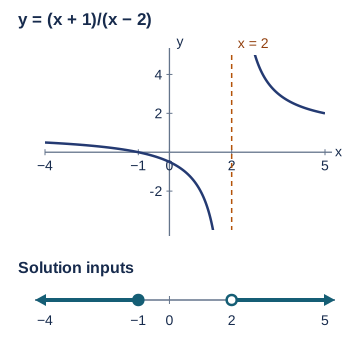
Check the original comparison. At −2 the fraction is 1/4, so it qualifies; at 0 it is −1/2, so it does not; at 3 it is 4, so it qualifies. At −1 it is zero. At 2 no fraction value exists. These checks illustrate the intervals; the factor signs establish every input in them.
2. Move a nonzero comparison to one side
Solve , with x ≠ 1.
Subtract 1 from both sides, then write 1 with the same denominator. This subtraction is safe for every allowed input:
The dividing points are 1, excluded by the denominator, and 3, where the new numerator is zero. Notice that the numerator 3 − x is positive to the left of 3 and negative to the right.
| Expression | x < 1 | 1 < x < 3 | x > 3 |
|---|---|---|---|
| 3 − x | + | + | − |
| x − 1 | − | + | + |
| Quotient | − | + | − |
Keep the negative intervals and the zero at 3. The solution is
On the original graph, compare the curve with the horizontal line at height 1, rather than with the axis. The curve lies below that line when x < 1 or x > 3 and meets it at 3. This gives the same intervals.
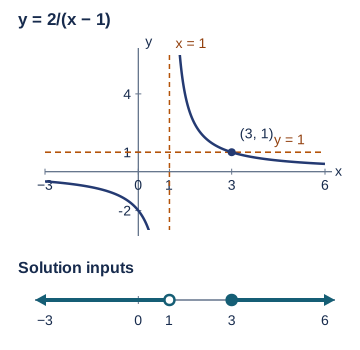
Check and diagnose. At 0, −2 ≤ 1 is true. At 2, 2 ≤ 1 is false. At 3, equality holds; at 5, 1/2 ≤ 1 is true. Blindly multiplying by x − 1 and writing 2 ≤ x − 1 gives only x ≥ 3 and misses the whole interval x < 1. On that interval the multiplier is negative, so the direction must reverse.
3. Cancellation leaves a hole
Solve . Record x ≠ 1 before factoring:
The shorter expression is positive when x > −1. Intersect this with the original domain, which still excludes 1. The answer is
On the three intervals separated by −1 and 1, the signs are negative, positive, positive. At −1 the original fraction is zero, which fails the strict inequality. At 1 it is undefined, even though the shorter formula would give 2. The graph follows the line y = x + 1 with a hole at (1, 2), not a vertical asymptote. A graphing screen may make a single missing point hard to see, so the written restriction is essential.
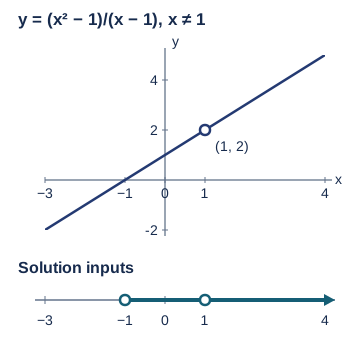
Check the original expression. At −2 it equals −1 and fails. At 0 it equals 1 and qualifies. At 2 it equals 3 and qualifies. At −1 it equals 0 and fails. At 1 division by zero excludes it. The sign stays positive across the hole; an excluded point does not always cause a sign change.
4. Revisit the walking model with a time limit
The earlier walker covers 12 km at a constant speed, then another 12 km at a speed 2 km/h faster. Now the total walking time, excluding stops, must be at most 5 hours. What first speeds satisfy the model?
Let v be the numerical value of the first speed in km/h, so the second speed is (v + 2) km/h. Time equals distance divided by speed, so the condition is
The algebraic exclusions are 0 and −2; the physical domain v > 0 is stronger. Throughout that domain, both v and v + 2 are positive. We may therefore multiply every term by their product without reversing the inequality:
Expand, move the left side to the right and factor:
For positive v, the factor 5v + 6 is positive. Thus the product is nonnegative exactly when v − 4 is nonnegative. The first speed must be at least 4 km/h:
The second speed is then at least 6 km/h, always 2 km/h faster than the first. The other factor's zero, −6/5, lies outside the physical domain. Unlike the equation for exactly 5 hours, the time-limit inequality accepts a whole interval.
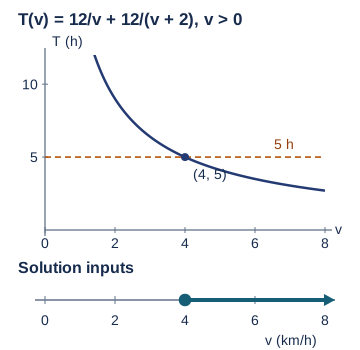
Check units and the boundary. At 4 km/h, the times are 3 h and 2 h, exactly 5 h. At 3 km/h, they are 4 h and 12/5 h, totalling 6.4 h, which is too long. At 6 km/h, they are 2 h and 1.5 h, totalling 3.5 h, which qualifies. This constant-speed model gives no upper speed bound; real-world feasibility would require additional information.
Keep the three representations connected. Mark original denominator exclusions; find the zeros of the single fraction after moving the comparison to zero; justify the interval signs; then select graph regions and number-line endpoints that match the inequality. A numerical check can catch an error, but checking a few inputs alone does not establish an entire interval.
Course context. Ontario MHF4U expectations 4.1–4.2 connect equations, inequalities, numerical checks and graphical solutions of simple rational inequalities using graphing technology (curriculum, printed p. 94). The sign charts here explain the interval reasoning; they are not presented as the exact method mandated by those expectations. For Québec CEGEP differential calculus (competency 0M02), this is supporting algebra review. It is not a claim that every Québec secondary course requires this topic; follow your own course outline.
8. Understand functions, composition and domains
A function assigns exactly one output to each permitted input. Its domain is the set of permitted inputs. When a formula is given without a stated domain, find all real inputs for which it makes sense; retain any additional restrictions specified in the problem. Composition means substituting one function’s output into another, not multiplying the functions.
Worked example
If and , then . For , real outputs require .
Common mistake. is not generally . Replace every occurrence of the input before simplifying.
Try it yourself
For this check, let and , using the nonnegative real square root. Find and , and state the real domain of each. Explain each restriction by following the input through the two functions. Which composition, if either, is defined at ?
Show answer and reasoning
Applying first gives . The input to the square root must satisfy , so the domain is . Reversing the order gives , with domain : the square root requires , and subtracting 2 adds no restriction. At , the first composition is undefined over the reals, while the second equals . A negative output is allowed; it is the input to the square root that must be nonnegative.
9. Connect exponentials and logarithms
Logarithms undo exponentials. For a positive base , means . In real-valued work, the logarithm’s argument must be positive. Here is the base, is the argument, and is the exponent needed to obtain . The symbol means logarithm to base , where .
Worked example
gives , so . Leaving the answer exact avoids an unnecessary approximation.
Common mistake. There is no rule . For positive and , it is the product rule .
Try it yourself
Solve .
Show answer and reasoning
, which satisfies the positive-argument requirement.
10. Calculate slopes and average rates
A slope compares a change in output with a change in input. Keep the subtraction order consistent. Rates also have units: metres divided by seconds gives metres per second. A secant line is the straight line through two points on a graph; its slope is the average rate between their inputs.
Worked example
For , the average rate from to is This is the slope of a secant line, not a rate at every point.
Common mistake. Dividing output values instead of output differences, or reversing only one subtraction.
Try it yourself
Find the slope through and .
Show answer and reasoning
Your next revision session
- Mark each skill comfortable, needs a reminder, or needs practice.
- Start with fractions, signs and equation solving if those are uncertain: they appear throughout the other skills.
- Explain your steps aloud, verify by substitution or expansion, and retry missed questions later without notes.
Move from factoring to polynomial division
Comfortable expanding brackets and factoring a quadratic? Learn to find a quotient and remainder, test a factor by substitution, then find all zeros. The separate lesson explains every subtraction and includes four questions with worked solutions.
Useful for
Work on the step you’re missing.
Tell us the subject and your preferred time. Nablio confirms the details by text or email.
Request a lesson